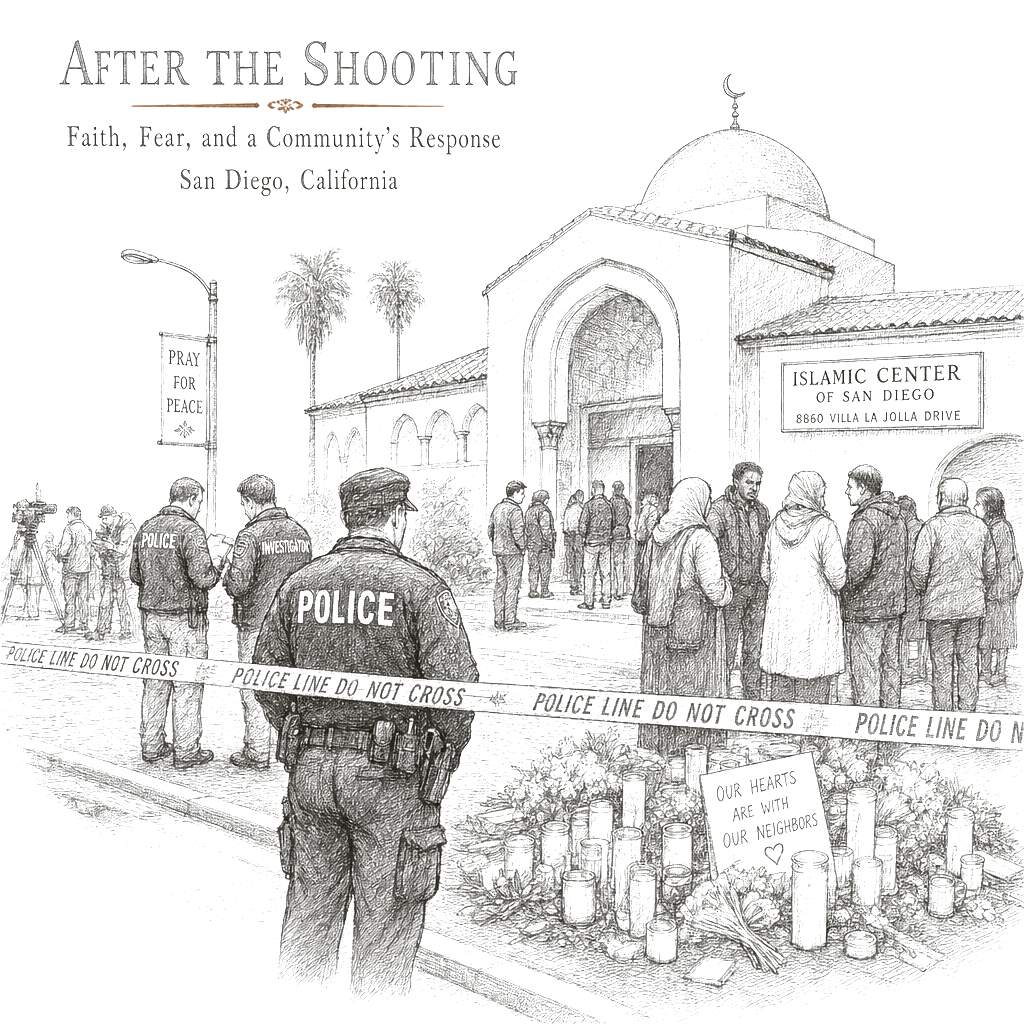
Caleb Vazquez, one of two teenagers who killed three people in a shooting at the Islamic Center of San Diego this week, had been flagged to law enforcement a year earlier for alarming behavior and for idolizing Nazis and mass shooters, court records reviewed by The Associated Press show. Officers who made a welfare check at Vazquez’s home obtained a court order on Jan. 29, 2025, under a California law that allows authorities to confiscate firearms from people considered dangerous.
The court records also show that officers wrote that Vazquez was “involved in suspicious behavior idolizing nazis and mass shooters.” When the officers requested access to see how the guns were being stored, Vazquez’s father initially denied them entry, the records say. In the affidavit signed by Marco Vazquez, the father said the family had voluntarily removed the guns from the house and stored them securely days earlier.
Investigators later said Vazquez, 18, met Cain Clark, 17, online and that both were radicalized. Police have not said what information they relied on to determine how the two knew each other, and they have not specified which teenager’s weapons were used in the shooting.
As the search for the teens unfolded on Monday, police said they began after Clark’s mother called to report that her son was suicidal and had run away. San Diego Police Chief Scott Wahl said Clark’s mother told authorities her son was dressed in camouflage, had taken multiple weapons from the home, and was with an acquaintance. Authorities were still interviewing Clark’s mother about possible locations for the teens when the shooting began at the Islamic Center of San Diego.
Court filings reviewed by AP indicate that after the initial gun-confiscation order, Vazquez took steps that included securing knives and moving firearms that had been kept in a gun safe to an outside storage facility, according to the records. The filings also mention “serious allegations” against Vazquez and say he had previously been committed to an involuntary psychiatric hospitalization, AP reported, adding that the filings did not describe what he was admitted for. The court documents, first reported by The New York Times, did not detail the reasons for the hospitalization.
Vazquez’s family said in a statement released Thursday through an attorney that he was on the autism spectrum and that he grew to resent parts of his identity, while also linking his path toward violence to online exposure. The family said in the statement that hateful rhetoric, extremist content and propaganda found across parts of the internet and social media contributed to his “descent into radicalized ideologies and violent beliefs,” which attorney Colin Rudolph released. The statement also said the family encouraged Vazquez to seek help and that he spent time in rehabilitation centers.
In writings attributed to Vazquez and Clark that expressed white supremacist views, Vazquez wrote of having “some mental health issues” and being rejected by women, according to AP. Those writings, AP said, described hatred toward Jewish people, Muslims, Black people and other groups, and they suggested the teenagers idolized previous shooters who died while carrying out mass shootings.
Experts working on interventions with people being drawn to violent extremism said that spotting and interrupting radicalization can be difficult when it spreads through fast-changing online culture. Samira Benz, who works for the Violence Prevention Network, said the work has become increasingly complicated as the internet “blurs ideologies” and creates niche, meme-based languages that can be fleeting and hard to decipher. Benz said: “Even if a parent is looking at the phone of their child, they don’t necessarily see something bad is going on.”