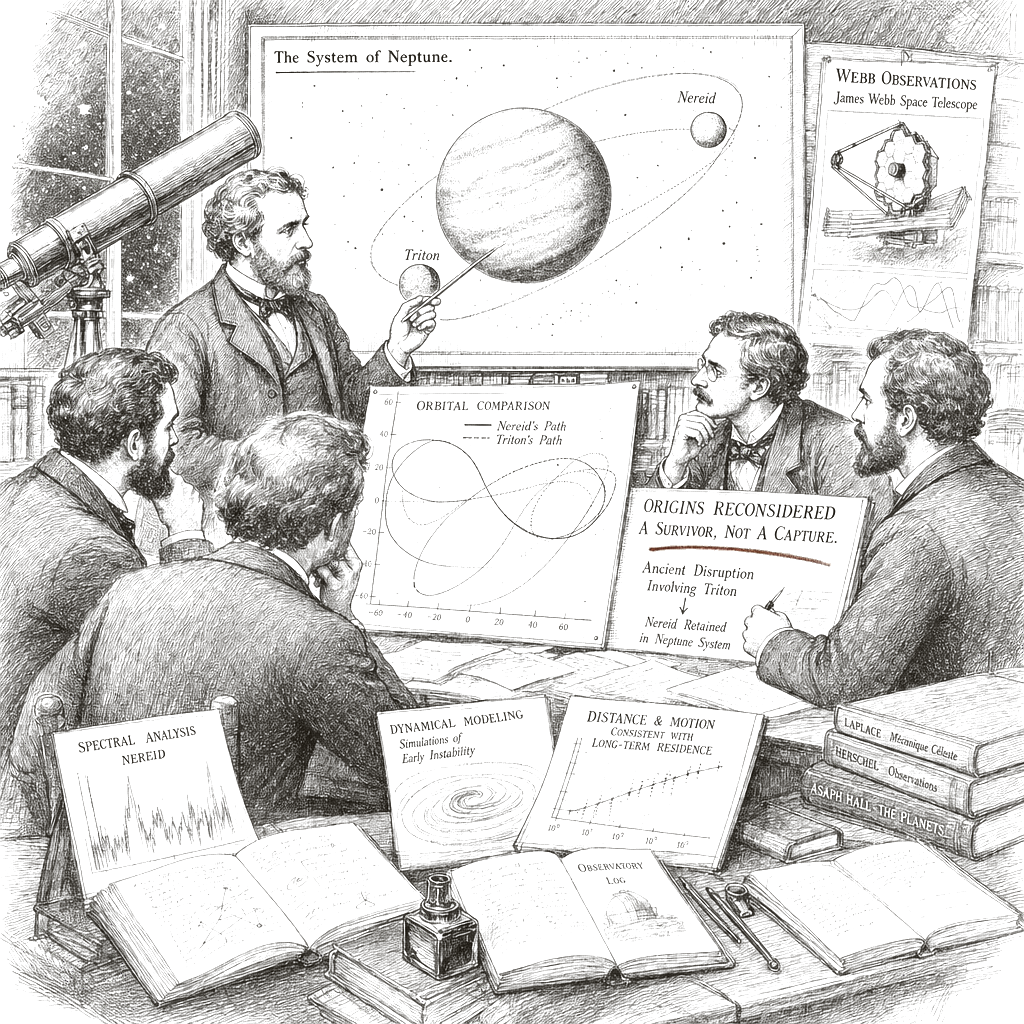
Neptune’s far-flung moon Nereid may be one of the last survivors of Neptune’s original moon system, according to a new study that used NASA’s James Webb Space Telescope to probe what the moon is made of and how its orbit behaves. The work, led by researchers including Matthew Belyakov of the California Institute of Technology, was reported Wednesday as scientists sift through a limited set of observations of a planet whose moon Nereid is among the least understood.
In the study’s framing, Triton’s arrival helps explain why Neptune’s current satellite family looks the way it does. Neptune, the solar system’s eighth planet, has 16 known moons. Triton, its biggest moon, “barged in from the solar system’s frigid outskirts billions of years ago,” scattering Neptune’s earlier moons and pushing them onto “destructive collision courses,” the researchers said.
Against that backdrop, the team used Webb to look specifically at Nereid, a moon that was discovered in 1949 by Dutch astronomer Gerard Kuiper and named after Greek mythology’s sea nymphs. Nereid’s orbit is described as extremely eccentric and stretched, with the moon taking practically an entire Earth year to complete one trip around Neptune. In that egg-shaped loop, it passes less than 1 million miles (1.4 million kilometers) from Neptune at one end and as far as 6 million miles (9.6 million kilometers) at the other end.
Nereid’s size is described as roughly 220 miles (350 kilometers) across. The new study argues that Nereid did not join Neptune later in the way some other small bodies might, and it says the moon’s composition does not match what scientists would expect if it had migrated inward from the Kuiper Belt. Researchers reported that Nereid’s relatively high ice content conflicts with the compositions of Kuiper Belt objects, which they said “suggests it was part of Neptune’s system all along.”
Belyakov told The Associated Press that “What we know about Nereid is very limited,” adding that “For its size, Nereid is extremely understudied.” He also said in an email that the new Webb results “strongly rule out” the idea that Nereid wandered in from elsewhere “and got ensnared by planetary gravity,” pointing to the scarcity of evidence for the capture scenario and the match between Webb’s observational constraints and the moon’s history.
The study’s account of Neptune’s past also links Nereid to the broader aftermath of Triton. Belyakov and his team said Neptune’s innermost moons likely formed from shattered remains of the original moons that were “Triton’s casualties.” They also described the Nereid orbit as compatible with a scenario in which the moon originally formed close to Neptune and was later pushed outward during Triton’s capture and migration.
Independent astronomer Scott Sheppard of Carnegie Science, who was not part of the research, described the result as promising. He said the work is “an exciting result,” and he noted that Webb observations indicate Nereid’s peculiar orbit matches what scientists “might expect from a moon that originally formed close to Neptune and was later pushed outward from the capture of Triton.”
The researchers said the system offers limited targets for study: Neptune has only been visited by one spacecraft, NASA’s Voyager 2, which flew by in 1989. The study’s conclusions were published in Science Advances. Scientists said a future visiting spacecraft could help clinch Neptune’s origin story, though they said no mission is currently planned.
All three of the solar system’s other giant planets have more moons than Neptune, with Saturn topping the list at 292. For now, Nereid’s role as a potential survivor of Neptune’s earlier moon generation is the latest attempt to reconstruct how an icy planet’s satellite system assembled after a dramatic cosmic event.