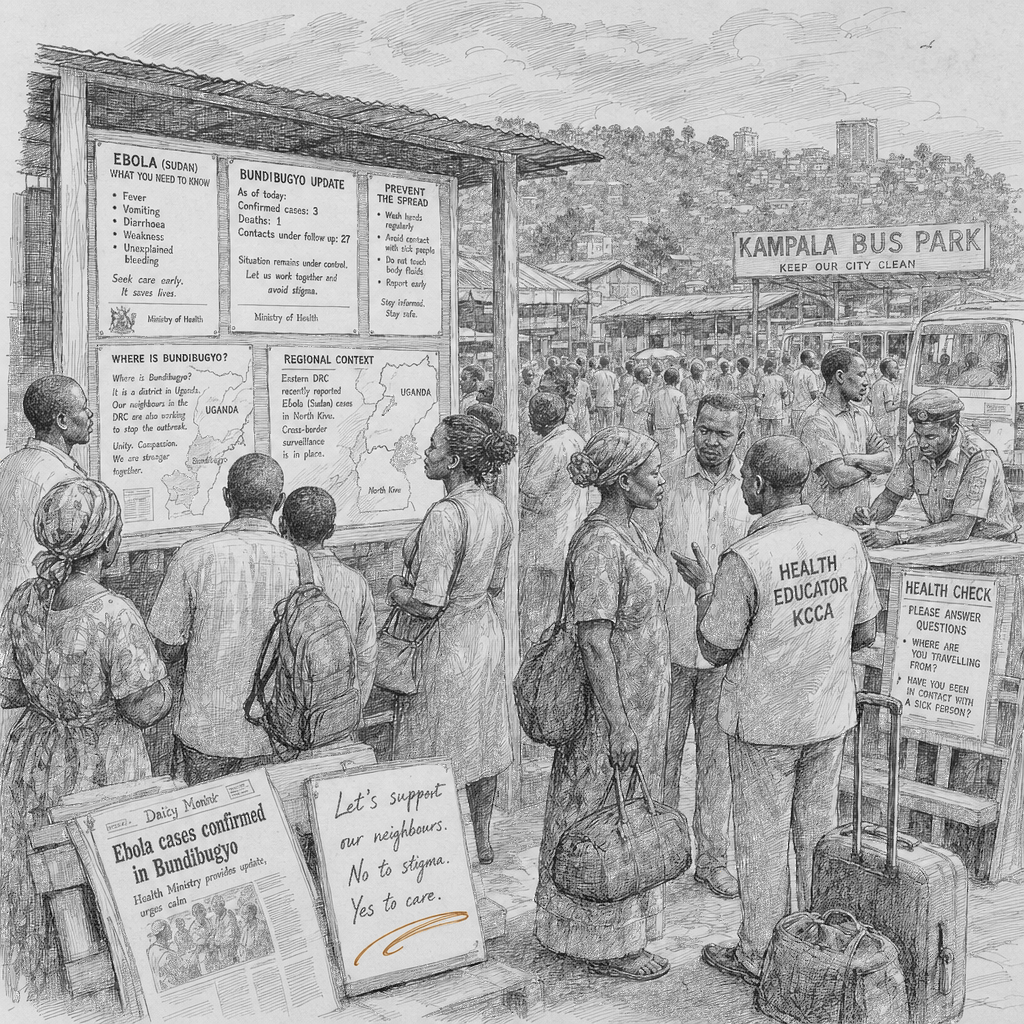
Uganda counters Ebola stigma tied to Bundibugyo name
Ugandan officials moved to contain not only the risk of Ebola crossing into Uganda but also the stigma that has attached itself to the name of a western district, Bundibugyo, after a rare Ebola virus subtype linked to that area was associated with the current outbreak in eastern Congo.
Alan Kasujja, a spokesman for the Ugandan government, urged global health authorities to clarify that Uganda is not the epicenter of the outbreak, saying on X that “Bundibugyo is too beautiful to be the name of a disease” and calling on officials to “take back its name from this madness.” The remarks echoed a local concern that the name could stigmatize Bundibugyo residents long after the immediate health risk is determined elsewhere.
Bundibugyo is a mountainous district in western Uganda known for cocoa farming, and even some residents struggle to pinpoint it on a map, according to reporting on the district’s background. The government’s concern in recent days has been that the Ebola naming—derived from the location where a virus was first identified—will lead people to assume the outbreak is spreading from Uganda’s territory.
The World Health Organization is responsible for taxonomic descriptions, and Uganda’s officials pointed to the sensitivity of naming practices to avoid stigmatizing entire communities. Uganda’s stance also reflects experience: officials have repeatedly said past Ebola outbreaks in the country required rapid response while they worked to counter misperceptions.
How the Bundibugyo link began
Scientists and public health officials trace the Bundibugyo name to an Ebola outbreak in November 2007 in a remote part of western Uganda that was flagged as a new species of Ebola. The outbreak was not the Sudan virus—named for a region in present-day South Sudan where that type was first identified—and it was not the Ebola type known as Zaire, which was named for the era when present-day Congo was known when Ebola was first discovered in 1976.
According to the reporting, health specialists who helped identify the virus said the 2007 outbreak in Bundibugyo killed at least 37 people but was contained by the end of the year, and a second, smaller outbreak occurred in Congo’s northeast in 2012. The reporting also said the 2007 outbreak was spreading in Congolese villages before health authorities there identified it as the cause of sickness, highlighting that the disease’s path was not confined to the district that later became part of its name.
Dr. Tom Ksiazek, a virologist at the University of Texas Medical Branch who directed the team within the U.S. Centers for Disease Control and Prevention that first identified the Bundibugyo virus, was cited in the reporting describing how initial cases in those outbreaks were identified early enough to trigger a quick response.
Five Uganda cases linked to Congo outbreak
While authorities said there is no Ebola in Bundibugyo district, Uganda has reported five cases that all are linked to the outbreak in Congo, the reporting said. One case involved a 59-year-old Congolese man who was admitted to a hospital in Kampala, Uganda’s capital, on May 11 and died three days later.
Ugandan health authorities said on Saturday that a driver and a health worker—both Ugandans—who were exposed to that Congolese patient have since tested positive. The remaining cases were two Congolese women who sought medical care in Uganda before Congo declared an outbreak on May 15.
Uganda’s President Yoweri Museveni said the outbreak is on “the Congo side mainly,” and he urged tourism authorities to fight the perception that Ebola is spreading in Uganda. Museveni also urged Ugandans to “stop shaking hands” as part of measures intended to reduce infection risk.
Travel restrictions and postponed gathering
Museveni ordered the postponement of an annual religious event that attracts thousands of pilgrims from Congo and elsewhere and that takes place around a Catholic basilica just outside Kampala by June 3. He also ordered suspension of public transportation and flights between Congo and Uganda, according to the reporting.
The steps underscore the practical challenge of reducing cross-border contact while health authorities seek to identify possible exposure chains quickly. In the same reporting, Dr. Emmanuel Batiibwe, who led efforts to stop an Ebola outbreak in 2022 that killed at least 55 people, said cross-border risk is high and that stopping spread into Uganda will require “enhanced surveillance at all points of entry.”
Contact tracing and protective equipment remain key
Batiibwe said enhanced surveillance must be paired with active efforts to interrupt transmission. The reporting said tracing contacts and isolating them are especially key to stopping spread of the virus in addition to ensuring healthcare workers have proper protective equipment.
The reporting noted that vaccines and treatments for Ebola do not work for Bundibugyo patients, which further increases pressure on containment measures centered on tracking exposures and reducing opportunities for further transmission. It also cited WHO information that Ebola viruses’ natural hosts are believed to include a family of fruit bats, and that Ebola spreads through contact with bodily fluids of an infected person or contaminated materials.
Uganda has had multiple Ebola outbreaks, the reporting said, including one in 2000 that killed more than 200 people and an outbreak in Kampala last year. In this latest situation, officials are effectively balancing a public-health response focused on surveillance and isolation with a communications challenge about a virus name that locals associate with their district’s identity rather than with an outbreak location.