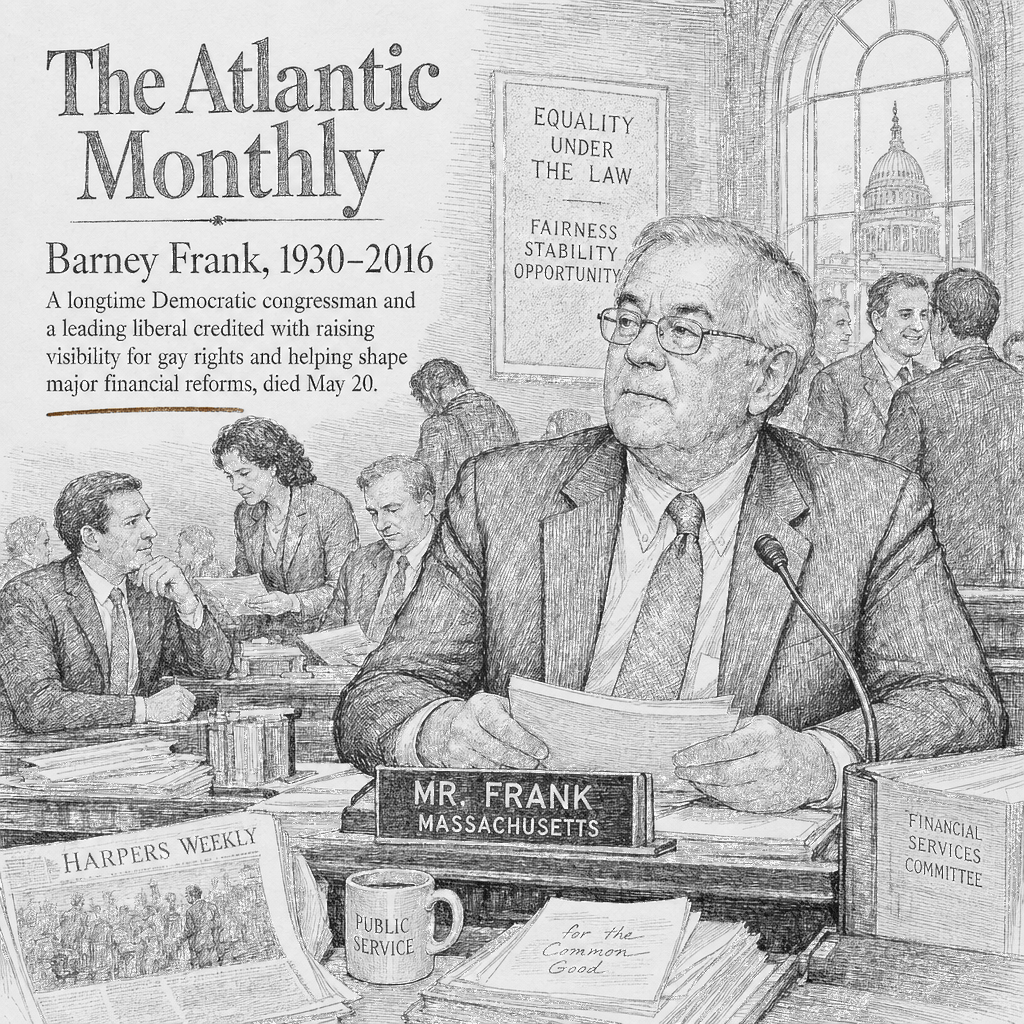
Frank, a longtime Democratic congressman who helped bring national attention to gay rights while later playing a major role in reshaping U.S. financial regulation, died May 20 at age 86, according to the Associated Press report. Jim Segel, Frank’s former campaign manager and close friend, said Frank died late Tuesday. Frank had entered hospice in April in Ogunquit, Maine, where he lived with his husband, Jim Ready.
A Massachusetts fixture for more than three decades, Frank represented swaths of Boston’s suburbs for 32 years before moving to Maine. In the AP report, Segel described Frank’s final chapter as illness and hospice care, and the piece identified Frank’s surviving relatives as Ready, sisters Ann Lewis and Doris Breay—both long associated with Democratic strategy—and brother David Frank.
Frank styled himself as a “left-handed gay Jew,” and colleagues and contemporaries frequently linked his public presence to his sharp wit and confrontational style. The AP report said he focused on marginalized communities and, though he represented the party’s left wing, he often maintained close relationships with Democratic leaders even when those ties at times frustrated progressives.
His political record also made him a prominent LGBT rights figure during periods when public disclosure carried political and personal risk. Frank publicly came out as gay in 1987, described as the first member of Congress to do so voluntarily. With his 2012 marriage to Ready, Frank became the first incumbent lawmaker on Capitol Hill to marry a same-sex partner, according to the AP account.
In remarks from an April interview that AP included as he entered hospice, Frank said he hoped to be remembered for a progressive approach that used conventional political methods. He said the central obstacle to defeating populism and advancing farther was that mainstream Democrats needed to show they opposed parts of their left-wing friends’ agenda that were politically unacceptable, while also warning against taking “the most unpopular parts” of an agenda “and make them litmus tests.” He added that his friends on the left were doing that in a way he feared would derail progress.
Frank’s public path to politics began long before his national breakthroughs on LGBT issues. The AP report said he was born in 1940 in Bayonne, New Jersey, and that in his 2015 memoir he traced his decision to pursue public life to the 1955 lynching of Emmett Till, a Black 14-year-old from Chicago. The report said Frank volunteered in Mississippi during Freedom Summer in 1964, while writing about how his speech and accent made it harder to connect with rural Mississippians.
In Congress, Frank’s reputation reflected both pragmatism and a willingness to sharpen conflict. The AP report said he arrived in 1980, worked initially through the liberal Democratic Study Group, and later sometimes found himself aligning more with Speaker Tip O’Neill’s less confrontational approach. The report also recounted that during a major tax overhaul effort, Frank initially intended to vote “no,” but said he changed his mind after working out a deal that boosted affordable housing tax credits, writing that he was “happy to sacrifice” ideological purity for legislation that would become law regardless of his vote.
Frank’s LGBT landmark years included both prominence and controversy. AP said his approach—inviting a reporter to ask about his sexuality in 1987 and responding, “yeah, so what?”—helped make him the best-known gay member of national politics through the 1980s and 1990s, at a time when media reporting on whether someone was gay was often tied to scandal. The AP report said he helped secure AIDS funding and pressed the Clinton administration, without success, to lift a ban on gays serving in the military.
The AP report also described lows, including an overwhelming 1987 House vote to reprimand Frank for poor judgment involving a male prostitute he hired in 1985, along with a push by then-House Republican whip Newt Gingrich for censure that was rejected. Frank was also targeted by conservative leaders as his visibility rose, including House Majority Leader Dick Armey calling him “Barney Fag” in 1995; AP said Armey later apologized from the House floor after misspeaking. Over time, Frank became known as a quotable lawmaker across multiple policy topics, including abortion, where AP reported he criticized Republicans’ push to curb social programs, and after the Ken Starr report on Monica Lewinsky and President Bill Clinton, where AP said Frank complained it required “too much reading about heterosexual sex.”
As his career shifted toward financial oversight, Frank became central to some of the era’s biggest legislative outcomes. By 2007, the AP report said, he chaired the House Financial Services Committee. After the 2008 financial crisis, Frank helped support a rescue package with the Bush administration, a move that AP said contributed to a populist revolt. Once the immediate crisis eased, AP credited Frank with helping develop the Dodd-Frank Act, described as the most significant reform legislation since the New Deal, alongside then-Senate Banking Committee Chairman Chris Dodd.
In the AP report, Dodd said, “Barney and I shared a fantastic relationship,” and added that his “many good moments in” his time in Congress included none more “significant, joyful, or productive than” the period working with Frank on the banking bill. The AP report also said that during Donald Trump’s second term, the Republican administration worked to roll back many provisions of Dodd-Frank, with the administration arguing the rules were too onerous.
Frank’s later political involvement continued in a more limited way after he stepped away from Congress. AP said he faced a difficult reelection campaign in 2010 as the tea party wave swept through American politics, and that he opted against running again in 2012 while remaining engaged afterward, including work as a contributor to Newsmax. The AP report said he remained a fierce critic of Trump and, when asked about who might succeed the president, told listeners, “unfortunately I won’t get to vote for it.”