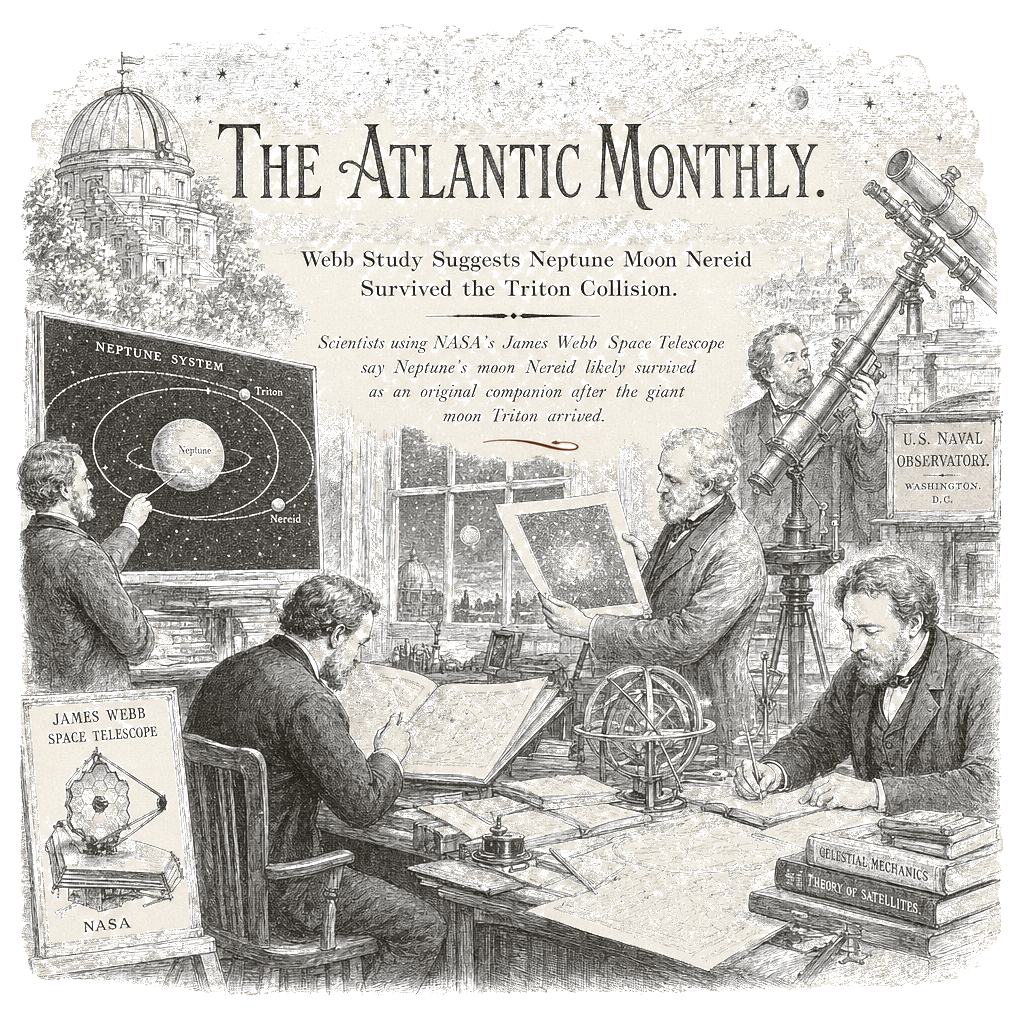
Neptune’s far-flung moon Nereid may have been among the planet’s original companions that survived a major disruption, scientists reported Wednesday using observations from NASA’s James Webb Space Telescope.
The new study builds on the idea that Neptune’s biggest moon, Triton, arrived later and changed the system’s early dynamics. According to the researchers, Triton “barged in from the solar system’s frigid outskirts billions of years ago,” scattering Neptune’s original moons and putting them on collision courses.
In that scenario, Triton’s arrival would have been disruptive enough to reshape Neptune’s moon family, but the team led by Caltech says Nereid’s properties point to survival rather than replacement. Their interpretation suggests Nereid was not an interloper that drifted in later under planetary gravity; instead, it likely avoided becoming one of the casualties by escaping into Neptune’s extreme, elliptical orbit.
The study reported that Nereid’s orbit is highly eccentric and that it takes nearly an entire Earth year for the moon to circle Neptune. The AP report also said the moon comes to within less than 1 million miles (1.4 million kilometers) of Neptune at one extreme of its loop and reaches as far as 6 million miles (9.6 million kilometers) at the other.
Researchers also said the Webb observations undercut the earlier expectation that Nereid migrated inward from the distant Kuiper Belt, the region beyond Neptune associated with many icy bodies. The AP report says the telescope data showed Nereid’s composition did not match objects from the Kuiper Belt, including because it has too much ice.
Caltech study author Matthew Belyakov told The Associated Press that Nereid remains poorly understood, saying, “What we know about Nereid is very limited. For its size, Nereid is extremely understudied.” He also said the latest observations “strongly rule out” the idea that Nereid wandered by and got ensnared by Neptune’s gravity, adding that the team still lacks many lines of evidence for the system overall.
The findings arrive amid limited direct exploration of Neptune. The AP report said Neptune has been visited by only one spacecraft—NASA’s Voyager 2 in 1989—and Nereid was discovered about 40 years earlier by Dutch astronomer Gerard Kuiper, who named the moon after sea nymphs from Greek mythology.
Scott Sheppard, a planetary astronomer at Carnegie Science who was not part of the study, said the new observations help align Nereid’s unusual orbit with expectations from Neptune’s disrupted past. In an email to AP, Sheppard said Nereid’s orbital history matches “the history we might expect from a moon that originally formed close to Neptune and was later pushed outward from the capture of Triton.”
The researchers also said Neptune’s innermost moons likely formed from shattered remnants of the original companions that Triton displaced. They noted that visiting spacecraft could further test the origin story, though none are currently planned, and said Science Advances published the study.