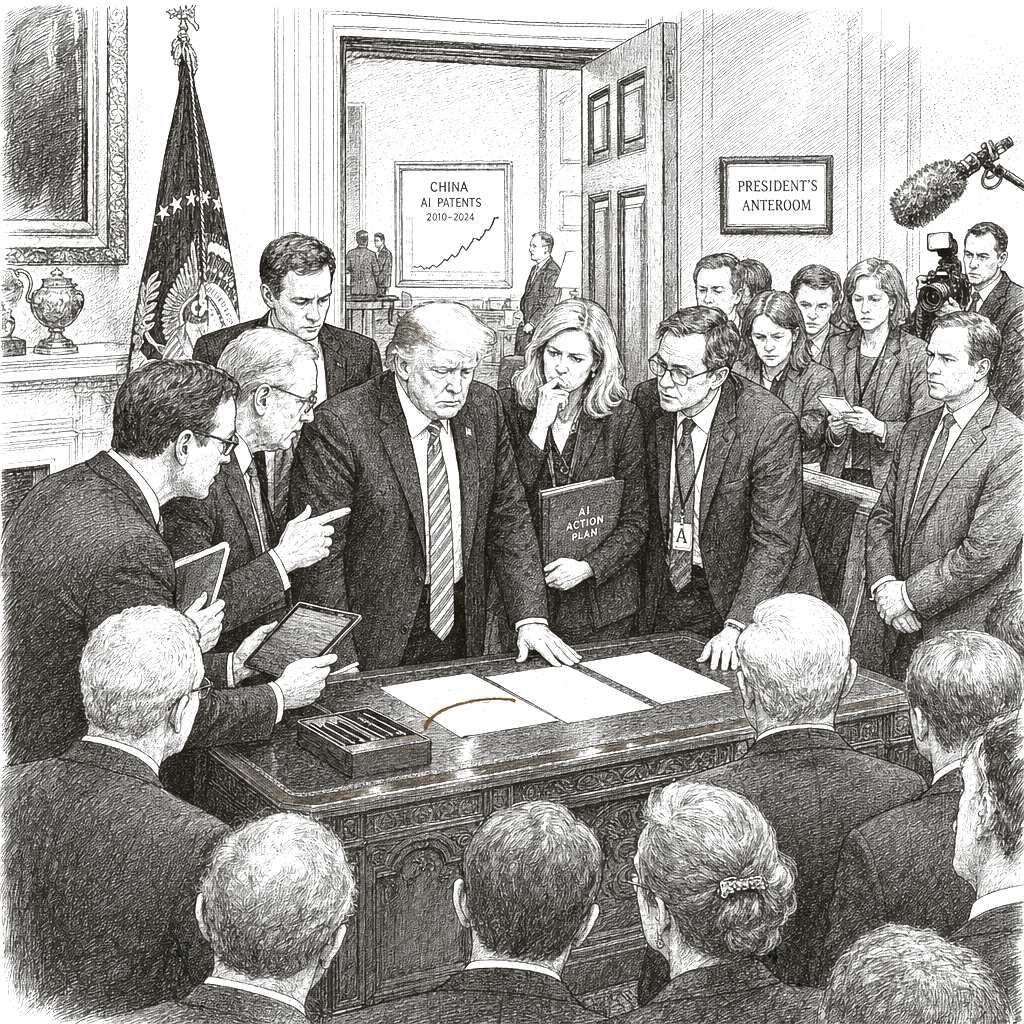
President Donald Trump abruptly postponed the signing of an executive order on artificial intelligence hours before a White House ceremony Thursday, saying he became concerned after reading the draft that the measure could stifle the United States’ competitive lead over China in the rapidly evolving technology.
“We’re leading China, we’re leading everybody, and I don’t want to do anything that’s going to get in the way of that lead,” Trump told reporters. The Oval Office event with technology industry executives was canceled after Trump reviewed the order’s text and decided it could hurt the domestic AI industry, according to a person familiar with the White House’s deliberations but not authorized to speak publicly.
The executive order would have set up a voluntary process for the government to examine the national security implications of cutting-edge AI systems before companies released them to the public, the person said. The proposed framework was described as a collaborative effort with leading U.S.-based AI developers, including Anthropic, OpenAI, and Google. It would not have imposed mandatory requirements, but it marked the most significant federal step toward structured oversight of frontier AI models in months.
The last‑minute pullback is the latest in a series of Trump administration moves that have favored industry self‑regulation over government mandates on artificial intelligence. Shortly after returning to office, Trump rescinded a Biden‑era executive order that had required developers of powerful AI systems to share safety test results with the federal government. He has also announced a $500 billion private‑sector investment plan for AI infrastructure during a summit in Paris earlier this year and repeatedly said that maintaining American dominance over China in AI is a top priority.
The Commerce Department has been working on separate voluntary measures that would ask companies to report their national security risk assessments, although that effort has moved slowly. Commerce Secretary Scott Bessent has signaled support for a light‑touch approach.
Dean Ball, a research fellow at George Mason University’s Institute for Law and AI, said the canceled executive order reflects the administration’s deregulatory instincts but noted that major AI companies themselves have pushed for some federal standards. “They are deathly afraid of a patchwork of state laws,” Ball said, adding that “the tech industry has mixed feelings about a completely unregulated approach to AI.”
The White House did not say whether a revised version of the order would be considered or if the proposal was shelved indefinitely. The cancellation came as Trump prepared to travel to Beijing next week for a summit with Chinese President Xi Jinping, where trade and technology competition are expected to dominate the agenda.