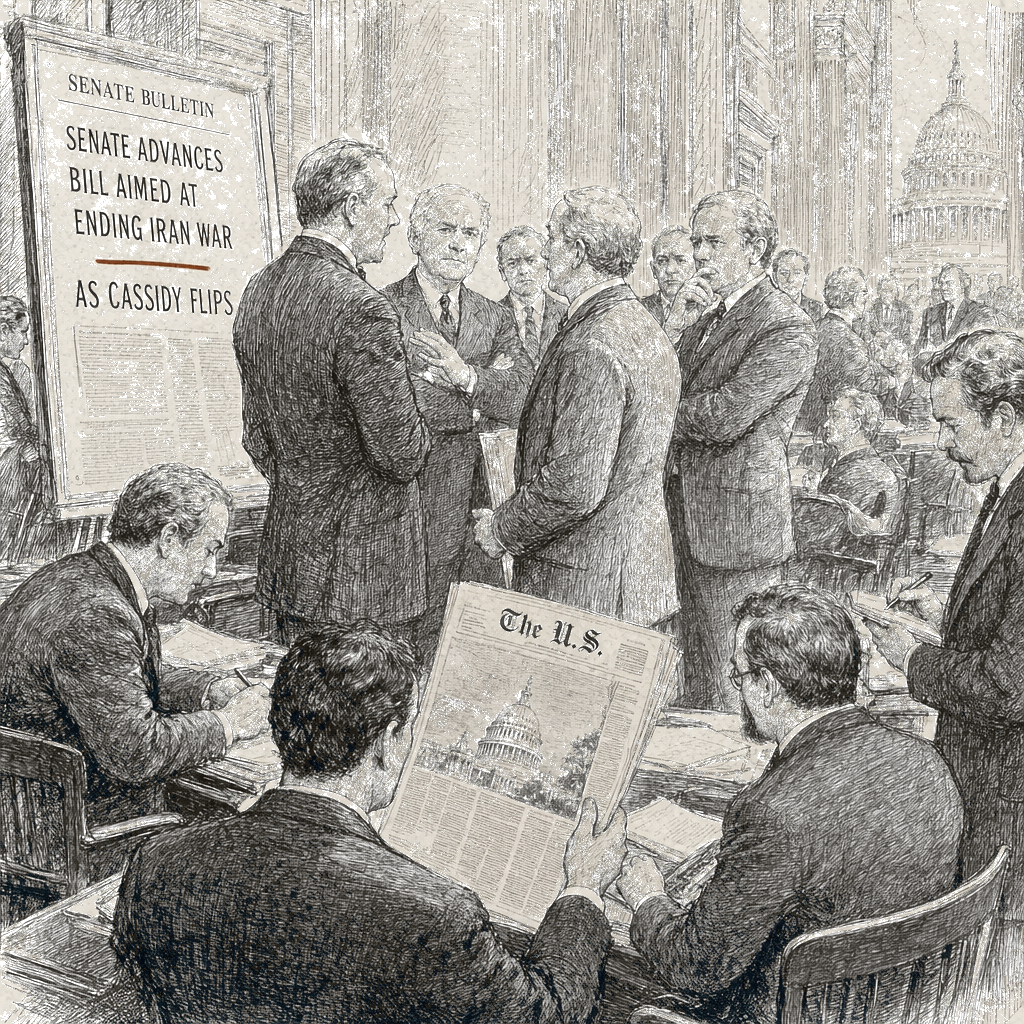
The Senate’s Tuesday vote advanced a war powers fight that Democrats say has grown more urgent as the Iran conflict has continued without what they consider required congressional approval. The bill passed 50–47 after three Republicans were absent and their votes could have been enough to defeat the measure if they maintained their position on the war.
Democratic leadership framed the outcome as a sign of momentum among Republicans, even as the legislation’s prospects for ultimate effect remained uncertain. Senate Democratic leader Chuck Schumer said afterward that Republicans were “starting to crack, and momentum is building to check him,” adding, “We are not letting up.”
The new Senate tally hinged in part on Sen. Bill Cassidy of Louisiana, who supported the resolution for the first time. Cassidy had returned to Washington “defiant” after his primary election loss last week, according to the report, and he said he was proud of his work upholding the Constitution while “carefully consider[ing]” how he would vote on the Trump administration’s priorities going forward.
Cassidy’s switch coincided with continuing support from other Republicans who had previously backed similar measures tied to war powers. The report said Sens. Rand Paul, Susan Collins and Lisa Murkowski—each of whom had voted for comparable war powers resolutions before—cast votes in favor again Tuesday. Sen. John Fetterman of Pennsylvania, meanwhile, was the only Democrat to vote against the measure.
In addition to the Senate debate, the reporting described the dispute as one about information and congressional leverage over the conflict. Cassidy posted on social media that he supported the administration’s efforts to “dismantle Iran’s nuclear program” but said “the White House and Pentagon have left Congress in the dark on Operation Epic Fury,” arguing, “Until the administration provides clarity, no congressional authorization or extension can be justified.”
The bill advanced as Democrats pushed to force Trump out of the Iran war and as some House lawmakers prepared to take up a parallel effort. The report said the House is expected to vote Wednesday on a similar war powers resolution, after a measure “barely failed” in the House last week and ended in a tie.
Even if Congress ultimately passes legislation compelling withdrawal, the report said it remained unclear whether Trump would comply. It cited the White House’s position that it has technically ceased “hostilities” with Iran because there is a ceasefire, a stance Democrats and their allies have treated as an attempt to work around the War Powers Resolution of 1973.
Lawmakers also described frustration with the administration’s handling of planning and negotiations over the conflict. The report said Trump told lawmakers this week he ordered preparations for an attack on Iran on Tuesday, then called it off to give Gulf allies more time to negotiate with Iran, and that Democratic Sen. Chris Murphy said the pace of the situation was contributing to rising gas prices, saying in a floor speech that “Peace negotiations are stuck and so day after day after day grocery prices climb, gas prices climb.”
On the Republican side, Sen. Mike Rounds of South Dakota said he supported Trump’s decision to go to war but warned more Republicans were concerned about a long-term plan. Rounds said the War Powers Resolution “does provide an avenue for that discussion and debate to occur,” adding that he believed it “not the right time” to have that debate while also saying “a number of our members maybe just feel like it’s time to have the debate.”
The broader fight over war powers is not confined to Iran, the report said. It noted that earlier this year Republican senators backed a war powers resolution on the conflict with Venezuela that compelled the Trump administration to make its case to Congress for the military campaign, and it referenced how a final vote to withdraw from Venezuela flipped for two Republicans after a Secretary of State Marco Rubio agreed to a public hearing about the administration’s Venezuela strategy.
Although Tuesday’s Senate vote advanced the measure, three Republicans were absent and their votes could have been decisive if they remained opposed. That dynamic left the immediate path forward contingent on whether similar defections would appear in the House and whether any future Senate vote could hold together enough support to overcome the war powers battle’s remaining procedural hurdles.