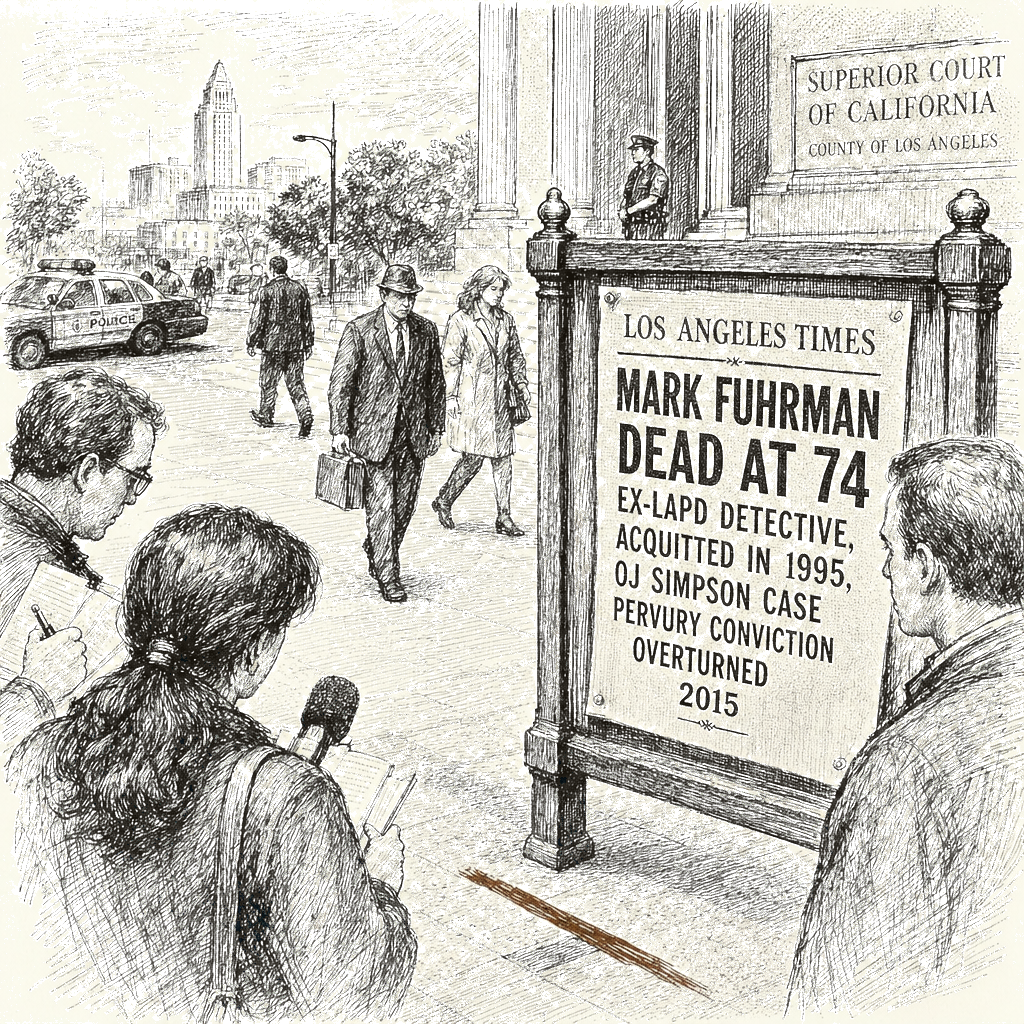
Fuhrman, a former Los Angeles police detective whose credibility became a focal point in the O.J. Simpson criminal case, died at 74, the Kootenai County office in Idaho said. Lynn Acebedo, the chief deputy coroner in Kootenai County, said he died May 12, and the county does not release the cause of death as a rule.
In 1994, Fuhrman was among the first two detectives sent to investigate the killings of Simpson’s ex-wife, Nicole Brown Simpson, and her friend, Ronald Goldman, in Los Angeles. Fuhrman reported finding a bloody glove at Simpson’s home, but his credibility came under attack as the defense sought to raise the prospect of racial bias during the trial.
Under cross-examination, Fuhrman testified that he had never made anti-Black racial slurs in the past decade. The testimony was later confronted with a recording that, prosecutors said, showed he used such language repeatedly.
A criminal-court jury found Simpson not guilty of murder in 1995, but a civil trial jury later found Simpson liable in 1997 for the deaths of Brown and Goldman and ordered him to pay $33.5 million to the relatives. Fuhrman was convicted of lying during his testimony at the time, according to the AP account of the case.
After the acquittal, Fuhrman retired from the Los Angeles Police Department. He later moved to Idaho with his family and set up a 20-acre farm where, AP reported, he raised chickens, goats, sheep and llamas.
In 1996, Fuhrman was charged with perjury and pleaded no contest. He subsequently became a TV and radio commentator, and he wrote the book “Murder in Brentwood” about the killings, AP reported.
Alan Dershowitz, a lawyer and law professor who was a legal strategist on Simpson’s “Dream Team,” said Fuhrman was “a much better detective than he was a witness,” according to AP. Dershowitz also said: “He’s very smart, and you know, a very, very aggressive detective. Ultimately his actions helped us win the O.J. case because of his use of the ‘n’ word,” adding that he later knew Fuhrman personally and had a cordial relationship.
Kato Kaelin, a friend of Brown who testified in the murder trial, posted on X after Fuhrman’s death. Kaelin wrote that he wanted to “respectfully acknowledge Fuhrman’s death” and said he hoped Fuhrman’s loved ones “can find peace,” describing the O.J. case as “a deeply complex and painful chapter for everyone involved.”
Fuhrman’s life before the police career also included early family upheaval, AP reported. His father left when he was 7 years old, and Fuhrman often cared for his younger brother while his mother worked; he later joined the Marines before joining the Los Angeles Police Department.