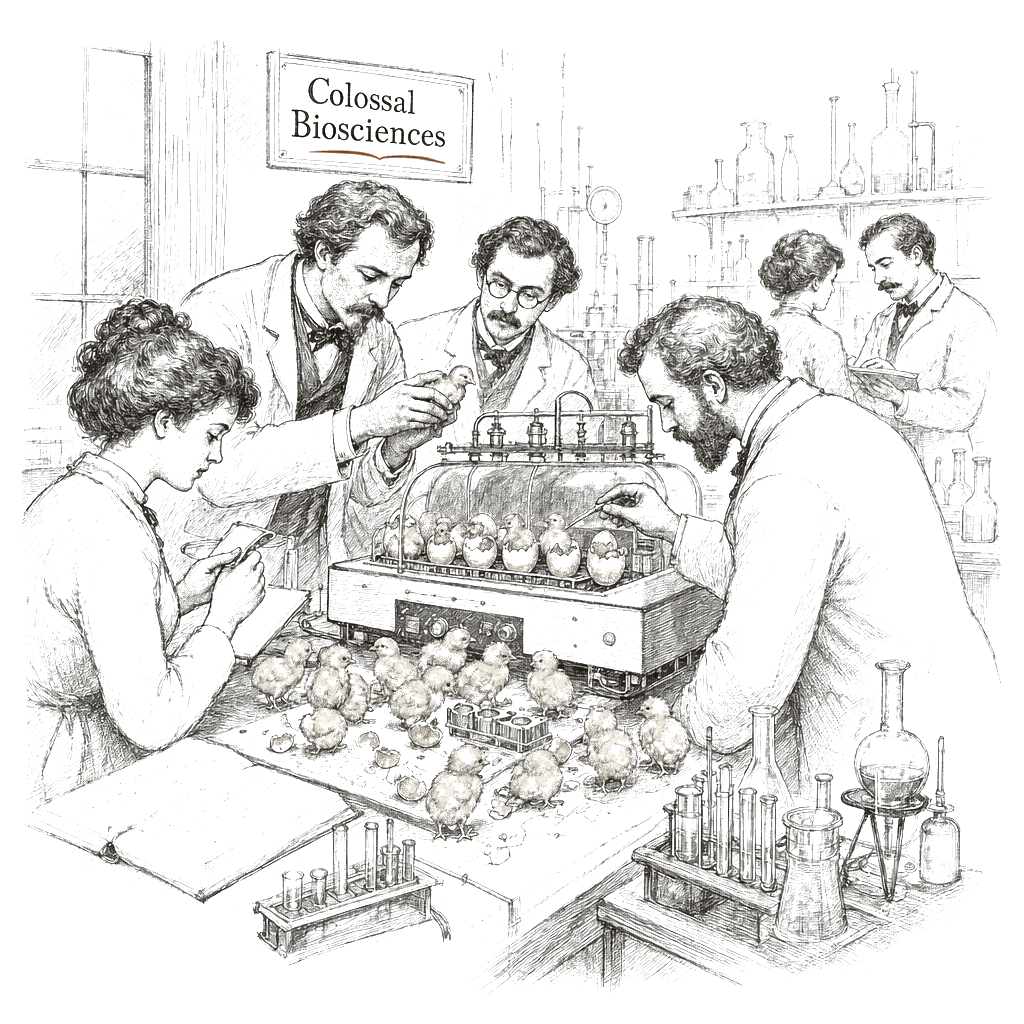
A de-extinction company said Tuesday that it has produced living chicks from what it calls an artificial eggshell, a milestone Colossal Biosciences said it is using to advance efforts to revive traits of extinct animals. The company reported that 26 baby chickens, ranging from several days to several months old, were born from a 3D-printed lattice intended to mimic an eggshell, in an incubator environment designed to support embryo growth.
Colossal said the system is built around an artificial eggshell membrane that helps deliver oxygen in a way the company says is similar to a real egg. In the reported process, Colossal scientists poured fertilized eggs into the artificial system, added calcium normally absorbed from a natural eggshell, and used imaging to observe embryos as they developed and grew.
Colossal has previously described work that genetically engineers living animals to resemble extinct species, including mice engineered to have long hair like the woolly mammoth and wolf pups patterned after dire wolves. In this new report, the company’s CEO, Ben Lamm, linked the artificial eggshell milestone to a longer-term goal: using the technology as a platform for engineering living birds to resemble New Zealand’s extinct South Island giant moa, which he said produced eggs about 80 times the size of a chicken’s egg and would be difficult for a modern bird to lay.
Lamm said Colossal wanted to build on what nature had already developed, while making it more scalable and efficient. He also framed the work as starting now on the engineering challenges that would be needed for “surrogacy and birth,” rather than waiting until a giant moa-shaped animal could be brought to term.
Independent scientists said the engineering is impressive but also said it does not fully meet what they consider the requirements of an artificial egg. Evolutionary biologist Vincent Lynch, at the University at Buffalo, said the approach lacks multiple components needed for a complete artificial egg, including temporary organs that form to nourish the embryo and remove waste. Lynch said in that context that Colossal’s work is an “artificial eggshell,” not an artificial egg.
Other researchers not involved with Colossal described broader implications for what this kind of incubation can accomplish. Nicola Hemmings, a biologist at the University of Sheffield who studies bird reproductive biology, said producing chicks from an artificial vessel is not necessarily new, and added that technologies like these can be useful for studying chick development and for generating insights that could apply to other mammals and possibly humans. She also said de-extinction may make more sense with currently endangered species, where scientists could preserve sperm and egg cells from living animals to attempt to bring related species back.
Hemmings said she is personally more interested in preserving what exists than trying to restore what is already gone. She pointed to the limitations of the longer-range de-extinction vision as scientists work through earlier steps, including comparing ancient DNA from well-preserved moa bones with genomes of living bird species and addressing egg-size and surrogate-birth challenges.
Even if researchers could create a tall, moa-like bird, some experts said the difficulties would not end at the hatch. Bioethicist Arthur Caplan of New York University’s Grossman School of Medicine said the big challenge would be determining what environment such an animal would live in.
In response to skepticism, Colossal’s reported emphasis remains on the practical steps the company says the artificial eggshell system enables today—while scientists and critics urge caution about how quickly those steps can translate into reviving extinct animals, rather than producing genetically modified birds that resemble them.