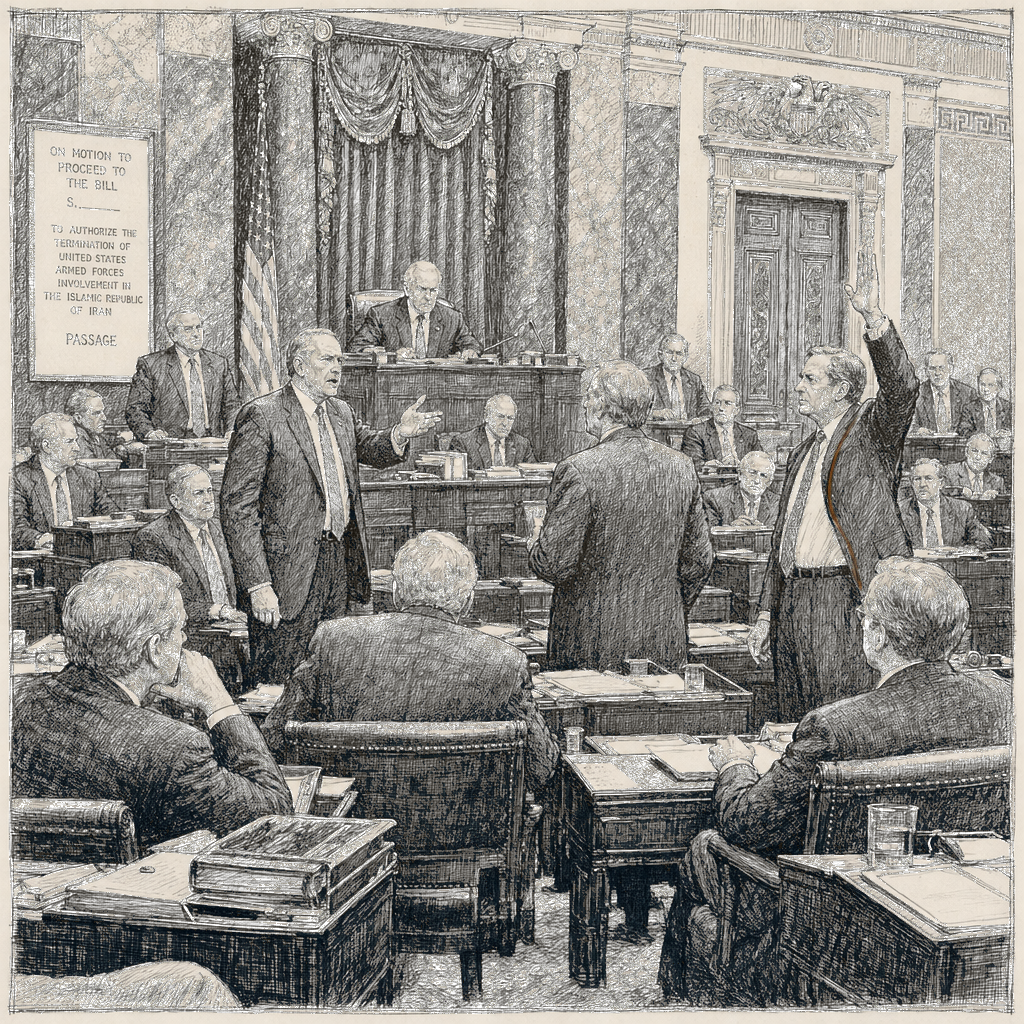
Senate advances bill to end Iran war as Cassidy flips to support
The Senate advanced Tuesday a bill that seeks to force President Donald Trump to withdraw U.S. troops from the Iran war, a vote that Democrats framed as evidence that support is growing for limiting the administration’s war powers. The measure passed 50-47 as a growing number of Republicans broke with the president’s direction on a conflict that Trump launched without congressional approval and that has stretched beyond two months.
The latest action followed a pattern in which Democrats pressed for repeated votes on war powers resolutions after Trump ordered the attack at the end of February. Under the approach Democrats were pursuing, Trump would have to either secure congressional authorization or withdraw U.S. troops, while Republicans previously voted together to reject those proposals.
The vote count showed the potential for further erosion of Republican support: three Republicans were absent Tuesday, and their votes would have been enough to defeat the measure if they had remained opposed. Even with the bill clearing the chamber, the outcome reflected how narrowly divided the Senate Republican conference has become on the Iran conflict, which has also been linked by lawmakers to rising gas prices in the U.S. and a ceasefire that has left the military course uncertain.
Chuck Schumer, the Senate Democratic leader, said after the vote that Democrats would continue the push. “Republicans are starting to crack, and momentum is building to check him,” Schumer said in a statement, adding, “We are not letting up.”
Republicans who previously supported similar war powers resolutions voted again Tuesday, including Sens. Rand Paul of Kentucky, Susan Collins of Maine and Lisa Murkowski of Alaska. Democrats had signaled they saw that consistency among some GOP members as part of a broader shift, but Cassidy’s decision was the centerpiece of the vote’s symbolism: after losing a Louisiana primary last week in which Trump endorsed his opponent, Cassidy backed the legislation for the first time.
Cassidy’s stance change reflected both his distance from Trump’s endorsement and his argument that Congress needed clearer information before authorizing extensions. After his primary loss, Cassidy returned to Washington and said he was proud of his work to uphold the Constitution while he “would carefully consider how he would vote” on priorities of the Trump administration going forward. Cassidy later posted remarks on social media stating, “While I support the administration’s efforts to dismantle Iran’s nuclear program, the White House and Pentagon have left Congress in the dark on Operation Epic Fury,” and he added, “Until the administration provides clarity, no congressional authorization or extension can be justified.”
The vote also highlighted a recurring question lawmakers raised about how the administration has treated war powers limits. Even if Congress passes a measure compelling Trump to withdraw, it may not be clear whether the administration would comply, given the White House’s position that it has technically ceased “hostilities” with Iran because there is a ceasefire. That approach, Democrats and other critics argue, is meant to circumvent the 1973 War Powers Resolution requirements.
Across Capitol Hill, Democrats expected to carry the fight forward in the House. The House is expected to vote on a similar war powers resolution Wednesday, Democrats said, after a comparable measure nearly passed last week, ending in a tie. Democratic Sen. Chris Murphy of Connecticut also tied the political push to economic effects in a floor speech, saying “Peace negotiations are stuck and so day after day after day grocery prices climb, gas prices climb.”
In the Senate debate surrounding the effort, GOP concerns were also voiced in terms of needing more detail. Sen. Mike Rounds of South Dakota said he supports Trump’s decision to go to war but warned that more Republicans were growing concerned about a long-term plan, adding that the administration may need to provide more information. Rounds said the War Powers Resolution “does provide an avenue for that discussion and debate to occur,” while also saying he would rather “stand strong with the president” at this point, even as he described a growing view among some members that it was time to have the debate.
Lawmakers also pointed to earlier precedent for seeking congressional scrutiny of Trump’s military actions. This year, Republican senators voted to advance a war powers resolution on the conflict with Venezuela and compelled the Trump administration to make its case to Congress for the military campaign. In that episode, senators including Todd Young of Indiana and Josh Hawley of Missouri ultimately flipped after Secretary of State Marco Rubio agreed to a public hearing on the administration’s Venezuela strategy.