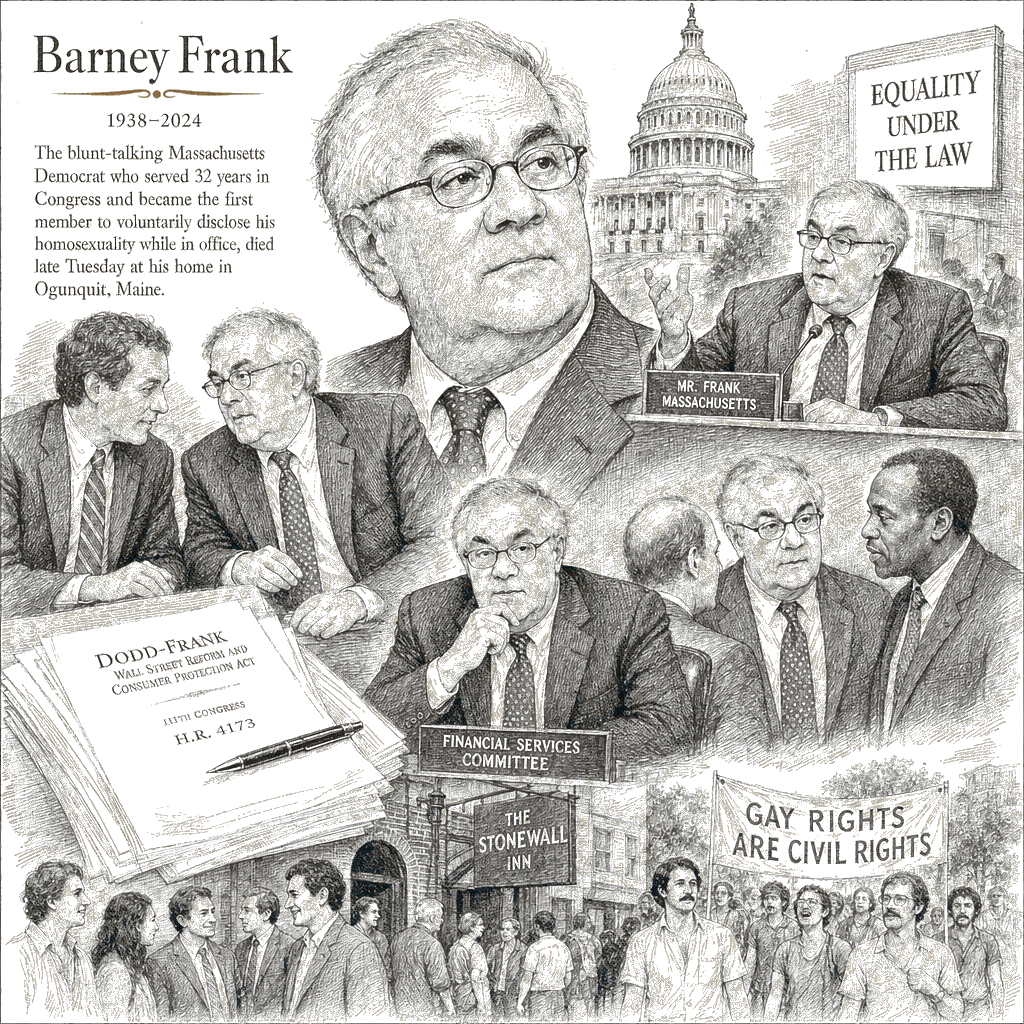
Barney Frank, the sharp-witted liberal titan who brought gay rights to the forefront of American politics and reshaped Wall Street regulation after the 2008 meltdown, died late Tuesday at his home in Ogunquit, Maine. He was 86. The death was confirmed by Jim Segel, Frank’s former campaign manager and close friend.
Frank represented Massachusetts in the U.S. House from 1981 to 2013, a career that spanned the Reagan era, the Clinton impeachment, the Iraq War, and the Great Recession. He rose to chair the powerful House Financial Services Committee, where alongside Senator Christopher Dodd, he co-authored the Dodd-Frank Wall Street Reform and Consumer Protection Act. Signed into law in 2010, the sprawling legislation created the Consumer Financial Protection Bureau, imposed stricter capital requirements on banks, and established the Financial Stability Oversight Council — the most significant rewiring of the U.S. financial regulatory apparatus since the New Deal.
But Frank’s legacy was equally defined by his role as a gay rights pioneer. In 1987, he became the first sitting member of Congress to voluntarily disclose his homosexuality, a decision he later described as coming after years of private discomfort and growing public courage. At the time, there were few openly gay elected officials at any level of government, and the move came against a backdrop of the AIDS crisis and widespread societal hostility. Frank weathered the reaction, including a reprimand from the House in 1990 over his relationship with a male prostitute, and went on to become one of the most visible champions of LGBTQ equality in Washington. In 2012, he married his longtime partner Jim Ready, becoming the first sitting congressman to enter a same-sex marriage.
His rhetorical style was as distinctive as his policy record. Known for a lightning-fast tongue and a taste for legislative combat, Frank often dispatched opponents with one-liners that circulated far beyond Capitol Hill. The most famous came during a 1990s floor debate, when he told Representative Dick Armey, a Texas Republican, that arguing with him was “like arguing with a dining room table.” He once described negotiating with the banking industry over the Dodd-Frank bill as “like being asked to plan a party with a group of people who don’t want to have a party.” During the 1998 impeachment of President Bill Clinton, Frank was one of the White House’s most forceful defenders in the House, framing the proceedings as a partisan overreach.
His political career began in Massachusetts state government and as an aide to Boston Mayor Kevin White before he won a seat in Congress in 1980. Over the decades, he compiled a reliably liberal voting record — supporting abortion rights, gun control, and expanded social programs — while also earning respect across the aisle for his mastery of parliamentary procedure and his willingness to cut deals. In 2011, he announced he would not seek reelection, leaving the House at the end of the 112th Congress.
After leaving office, Frank and Ready moved to Ogunquit, Maine, where he entered hospice in April with congestive heart failure. He is survived by his husband, Jim Ready; his sisters, longtime Democratic strategist Ann Lewis and Doris Breay; and his brother, David Frank.