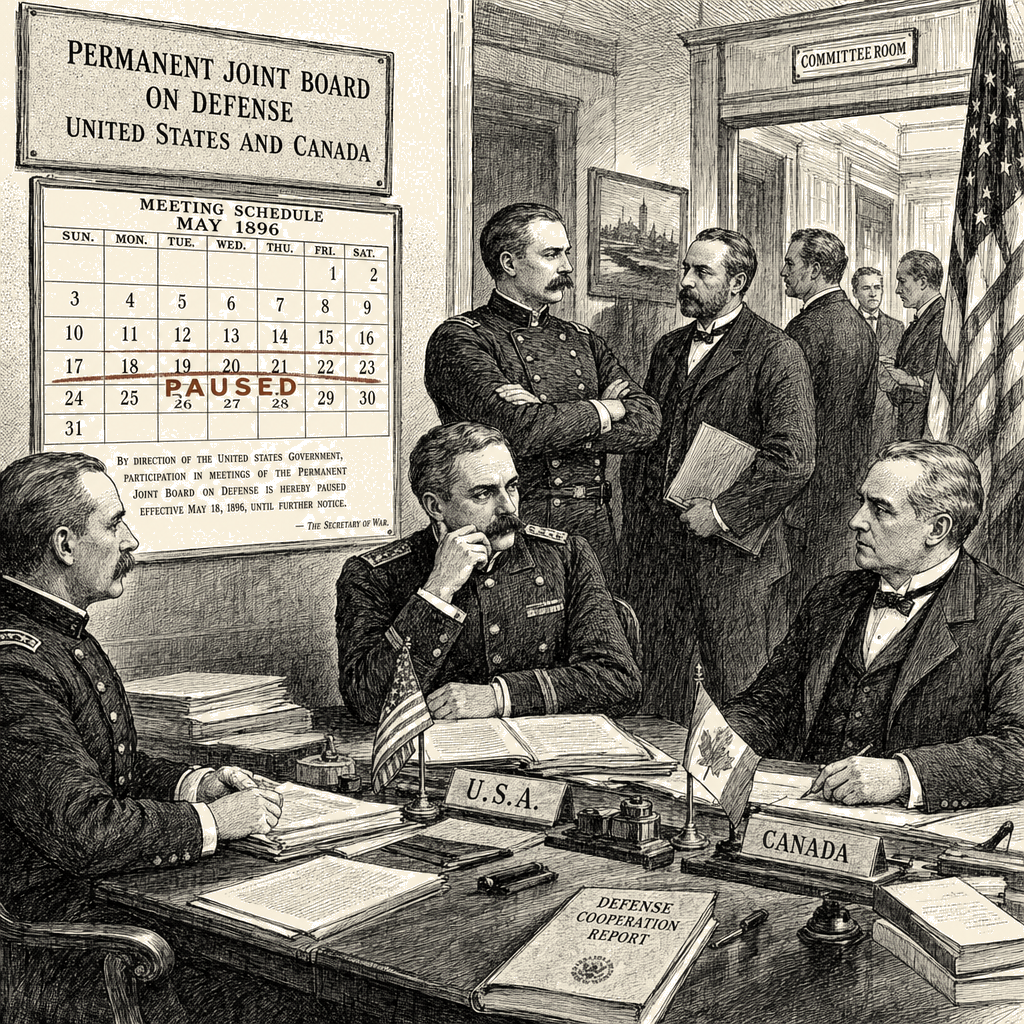
The Pentagon announced Monday it is suspending U.S. participation on the Permanent Joint Board on Defense with Canada, the binational military cooperation body that has operated continuously since President Franklin D. Roosevelt and Prime Minister Mackenzie King established it in 1940. The decision, announced by Undersecretary of Defense Elbridge Colby in a series of posts on X, accused Canada of failing “to make credible progress on its defense commitments” and signaled that the long-running bilateral arrangement can no longer paper over strategic differences.
“We can no longer avoid the gaps between rhetoric and reality,” Colby wrote. “Real powers must sustain our rhetoric with shared defense and security responsibilities.”
The board was created by Roosevelt and King during the buildup to World War II to coordinate the defense of the North American continent. It continued operating throughout the Cold War and remains the oldest permanent bilateral defense arrangement in U.S.-Canadian relations. The Pentagon did not specify whether the pause would extend to other joint commands such as the North American Aerospace Defense Command, known as NORAD.
The defense suspension is the latest flashpoint in a rapidly deteriorating bilateral relationship. Trump has long accused Canada and other NATO members of spending too little on their own militaries, arguing that the United States shoulders a disproportionate share of the alliance’s defense burden. Canada currently spends approximately 1.4% of its gross domestic product on defense, below the NATO target of 2% that was set in 2014.
The tensions extend beyond military spending. Trump and Carney, who became prime minister in March, are locked in a series of disputes over U.S. tariffs on Canadian goods that have escalated into a broader trade conflict. The Trump administration has imposed steep tariffs on Canadian steel and aluminum and has threatened additional duties on Canadian vehicles and aerospace products. A North American free trade pact that governs much of the cross-border commerce is set to expire later this year, and negotiations on its renewal have stalled.
Carney, a former central banker who has taken a confrontational posture toward the Trump administration, has responded by calling for Canada to reduce its economic dependence on the United States and to pursue new trade partnerships elsewhere. MSI previously reported that Carney said Canada must reduce U.S. economic ties over Trump tariffs.
The Pentagon decision drew bipartisan criticism from U.S. lawmakers. Rep. Don Bacon, a Nebraska Republican, said the pause sends the wrong signal to American allies at a time of global instability. “Canada is our friend and partner, and we should be strengthening these ties, not damaging them,” Bacon said in a statement.
The movement of U.S. troops through Canada to Alaska aboard military aircraft has long been a routine operational matter that relies on the goodwill and cooperation of the Canadian government. The Pentagon said it is reviewing the scope of the pause and how it will affect day-to-day military coordination, but did not provide a timeline for reassessment.