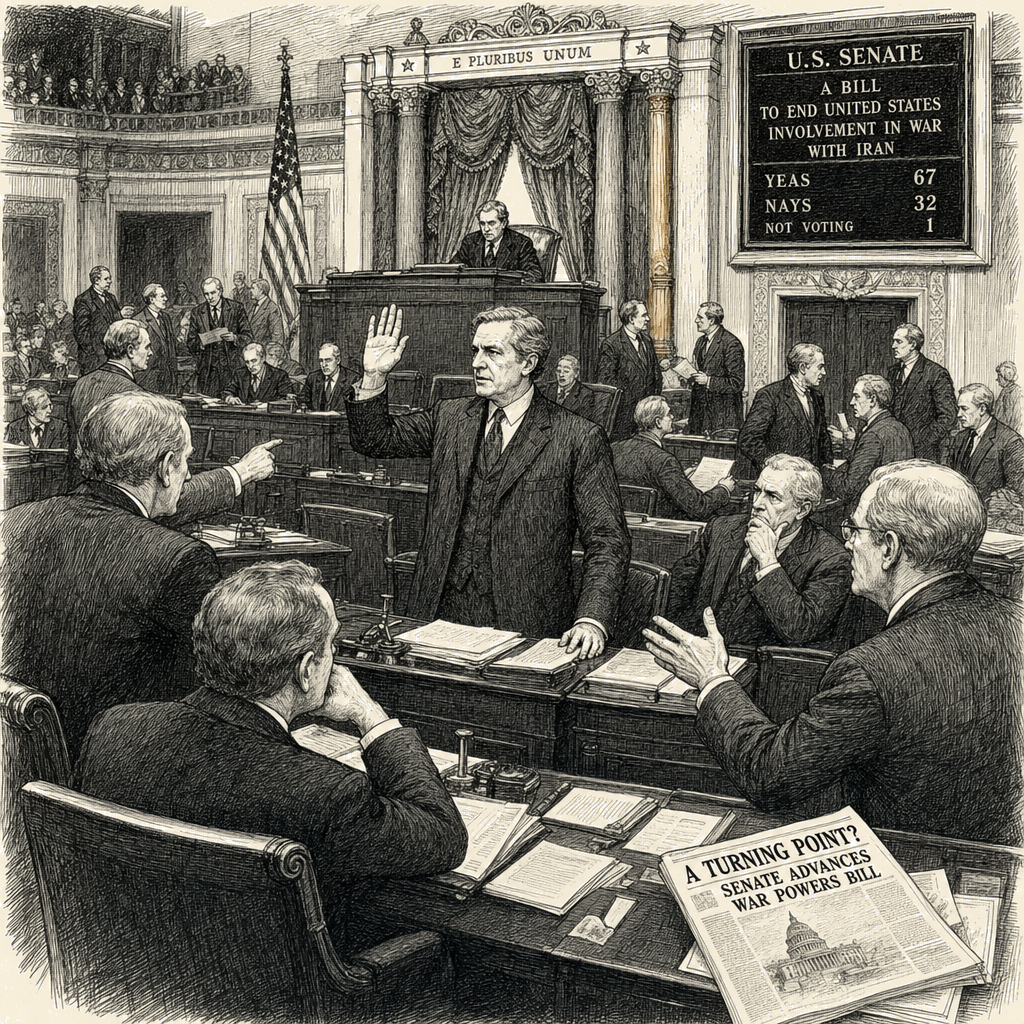
The Senate advanced legislation Tuesday that seeks to force President Donald Trump to withdraw from the Iran war, as a growing number of Republicans defied the president’s direction on a conflict that has spanned well over two months.
The 50-47 vote tally marked the first time Democrats have overcome Republican ranks on the issue. Since Trump ordered the military operation on Iran at the end of February, Democrats have forced repeated votes on war powers resolutions that would require him to either gain congressional approval or pull U.S. troops out of the conflict. Republicans had previously been able to muster enough votes to reject those proposals.
Louisiana Sen. Bill Cassidy provided the decisive defection. Cassidy switched sides on the resolution fresh off a primary election loss in which Trump personally endorsed his opponent. Cassidy’s pivot underscored the shifting political calculus for GOP lawmakers navigating the intersection of executive war powers and electoral pressure.
Despite the procedural success, the effort may not advance much further. Three Republicans were absent from Tuesday’s floor proceedings, and their votes would be enough to defeat the measure if they maintain their stance on the war. Lawmakers now face the prospect of a narrow, shifting coalition that could fracture again if the absent members return to the chamber.
Even if the resolution clears the Senate, Congress has a long history of struggling to override presidential military actions. The House has previously blocked or delayed similar war powers measures, and the White House has signaled a firm commitment to continuing the campaign. An eventual veto override would require a two-thirds majority in both chambers, a mathematical hurdle that current defections do not surmount.
The vote reflects a broader pattern of Republican lawmakers expressing skepticism about the scope and duration of the Iran operation. While the majority of the GOP caucus continues to support the administration’s military posture, isolated defections like Cassidy’s highlight the limits of unchecked executive authority when congressional authorization is absent.