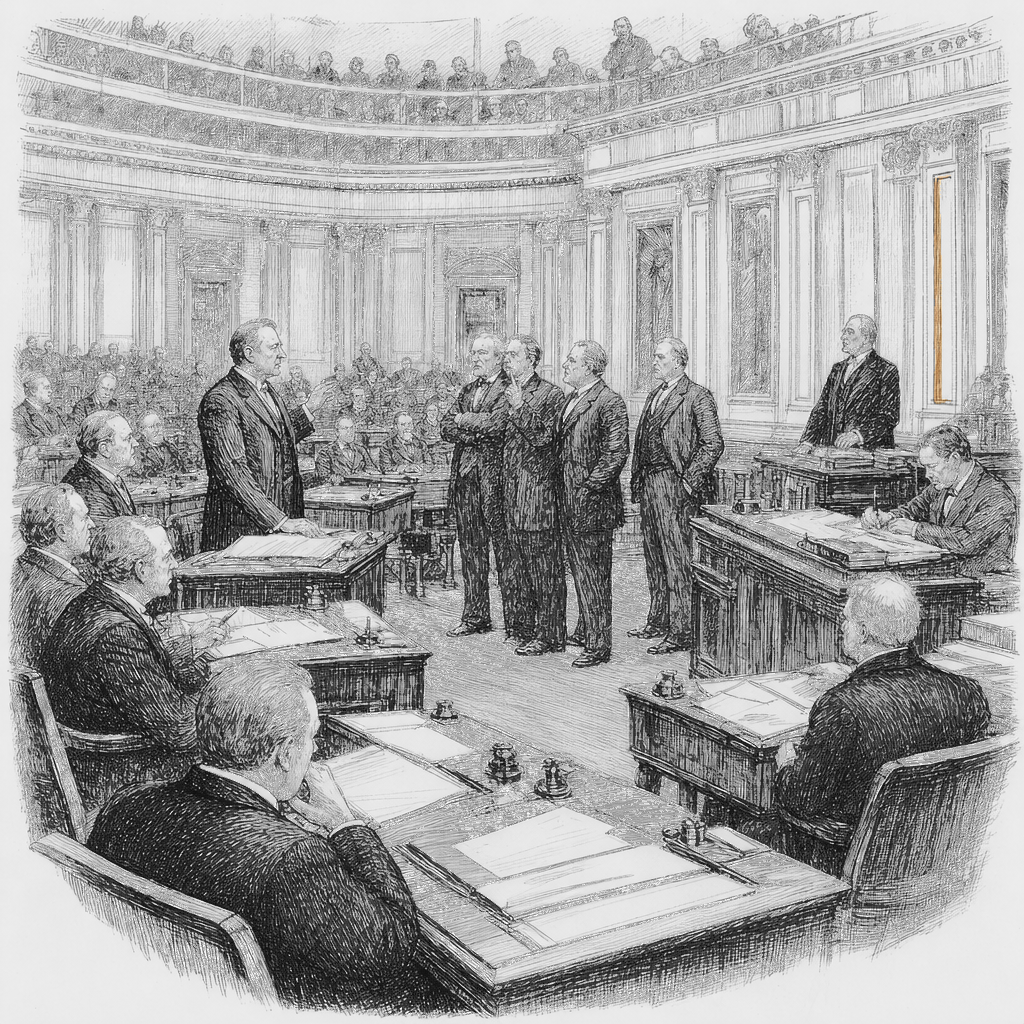
The Senate moved Tuesday to constrain President Donald Trump’s Iran war efforts, advancing legislation designed to force a withdrawal and testing how far Republican lawmakers will break with the White House on a conflict that has stretched for more than two months.
Democrats have pushed multiple votes on war powers resolutions since Trump ordered an attack on Iran at the end of February, seeking a congressional requirement that would either compel Trump to obtain authorization or pull U.S. troops back. Republicans had largely voted as a bloc against those measures—until Tuesday’s vote showed a fissure in that alignment, even though further progress may be limited.
The Senate passed the bill on a 50-47 vote, with three Republicans absent. Cassidy of Louisiana, who had been endorsed by Trump’s campaign in his primary race and then lost, supported the legislation for the first time. The AP report described the GOP split as small but growing, with the vote illustrating broader unease among Republicans as the conflict continues, remains in a fragile ceasefire, and contributes to rising gas prices in the U.S.
In a statement after the vote, Senate Democratic leader Chuck Schumer said, “Republicans are starting to crack, and momentum is building to check him,” adding, “We are not letting up.” The AP report framed the comments as part of Democrats’ push to keep pressuring Congress to assert authority over the war.
Among Republicans, Sens. Rand Paul of Kentucky, Susan Collins of Maine and Lisa Murkowski of Alaska had previously backed similar war powers resolutions and voted the same way again Tuesday. Sen. John Fetterman of Pennsylvania was again the only Democrat to vote against the legislation.
Cassidy, according to the AP report, returned to Washington after his primary loss “defiant,” saying he was proud of work to uphold the Constitution and that he would “carefully consider” how he would vote on priorities of the Trump administration going forward. The report also cited Cassidy’s social media remarks after his primary loss, including his statement that the White House and Pentagon had left Congress “in the dark” on the operation described as “Operation Epic Fury,” and his view that “until the administration provides clarity, no congressional authorization or extension can be justified.”
The AP report said the decision by Trump to endorse Republican Sen. John Cornyn’s primary opponent Tuesday—along with Cassidy’s primary loss—raised questions about how securely Trump holds the Senate GOP conference, but it also noted the bill’s path forward is uncertain. Even if Congress compels a withdrawal later, the report said it is not clear Trump would comply, pointing to the administration’s argument that it has technically ceased “hostilities” with Iran due to a ceasefire, which it has used to work around the War Powers Resolution of 1973.
At the same time, lawmakers signaled impatience with what they described as limited information from the administration. Democratic Sen. Chris Murphy of Connecticut, in a floor speech cited by the AP report, said, “Peace negotiations are stuck and so day after day after day grocery prices climb, gas prices climb.” Republican Sen. Mike Rounds of South Dakota told reporters he supports Trump’s decision to go to war but said more Republicans are growing concerned about a long-term plan, adding that the administration may need to provide more detail.
Across the Capitol, the AP report said House Democrats are expected to vote Wednesday on a similar war powers resolution. It also said a comparable measure in the House last week ended in a tie after barely failing to pass, and Democrats described the upcoming vote as an opportunity to advance further.
Summary sources cited above
- Associated Press report by Stephen Groves, published May 19, 2026