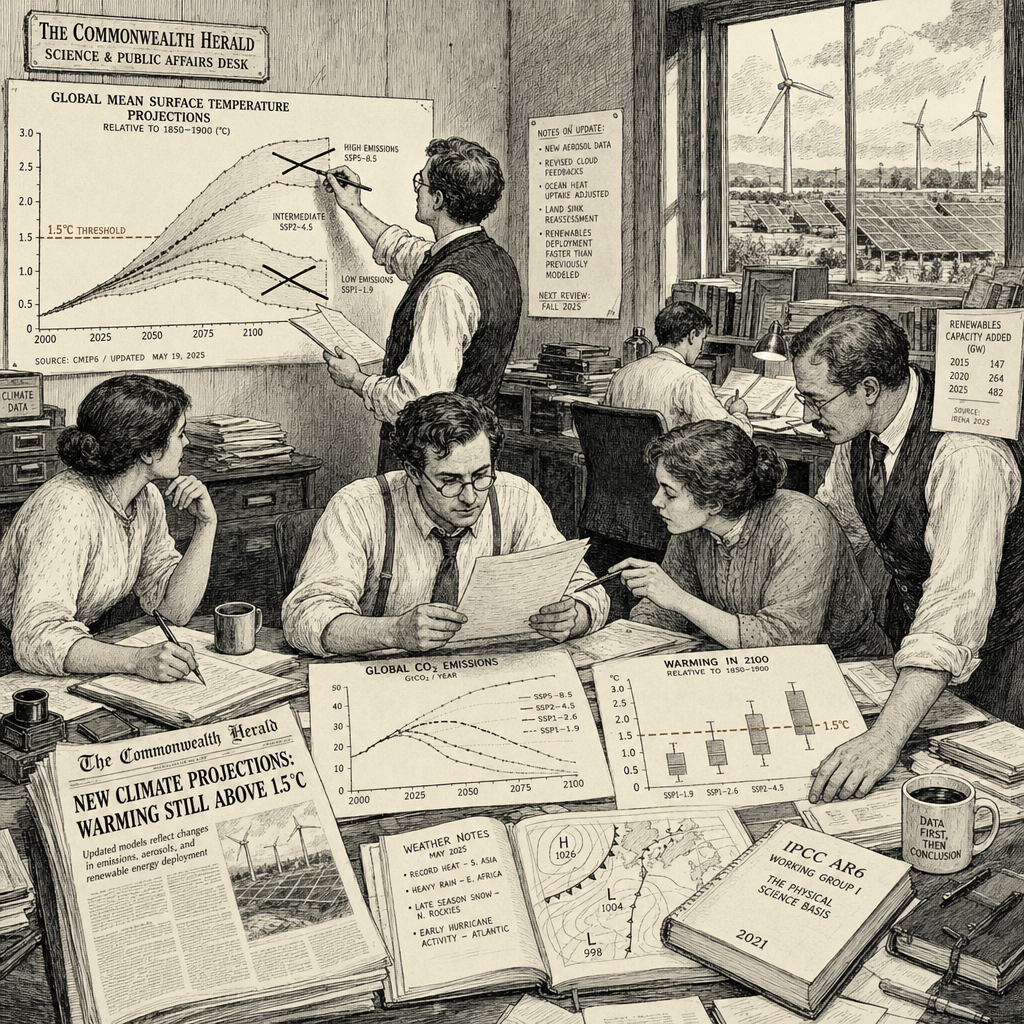
The new set of projections, reported Tuesday by the Associated Press, replaces the long-standing practice among climate modelers of using a wide band of scenarios that included a high-emission “business as usual” extreme — in which the world continued burning fossil fuels at an accelerating rate — and a low-emission extreme that assumed near-immediate global policy shifts toward deep decarbonization. Neither endpoint any longer matches the observable trajectory of the global energy system, according to the international consortium of researchers behind the update.
The revision carries a dual message: it reduces the likelihood of the most catastrophic warming scenarios — those projecting temperature increases of 5°C or more by 2100 — while simultaneously foreclosing the possibility that the world will achieve the most ambitious goal of the Paris Agreement, limiting warming to 1.5°C above pre-industrial levels. Current policies and energy trends, the new scenarios suggest, place the world on a trajectory toward roughly 2.5°C to 3°C of warming by the end of the century.
Johan Rockström, director of the Potsdam Institute for Climate Impact Research, said the narrowing of the range reflects real but insufficient progress. The rapid deployment of solar and wind power has made the highest-emission futures far less likely than they appeared a decade ago, Rockström said. However, he added, emissions have not fallen fast enough to prevent the lower end of plausible outcomes from drifting upward.
Bill Hare, a climate scientist and CEO of Climate Analytics, described the update as providing a more realistic basis for policy planning. He cautioned that the new scenarios show the window for keeping warming below 2°C is closing quickly.
Roger Pielke Jr., a policy analyst at the University of Colorado, characterized the shift as a natural maturation of climate science, moving from speculative extremes to evidence-based ranges grounded in observed changes in how the world generates electricity.
The seven new scenarios were developed as part of the next generation of climate models that inform the Intergovernmental Panel on Climate Change. The Associated Press report noted that the extremes at both ends became less probable primarily because of shifts in the global energy mix. Carbon dioxide emissions from burning oil, gas and coal remain near record levels globally, but the rising share of renewable sources such as solar, wind and geothermal has consistently beaten earlier projections, pulling down the top end of emissions forecasts. At the same time, the failure to accelerate the decline of fossil fuels has pushed the bottom end higher.
Scientists said the update underscores the need to accelerate the transition away from fossil fuels and begin deploying carbon removal technologies at scale if the world hopes to keep warming within the remaining temperature guardrails. The revised projections, while tempering the most extreme fears, offer no room for complacency.