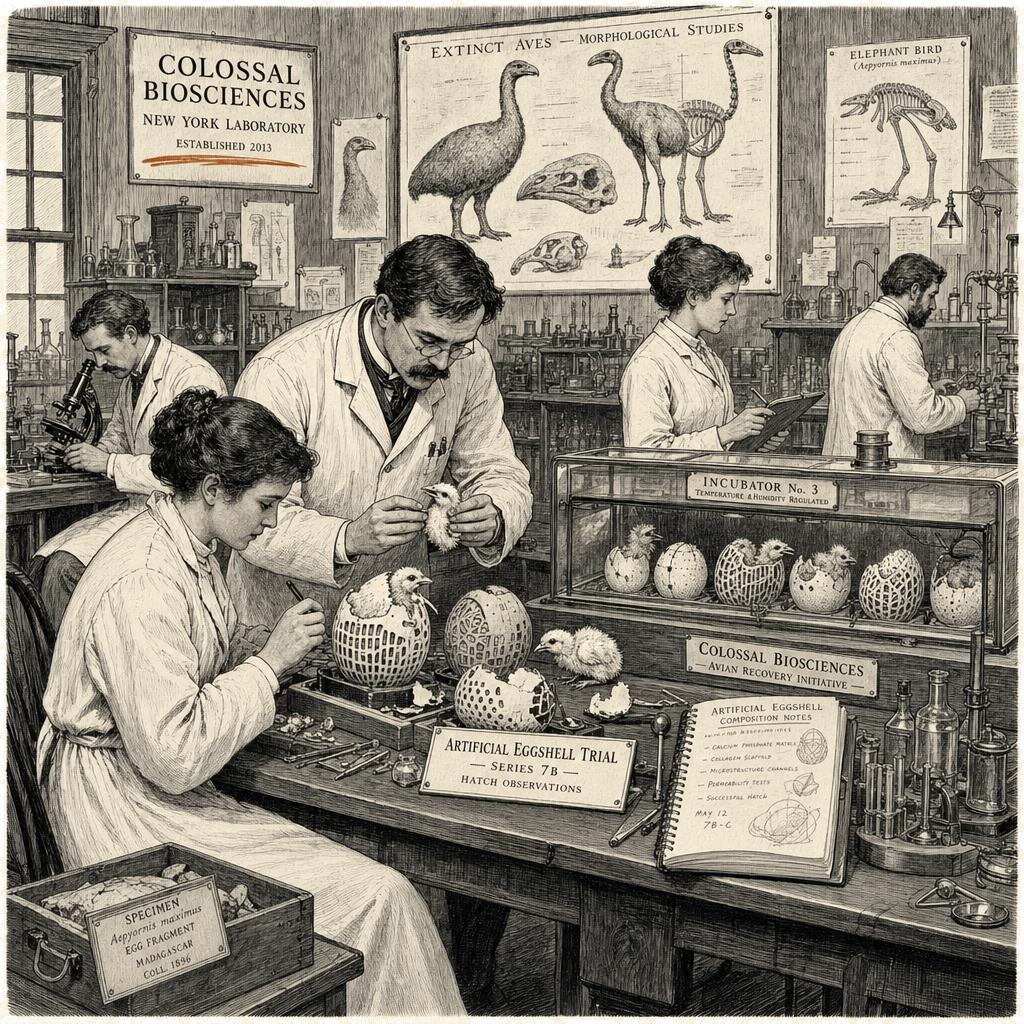
Colossal Biosciences said Tuesday that it has successfully hatched 26 live chicks using a 3D-printed artificial eggshell, a development the Dallas-based biotechnology company described as a key step toward its goal of resurrecting extinct bird species. The chicks, ranging from a few days to several months old, were born from a lattice structure designed to replicate the physical and structural properties of a natural eggshell, according to the company.
Chief Executive Ben Lamm said the artificial egg platform could eventually be used to revive New Zealand’s South Island giant moa, a bird that stood about 12 feet tall and went extinct centuries ago. Moa eggs are roughly 80 times the volume of a chicken egg, making them too large for any modern bird to lay or incubate. An artificial substitute would allow Colossal to engineer a living bird embryo in the lab and bring it to term without a surrogate.
“Our work with the artificial egg is proof that the physical environment for avian development can be engineered,” Lamm said in a statement. He said the technology could be scaled to accommodate species with far larger eggs, though he did not provide a timeline for a moa hatching.
Colossal has previously drawn attention for other de-extinction projects. The company announced last year that it had engineered mice with long, thick hair characteristic of the woolly mammoth, and earlier this year it unveiled wolf pups created through genetic editing to carry traits of the extinct dire wolf. Those projects used existing species as hosts; the artificial egg marks the first time Colossal has replaced the natural egg environment entirely.
The announcement was met with a mixed response from scientists who study extinction and conservation biology. Several researchers contacted by the Associated Press questioned whether the high cost and technical difficulty of de-extinction work is justified when hundreds of living species face immediate extinction. Others acknowledged the engineering achievement but argued that resources would be better spent preserving existing habitats and endangered populations.
Colossal has said its long-term mission includes genetic rescue of threatened species, not just revival of lost ones, and that the tools developed for de-extinction, such as artificial egg technology, may have broader applications in avian conservation. The company has raised more than $235 million in venture funding since its founding in 2021.