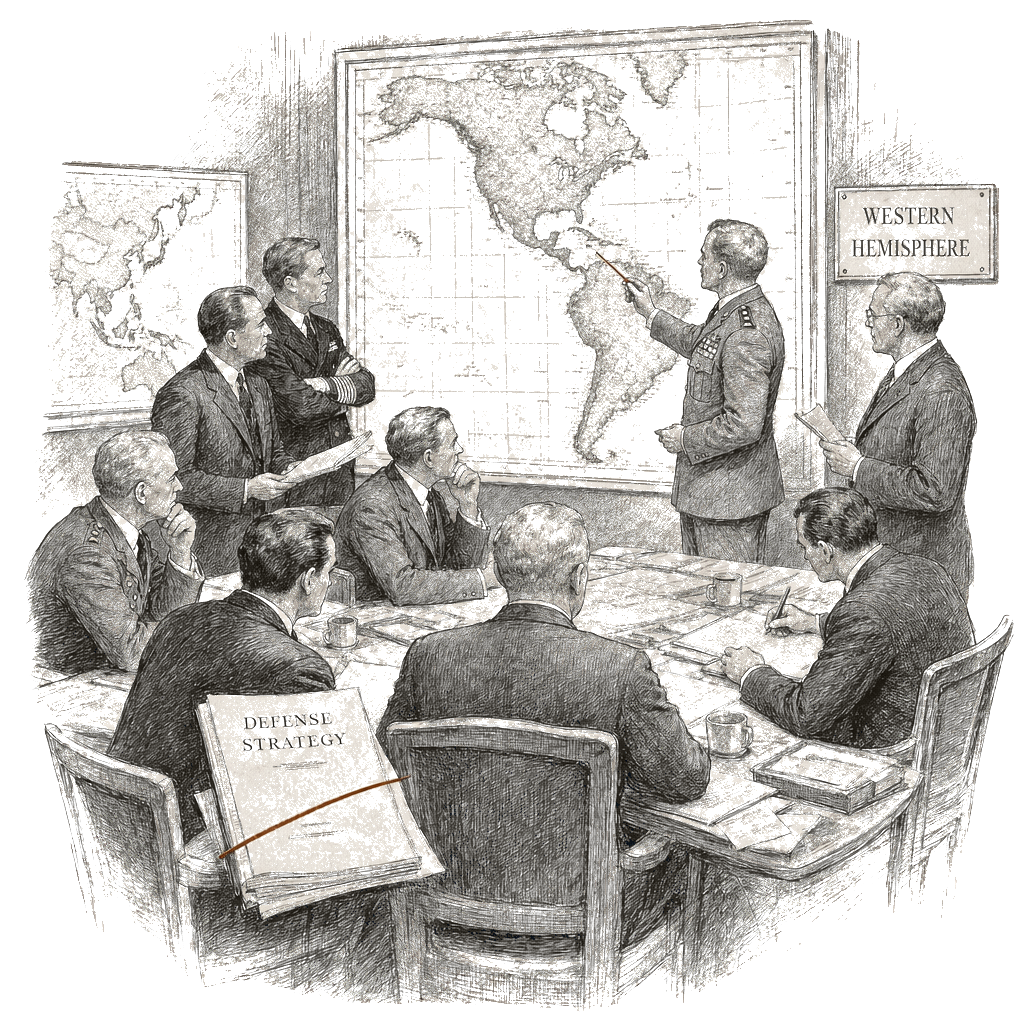
In January, the Trump administration released a National Defense Strategy that fundamentally shifts U.S. foreign policy priorities, emphasizing control of the Western Hemisphere over decades-long efforts to counter China while directing U.S. allies to take greater responsibility for their own defense. The 34-page document, the Pentagon’s first comprehensive defense strategy since 2022, sharply criticizes U.S. allies for relying on American military protection and explicitly seeks to guarantee U.S. access to strategic terrain including Greenland and the Panama Canal.
“For too long, the U.S. Government neglected — even rejected — putting Americans and their concrete interests first,” states the opening sentence of the document, which calls for “a sharp shift — in approach, focus, and tone.”
The strategy represents a significant departure from decades of U.S. commitment to collective security arrangements, signaling that allies traditionally dependent on American military backing may face new pressure to strengthen their own defenses. The document’s emphasis on Western Hemisphere dominance suggests the Trump administration is prioritizing regional control over the Cold War-era alliance structures that have shaped U.S. foreign policy.
The Pentagon’s Departure From a Generation of Alliance Strategy
The strategy simultaneously presents a softer approach to China while intensifying pressure on allies. The document states that the goal “is not to dominate China; nor is it to strangle or humiliate them,” and it calls for opening a “wider range of military-to-military communications” with China’s army. This represents a significant departure from the Biden administration’s 2022 strategy, which identified China as America’s “pacing challenge” and committed to supporting Taiwan’s “asymmetric self-defense.”
Notably, Trump’s defense strategy makes no mention of Taiwan, a self-governing island that Beijing claims as its own. The U.S. is legally obligated to provide military support to Taiwan under U.S. law, but the new strategy offers no explicit commitment to that obligation.
NATO Allies Expected to Lead on Europe
The Pentagon strategy asserts that Europe’s NATO members are “strongly positioned to take primary responsibility for Europe’s conventional defense” and that Russia represents only a “persistent but manageable threat” to NATO’s eastern members. The strategy says the Pentagon will continue to play a key role in NATO “even as we calibrate U.S. force posture” in the European theater to focus on priorities elsewhere.
The U.S. has already confirmed it will reduce its troop presence on NATO’s borders with Ukraine, a move that has prompted concern among European allies about potential security gaps as Russia continues aggressive actions.
Western Hemisphere as Primary Strategic Focus
In the Western Hemisphere, the strategy specifically identifies Greenland and the Panama Canal as areas requiring guaranteed U.S. military and commercial access. The timing comes after Trump reached what he described as a “framework of a future deal” on Arctic security with NATO leader Mark Rutte that would offer the U.S. “total access” to Greenland, a Danish territory. Danish officials said formal negotiations on the arrangement had not yet begun.
The Pentagon also highlighted an operation earlier in January that toppled Venezuelan President Nicolás Maduro, saying that “all narco-terrorists should take note.” The language suggests the Trump administration views the Western Hemisphere as a primary sphere of influence.
The strategy urged cooperation with neighbors from Canada to Central and South America, but with a warning: “We will engage in good faith with our neighbors, but we will ensure that they respect and do their part to defend our shared interests, and where they do not, we will stand ready to take focused, decisive action that concretely advances U.S. interests.”
The Philosophy Underlying the Shift
The document reflects Trump’s “America First” philosophy, which emphasizes nonintervention overseas, questions decades of strategic relationships, and prioritizes U.S. interests. It follows the White House’s National Security Strategy released earlier, which similarly focuses on domestic priorities and skepticism toward long-standing alliances.
The strategy’s opening — “For too long, the U.S. Government neglected — even rejected — putting Americans and their concrete interests first” — signals the administration’s belief that past administrations subordinated American advantage to alliance maintenance. Whether that framing will strengthen or strain the relationships the U.S. has maintained since World War II remains an open question for the allies now being asked to do more with less American security commitment.