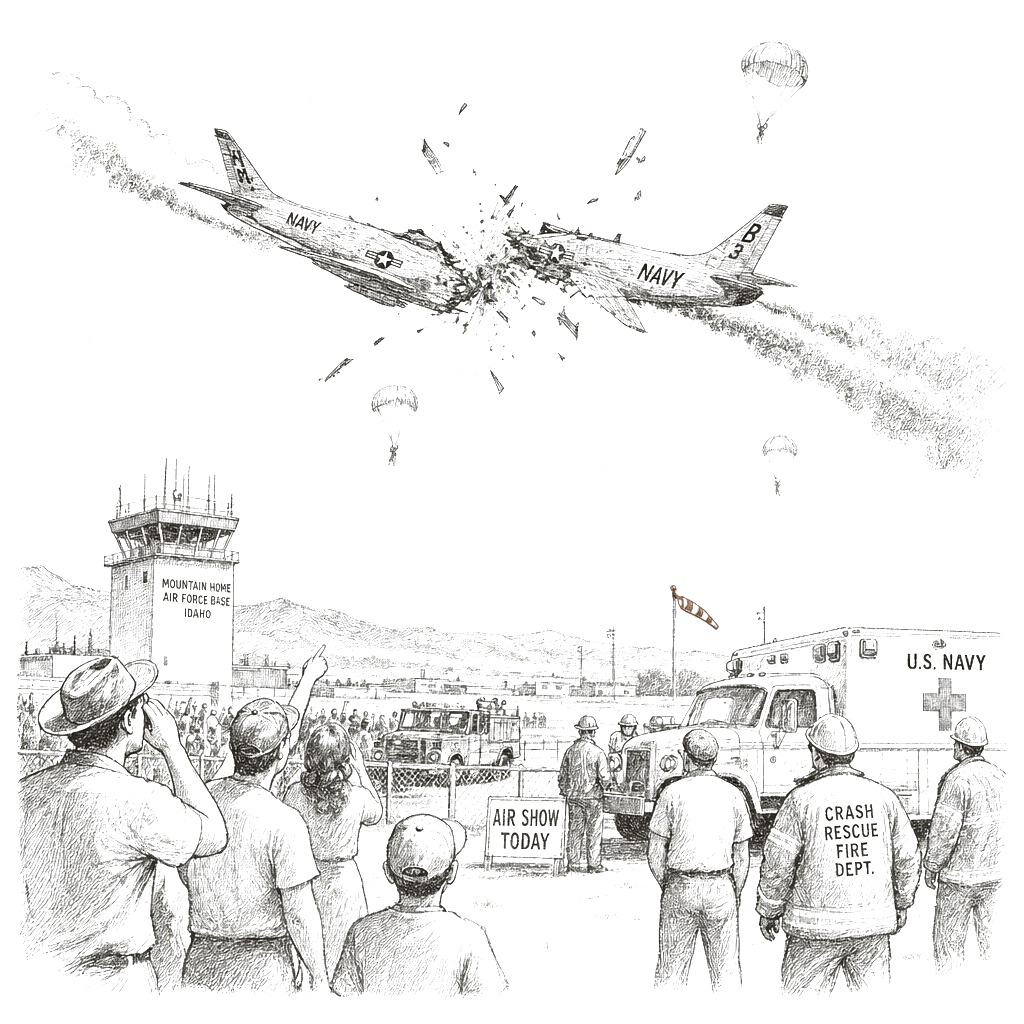
After two EA-18G Growlers collided midair during the “Gunfighter Skies” air show at Mountain Home Air Force Base in Idaho, the planes came together in a close, twisting impact before both aircraft separated downward into a field, sending up a fireball and black smoke, according to the U.S. Navy and aviation specialists who spoke about the sequence. The collision occurred Sunday, about 57 miles (92 kilometers) southwest of Boise.
Naval Air Forces spokesperson Cmdr. Amelia Umayam said that all four crew members were able to eject and deploy parachutes, floating down to safety as the jets continued toward the ground. She said only one of the four was injured, and that the injury was not life-threatening.
Flynn, a former F-35 senior test pilot and demonstration expert, described the outcome as unusual. “Truly remarkable,” she said in an interview quoted in the report. “It is astonishing considering the way the airplanes impacted each other — incomprehensible even,” Flynn added, describing the collision dynamics that the crews survived.
The jets were EA-18G Growlers from Electronic Attack Squadron 129 in Whidbey Island, Washington, with two crew members in each aircraft. The Growler is just over 60 feet (18.5 meters) long and made its first flight in August 2006, and the Navy has said it was the first newly designed electronic warfare aircraft produced in more than 35 years.
Spectator videos showed one jet slightly behind the other before impact, and then both aircraft appearing to become “sandwiched together” as the collision unfolded. The video also showed the jets twisting and rocking together, pointing straight up for a moment before turning downward and diving toward the ground, an impact sequence that produced the fireball seen after the crash.
While the cause has not been officially released, Flynn suggested that the video indicates human error may have played a role, describing how the pilots were attempting to line up closely—wing tip to wing tip—and failed to safely rejoin in formation, a routine maneuver. Umayam said officials have not yet released information about what may have contributed to the crash, and she said the investigation is ongoing amid recovery efforts.
The Navy also emphasized recovery and personnel safety. Umayam told The Associated Press in an email that “Our priority is to ensure the safety and well-being of our personnel, as well as security of the aircraft during the recovery,” as officials work to recover damaged aircraft after the midair incident.
Ejection is a multi-step emergency process that depends on timing and available altitude. Aviation expert Jeff Guzzetti said ejection seats use motors and parachutes to propel crew members away from a plane, describing how the canopy is blown off first, followed by seat launch using solid rocket motors, parachute deployment, and then the seat dropping away as the crew member descends. Guzzetti said enough altitude and clearance from obstacles are required and that even after success, ejections can still cause serious injuries.
Guzzetti also said ejections are sometimes not possible during midair collisions because aircraft damage can be too extensive. “But the way the two Navy planes came together may have allowed the opportunity to eject,” he said, adding that if the jets had struck each other at a faster speed, the resulting structural damage could have left the aircraft incapable of breaking away without catastrophic breakup.
The Associated Press report said the Growlers were using a seat manufactured by Martin-Baker, a U.K.-based company that describes itself as a leading ejection-seat manufacturer and said the company’s seats have been used by the Navy since 1958. The report also quoted former Federal Aviation Administration official Michael O’Donnell, who said the explosiveness of an ejection can create forces that are equivalent to as much as 20 times gravity, potentially affecting the crew member’s body during egress.
O’Donnell compared it to a physical experience, saying, “A really, really bad roller coaster ride is not even close to that,” as he described the intense forces involved in ejection. In the same discussion, O’Donnell said the seats can still fail or be unusable if damage makes the sequence impossible.
Flynn also said the Growler fleet is difficult to replace. He described the aircraft as “invaluable national assets,” adding that there is “no newer version of these” and that there are “never enough of them,” while noting that Boeing stopped building new Growlers several years ago and that the collision resulted in the loss of two aircraft. As covered earlier in MSI reporting—MSI previously reported that four crew members ejected safely after two Navy jets collided at an Idaho air show—officials have continued to say the investigation remains ongoing.
Aviation safety expert John Cox said the environment of air shows leaves little room for error, even for highly trained pilots. Cox, CEO of Safety Operating Systems, said “Air show flying is demanding. It has very little tolerance,” and he said the pilots involved are among the best in their fields, with a “small margin for error.” He said he was glad that everyone involved was able to get out.
The report noted that the air-show industry has been working on safety improvements for years across roughly 200 events held annually in the United States, and it pointed to past fatal crashes in 2024 in separate incidents at different events.