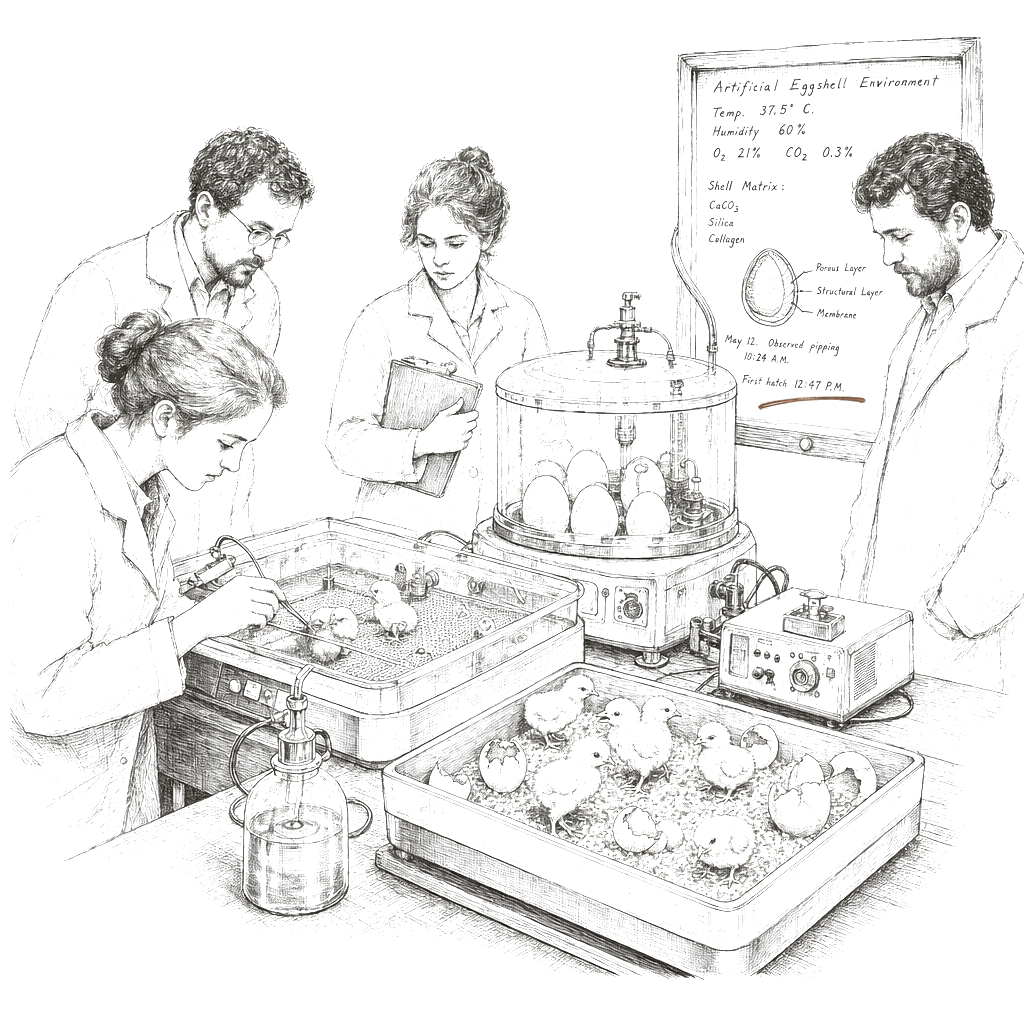
A de-extinction company is claiming a technical milestone: Colossal Biosciences said it has hatched live chicks from what it describes as an artificial eggshell environment, using a 3D-printed lattice designed to mimic key parts of a real egg. The company said the results involved 26 baby chickens, ranging from days old to several months old, born after the embryos developed inside the artificial system before hatching. Colossal characterized the development as progress toward its broader goal of reviving lost creatures, even as scientists and critics raised questions about how comparable the setup is to a full artificial egg and whether de-extinction is realistic.
According to Colossal, the experiment began by pouring fertilized eggs into an artificial system built from a 3D-printed structure intended to resemble an eggshell. The company said the eggs were then placed in an incubator, calcium was added because it is normally absorbed from the eggshell, and embryos were imaged during development and growth in real time. Colossal said scientists also designed an artificial eggshell with a membrane intended to allow the right amount of oxygen to enter, paralleling how oxygen moves in a real egg.
Colossal has previously said it genetically engineered living animals to resemble extinct species, including mice with long hair like the woolly mammoth and wolf pups that take after dire wolves. On Tuesday, CEO Ben Lamm said the artificial egg technology could one day be scaled up to genetically tweak living birds to resemble New Zealand’s extinct South Island giant moa. He also described the moa as a species whose eggs are “80 times the size of a chicken’s” and would be difficult for any modern bird to lay, making engineering and surrogate development central to any attempt.
Lamm said the company aimed to improve on what nature has done, arguing that an engineered system could be made more scalable and efficient. He said, “We wanted to build something that nature has done a pretty good job of developing and make it better and scalable and even more efficient.” Colossal described the work as beginning with engineering challenges for surrogacy and birth rather than waiting until the company is ready to attempt a giant moa hatch.
Independent researchers said Colossal’s results are promising for developmental biology but stop short of constituting a complete artificial egg. Evolutionary biologist Vincent Lynch, of the University at Buffalo, said the technology “might be able to use this technology to help them make a genetically modified bird, but that’s just a genetically modified bird. It’s not a moa.” Lynch also criticized the characterization of the system itself, saying, “That’s not an artificial egg because you’ve poured in all the other parts that make it an egg. It’s an artificial eggshell.”
Scientists quoted in the report said earlier work has used simpler methods to create transparent eggshells that allowed embryos to hatch from artificial coverings such as plastic films or sacks, and that those systems can still be useful for studying chicken development. Nicola Hemmings, who studies bird reproductive biology at the University of Sheffield and said she is not part of the Colossal team, said producing a chick from an artificial vessel is not necessarily new. Hemmings argued that current de-extinction efforts are better suited to endangered species, where researchers could preserve sperm and egg cells from living animals to attempt to bring more back, rather than trying to revive creatures that are already gone.
Beyond technical design, other experts said the hardest challenges may come after any “revived” animal is born. Arthur Caplan, a bioethicist with New York University’s Grossman School of Medicine, said the major hurdle would be environmental survival, saying: “The big challenge is, what environment is this animal going to live in?” He pointed to the difficulty of placing a species into a world that looks nothing like its past habitat.
Colossal said it still has a long road ahead before it attempts a moa resurrection using the artificial eggshell approach. Scientists said the work would likely require comparing ancient DNA from well-preserved moa bones to genomes of living birds, and they said any attempt would also demand a bigger “eggshell.” The company, Lamm said, wants to start now on engineering and surrogate-birth challenges, even before the goal of hatching a giant moa is within reach.