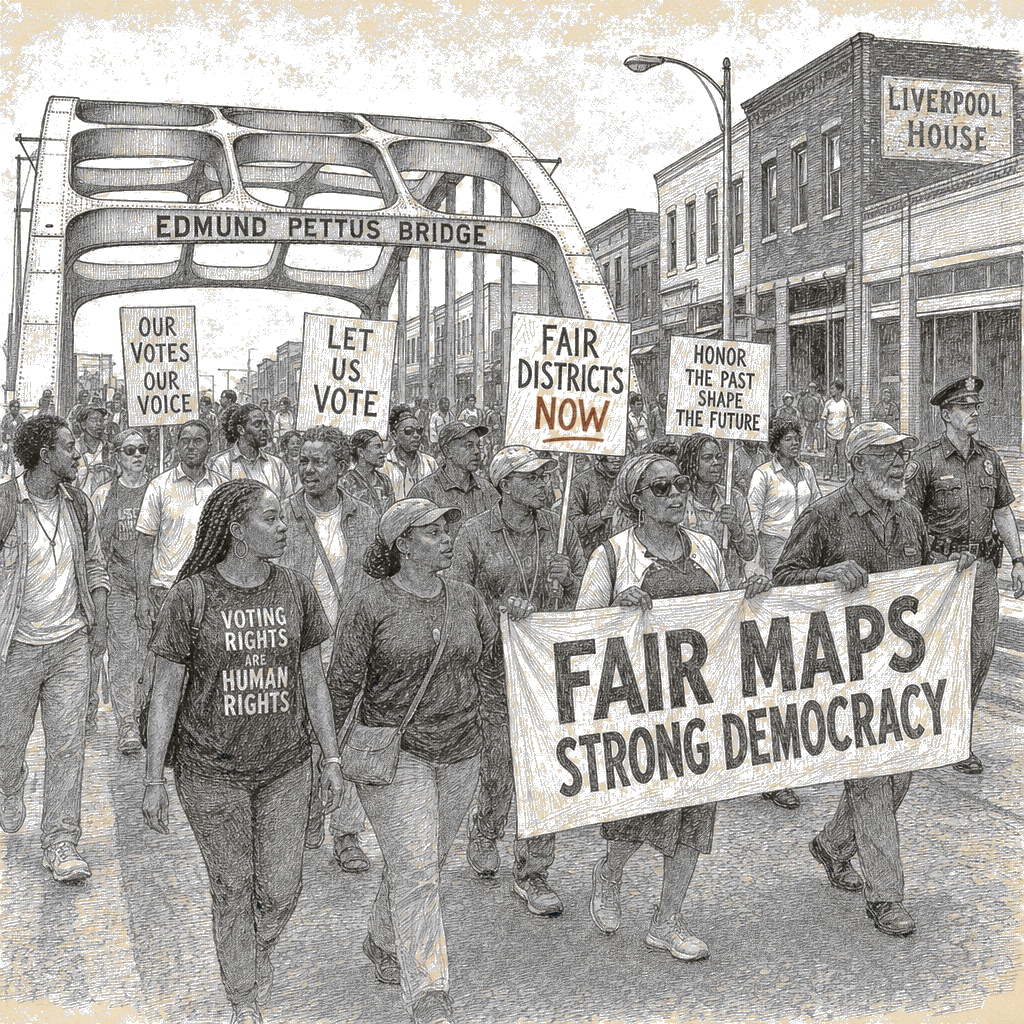
The buses from Atlanta rolled into Montgomery on Saturday afternoon, carrying passengers who had never cast a vote under a weakened Voting Rights Act. They stepped onto Dexter Avenue, where the Alabama State Capitol rose in the sun and a rally stage stood near the spot where the Rev. Martin Luther King Jr. addressed the original marchers in 1965. This time, the crowd was smaller, but the goal was the same: to push back against what participants described as a concerted rollback of voting rights.
Keith Odom, 62, had come from Aiken, South Carolina, for his first visit to Montgomery. Standing near the Capitol, he said he was overcome by the moment. “The history here — being a part of it, seeing it, feeling it,” he said, his voice trailing off. “I’m not trying to live a life that’s going backwards. I want to go forward, for my grandchildren to be able to go forward.”
The rally, organized by Fair Fight Action, was the first mass organizing response to a 6-3 Supreme Court ruling this spring that struck down Louisiana’s majority-Black congressional district because it considered race in map drawing. The decision, which justices in the majority said meant race-conscious redistricting is itself discriminatory, led Alabama and other states to redraw U.S. House districts in ways that dilute Black voters’ political clout, according to the plaintiffs in the Louisiana case and civil rights groups.
Among the crowd were several people who recited family histories that tied them to the original march. Justice Washington, a student at Kennesaw State University, said her grandmother was her inspiration. “I talked to my grandmother before I came, and she was so excited,” Washington said. “My grandmother told me she did her part, and now it’s time for me to do mine.”
Kobe Chernushin, 18 and white, came from Atlanta’s northern suburbs as an organizer with the Georgia Youth Justice Coalition. He filmed Khayla Doby, a 29-year-old executive for the group, as she recorded standups for social media. “I believe in the power of showing up,” he said.
Darrin Owens, 27, who has worked for former Vice President Kamala Harris and now trains Democratic candidates, said he attended as a citizen. “I’m here because of the same forces that pulled on John Lewis when he was a student,” Owens said. “Political activism is personal. Sometimes those lines are blurred, and as a Black person in America, a Black person living in a Southern state, I’m committed to action that stops what I consider to be un-American, this possibility that the person who represents me is someone who is not from my community and does not understand me or my community.”
Phi Nguyen, a 41-year-old civil rights lawyer and daughter of Vietnamese refugees, said she saw the country repeating a cycle of progress and backlash. “It feels like our country is stuck in this pattern of making progress, then there’s a huge backlash, and then people have to go through the same battle again just to get to where we were,” she said.
Nearby, Carole Burton and Tondalaire Ashford, both 72-year-old Montgomery residents who have been friends since attending a segregated junior high and then a newly desegregated high school, shared their experiences. “I don’t call it ‘integration,’” Ashford said, pointing at her skin. “It was never real integration, and it’s not like we can ever just blend in.” Burton added, “We just want to be treated like people with the same rights and opportunities the country has promised us. They’ve never fully lived up to it.”
The rally also celebrated the John Lewis Voting Rights Advancement Act, a proposed federal law named for the late congressman who was beaten on the Edmund Pettus Bridge in 1965. The bill, backed by some Democrats, would override the Supreme Court decision, reinvigorate the Voting Rights Act, and ban partisan gerrymandering, according to its sponsors.
Odom said he feared his state losing U.S. Rep. Jim Clyburn, a senior member of the Congressional Black Caucus, through redistricting. “They want to take away that legacy when we’re still living with Strom’s?” he asked, referring to Strom Thurmond, the late segregationist who represented South Carolina for decades.
Odom also said he worried that the young people who attended were not a vanguard but outliers. He recounted a conversation with a 20-year-old co-worker who told him she supported him but didn’t want to participate personally because she wondered what any politician would do for her. “I’m still going to tell her what I saw and what I heard,” he said.