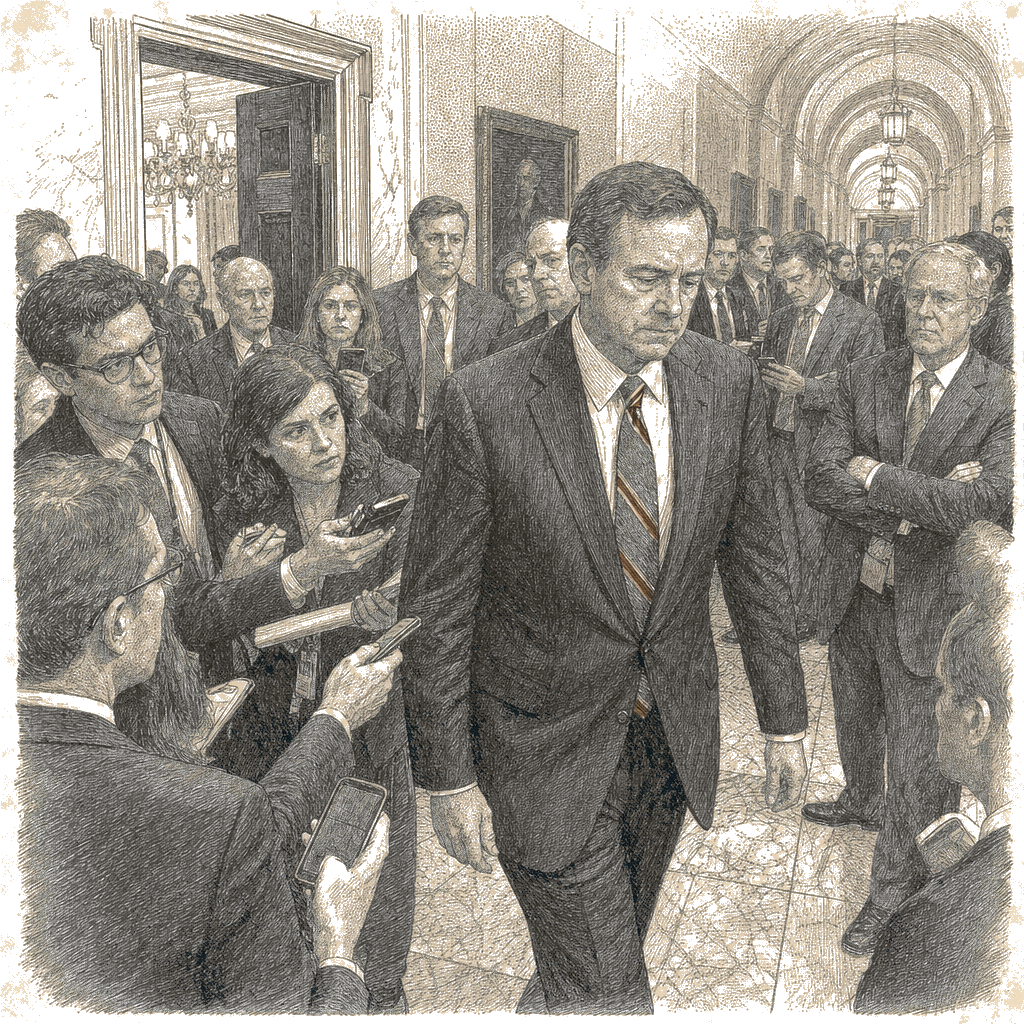
Sen. Bill Cassidy of Louisiana finished a distant third in the state’s Republican Senate primary on Saturday, blocked from a runoff by primary voters who never forgave his vote to convict President Donald Trump during the 2021 impeachment trial over the Jan. 6 attack on the U.S. Capitol. Cassidy outspent his rivals and spent years voting in alignment with Trump’s legislative agenda, but the effort collapsed under the weight of a presidential endorsement for Rep. Julia Letlow, who placed first and will face former Trump administration official and state Treasurer John Fleming in the June 27 runoff.
Charles Wandfluh, a 57-year-old voter in a New Orleans suburb, said Cassidy’s attempts to present himself as a Trump ally rang hollow. “He was trying to portray himself side by side with Trump, like he has worked with Trump on this and that,” Wandfluh said. “I’m like, ‘You voted to impeach the guy!’” Wandfluh described Cassidy as “a squirrel running around the tree, chasing nuts to find whatever he can get to benefit him.”
Cassidy’s scramble to repair his relationship with Trump was among the most conspicuous in a party full of contortions during the Trump era. As a physician, Cassidy overlooked Robert F. Kennedy Jr.’s history of anti-vaccine activism to support his confirmation as Trump’s health secretary, a decision that alienated some Republican voters who wanted Cassidy to block the nomination. The rapprochement did not last; Cassidy clashed with Kennedy once he took the job, and Trump voters remained unconvinced by Cassidy’s broader claims of loyalty.
Trump did not wait for the runoff to declare victory over the senator he had targeted. “His disloyalty to the man who got him elected is now a part of legend, and it’s nice to see that his political career is OVER!” Trump wrote on social media Saturday. Letlow, for her part, embraced the president’s backing without reservation. “There is no greater endorsement than the endorsement of President Trump,” she said after finishing first in the primary. “We’ll always be singing that from the mountaintops.”
Sen. Lindsey Graham of South Carolina, who feuded with Trump in the past but has since become a model of presidential loyalty, said the result carried an unmistakable message for Republicans weighing whether to defy the president. “What’s the headline? Trump’s strong. Those who try to destroy Trump politically, stand in the way of his agenda, are going to lose,” Graham said Sunday on NBC’s “Meet the Press.” “You can disagree with President Trump, but if you try to destroy him, you’re going to lose. Because this is the party of Donald Trump.”
Graham once described Trump as a “kook” who was “unfit for office” and appeared to break with him after Jan. 6, but he did not vote to convict. Cassidy was one of seven Republican senators who did. Four of them — Richard Burr of North Carolina, Mitt Romney of Utah, Ben Sasse of Nebraska, and Pat Toomey of Pennsylvania — declined to seek reelection. Alaska’s Lisa Murkowski, a vocal Trump skeptic, won reelection in 2022 when Trump was out of office. Maine’s Susan Collins, who has drawn Trump’s criticism but avoided a serious primary challenge, is seeking a sixth term in November from a state Vice President Kamala Harris carried in the last presidential election.
The Louisiana result is part of a widening retribution campaign. Earlier this month, Trump successfully backed challengers who unseated five Indiana state senators who opposed his redistricting plan. On Tuesday, he is supporting a primary challenger to U.S. Rep. Thomas Massie of Kentucky, who angered the president by opposing Trump’s signature tax legislation over debt concerns, pushing for the release of the Jeffrey Epstein files, and opposing the war with Iran. Over the weekend, Trump suggested he could next target U.S. Rep. Lauren Boebert of Colorado because of her support for Massie — a threat he issued despite Colorado’s candidate filing deadline having passed months ago.
Trump’s grip on his party remains firm even as he enters the back half of a constitutionally limited second term, presiding over lingering inflation, economic dissatisfaction, and an unpopular war with Iran. His job approval ratings are low, yet Republican lawmakers and primary voters have shown little appetite for crossing him.
For many Louisiana Republicans who voted for Letlow, the calculation was pragmatic. Mark Schulingkanp, a 46-year-old shipping industry worker, said his priority was securing federal dollars for the state. “Clearly having a senator that the president doesn’t like could cause a challenge or impede federal dollars coming to the state for roads, bridges, so many different programs,” he said. Jeanelle Chachere, a 66-year-old nurse, was more direct. She called Cassidy a “phony” and said she voted for Letlow “solely because of Trump’s endorsement.” She added: “I’m going by what he says because I like what he does.”
Cassidy also lost support from voters who wanted him to stand up to Trump more forcefully. Mark Workman, a 75-year-old retired physician, said he voted for Fleming to punish Cassidy for backing Kennedy’s confirmation as health secretary. “If Cassidy had stood up and blocked RFK, I would definitely have supported him because that would have been a strong, ballsy move,” Workman said. “He had the ability to stop him and he was too weak to do that.” Cassidy was squeezed from both directions — too disloyal for Trump’s base, too compliant for Republicans who wanted a check on the president.
In his concession speech in Baton Rouge, Cassidy addressed the president’s influence without naming him. “Our country is not about one individual. It is about the welfare of all Americans, and it is about our Constitution,” Cassidy told supporters. “And it is the welfare of my people, and my state, and my country, and our Constitution to which I am loyal.” His words amounted to a closing argument in a campaign that had already reached its verdict: in the party Trump has remade, a single vote cast five years ago was enough to end a Senate career.