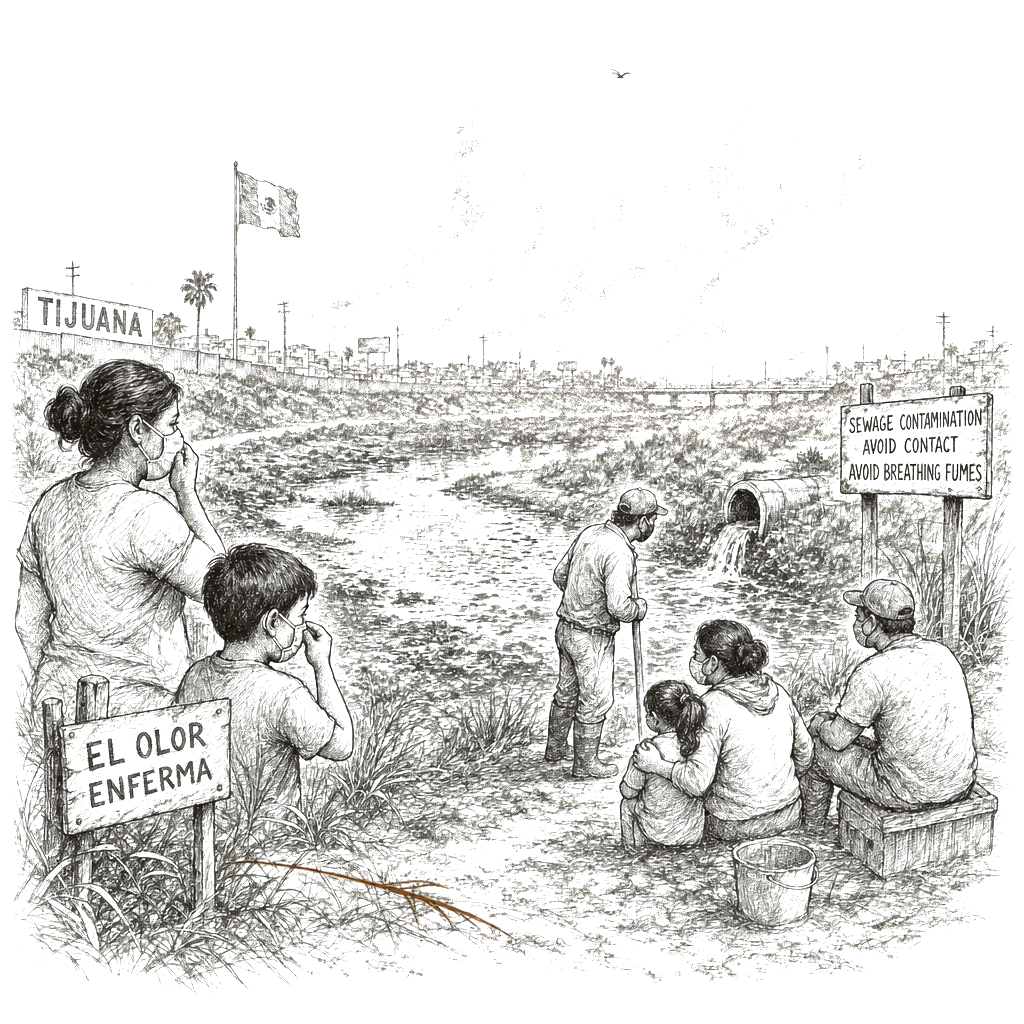
For decades, billions of gallons of raw sewage flowing from Tijuana have created hazardous air quality in Southern California’s Tijuana River valley, sickening residents through exposure to toxic hydrogen sulfide gas. Since 2018, more than 100 billion gallons of sewage laden with industrial chemicals have poured into the Tijuana River, according to the International Boundary and Water Commission. The contamination has created what the Environmental Protection Agency termed one of the nation’s worst environmental crises, affecting tens of thousands of people in largely poor, Latino communities near the river.
New scientific findings reveal the scale of the health threat. Researchers at UC San Diego measured hydrogen sulfide concentrations 4,500 times higher than typical urban levels, and a 2024 survey found 71% of households near the river could smell sewage inside their homes, with 69% reporting family members had gotten sick from exposure.
Residents of Southern California’s Tijuana River valley have grown accustomed to the stench of sewage seeping into their homes. Steve Egger, 72, says he and his wife have frequent headaches and wake up congested. Despite installing a hospital-grade air filtration system that cycles the air every 15 minutes, “most nights we breathe in a horrible stench,” Egger said.
The sewage flows across the border from Tijuana laden with industrial chemicals and trash. For nearly a decade, the contamination has been escalating. Since 2018, more than 100 billion gallons of raw sewage have poured into the Tijuana River, according to the International Boundary and Water Commission. The flow accelerated sharply this year: just since January, an additional 10 billion gallons have crossed into California.
The EPA has called it one of the nation’s worst environmental crises. It affects tens of thousands of people in the largely poor, Latino communities nearest the river in San Diego County. In 2024, a survey by San Diego County and the Centers for Disease Control and Prevention of roughly 40,000 households close to the river found that 71% could smell sewage inside their homes. Sixty-nine percent reported that a family member had gotten sick from exposure.
Hydrogen sulfide at levels that shocked researchers
What emerges from the river is not just an odor problem. Raw sewage emits hydrogen sulfide, a toxic gas that the CDC says can erode neurons in the nose and trigger asthma attacks. It can cause headaches, nausea, delirium, tremors, cough, shortness of breath, skin and eye irritation, and even death.
In September 2024, researchers at UC San Diego installed air monitors in neighborhoods where the smell is strongest. The measurements shocked them: hydrogen sulfide concentrations were 4,500 times higher than typical urban levels. When river flows peaked at night, the gas reached concentrations 150 times higher than California’s air quality standard.
The researchers have since detected thousands of other gases coming from the river that do not smell, many of them more toxic than hydrogen sulfide.
Medical evidence of the toll
A clinic about a mile from a location called “the Saturn hot spot”—where sewage shoots from underground pipes with overwhelming stench—has documented the health connection directly. When river flows have increased, the number of patients the clinic’s doctors treated for respiratory problems rose 130%, according to the physicians.
Navy SEALs who train in the river water have also reported falling ill. San Diego County beaches near the river have been closed for years.
A two-year timeline, and a longer one for air standards
The U.S. and Mexico signed an agreement last year to upgrade wastewater plants in Tijuana to handle population growth and the industrial waste from factories, many owned by U.S. companies. EPA Administrator Lee Zeldin said during a February visit to San Diego that the cleanup will take about two years.
But California’s response to the air quality threat will stretch much longer. The state’s hydrogen sulfide air quality standard is 56 years old and does not reflect current understanding of the gas’s health effects. Democratic Senator Steve Padilla, who represents the Tijuana River Valley, is authoring legislation to update the standard. Even if the bill passes, a new standard would likely not be developed until 2030.
San Diego County distributed more than 10,000 air filters to homes this year. Beaches remain closed. Residents remain exposed while the systems meant to protect them slowly advance.