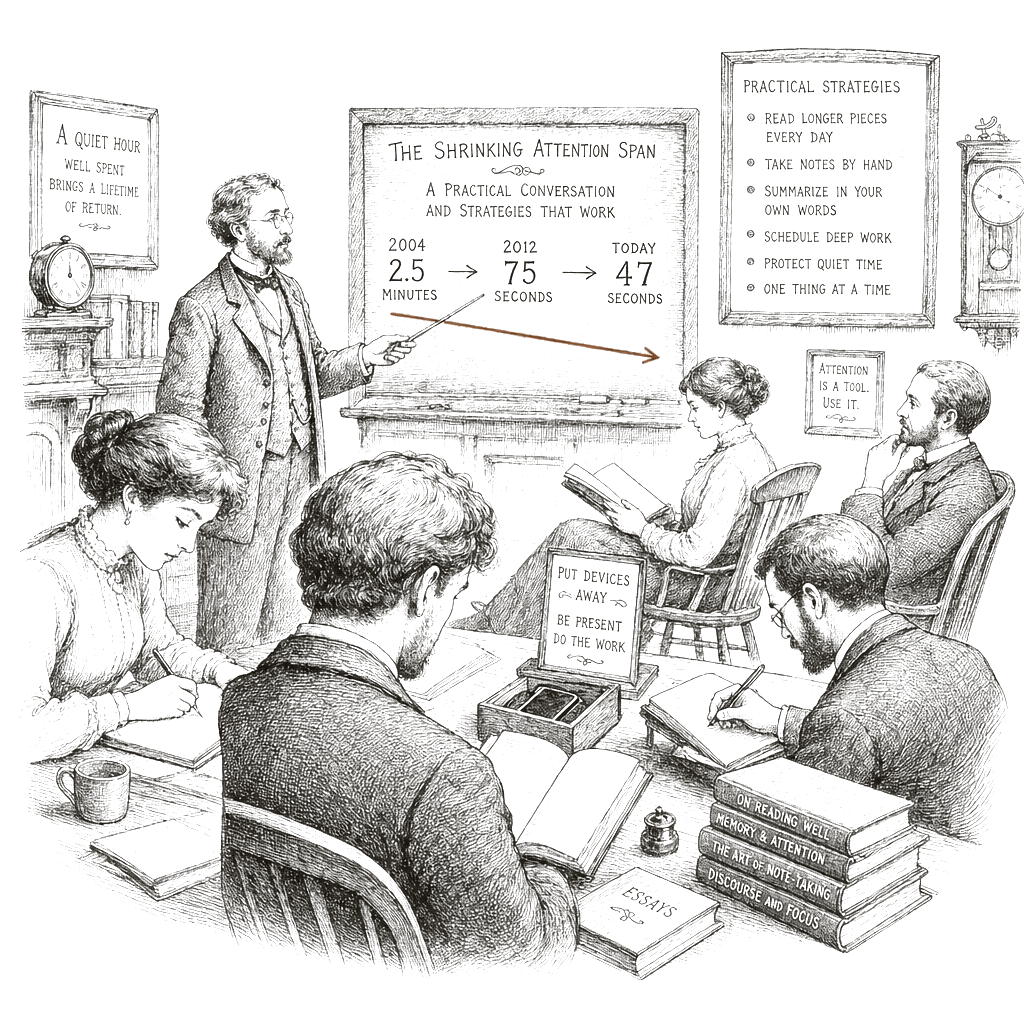
The average person’s attention span when viewing a single screen has fallen to 47 seconds, down from 2.5 minutes in 2004, according to decades of research. Psychiatrists and cognitive scientists say the decline is driven by constant notifications, 24/7 news cycles, and the deliberate design of social media platforms — but also that it can be reversed through intentional practice.
As digital technology competes relentlessly for human attention, researchers increasingly emphasize that the erosion of focus is not inevitable. Attention functions “in many ways similar to a muscle,” experts say, and can be rebuilt through deliberate strategies, from structured work periods to careful phone management.
How we lost focus
Shifting attention is an evolutionary feature, not a failure. Human brains are hardwired to quickly filter information and focus on potential threats or environmental changes. But what captures that attention has shifted dramatically. Where ancestors faced rustling bushes signaling danger, modern attention navigates constant notifications, 24/7 news cycles, and platforms engineered to hold focus as long as possible.
“When my patients talk to me about this stuff there is often a feeling of helplessness or powerlessness,” said Dr. Michael Ziffra, a psychiatrist at Northwestern Medicine. “But you can change these behaviors. You can improve your attention span.”
The COVID-19 pandemic accelerated the shift. Stacey Nye, a clinical psychologist at the University of Wisconsin-Milwaukee, noted that the pandemic warped many people’s sense of time and increased screen usage to unprecedented levels. “Our attention span has really been trained to only focus in those little, small blips and it interrupts our natural focus cycles,” Nye said.
Take active breaks without a phone
Experts recommend “active” breaks — roughly 30 minutes of structured disconnection — as among the most effective tools for retraining attention. These breaks can be as simple as a walk with attention to surroundings or moving to another room for a meal. The key distinction is that the activity must be physical or mental, not passive phone-scrolling.
The reason is direct: when the brain seeks stimulation, it reaches for the nearest source. Smartphones, in Cindy Lustig’s phrase, function as “ever-producing change machines” designed to satisfy that need.
Lustig, a cognitive neuroscientist at the University of Michigan, recommends disabling unnecessary notifications and using “do not disturb” mode, particularly before sleep. “Better yet, put your phone in a whole different room,” she said.
For inspiration, try creating a list of alternative activities — craft projects, brief meditation, preparing a simple meal, or outdoor time. The variety matters less than the consistency.
Work on one thing at a time
Multitasking, despite creating a feeling of productivity, undermines focus. “Be a single tasker,” Nye said. “Work on one thing at a time, for a specified period of time and begin to work your way up.”
Lustig advocates for the Pomodoro technique: a timer-based method in which you work on a single task for 25 or 30 minutes, then take a five-minute break. The psychological reframe — telling yourself “I can do anything for this amount of time” — shifts how the task feels. The world, Lustig notes, “will still be waiting for you at the end.”
Choose hobbies with deliberate practice
Simply having a hobby is insufficient. More effective hobbies incorporate deliberate practice and a specific goal — playing guitar for an audience, improving in a sport, or completing a challenging project.
And start with something you actually want to do. “You don’t want to start with the heavy nonfiction or like ‘War and Peace,’” Lustig said. “If you need to start with the romance novel, then start with the romance novel. You can work your way up.”
Experts emphasize self-compassion. Everyone experiences fluctuations in focus, and attention needs vary by person and task.
Attention builds like a muscle
The foundational insight from neuroscientists is that attention capacity is not fixed. “It is in many ways similar to a muscle in the sense that we can build it up with practice and exercises,” Ziffra said. “Conversely, it can weaken if we’re not exercising it.”
The starting point is intention. Rebuilding attention requires no special equipment or conditions — only deliberate commitment to changing the habits that fragment it.