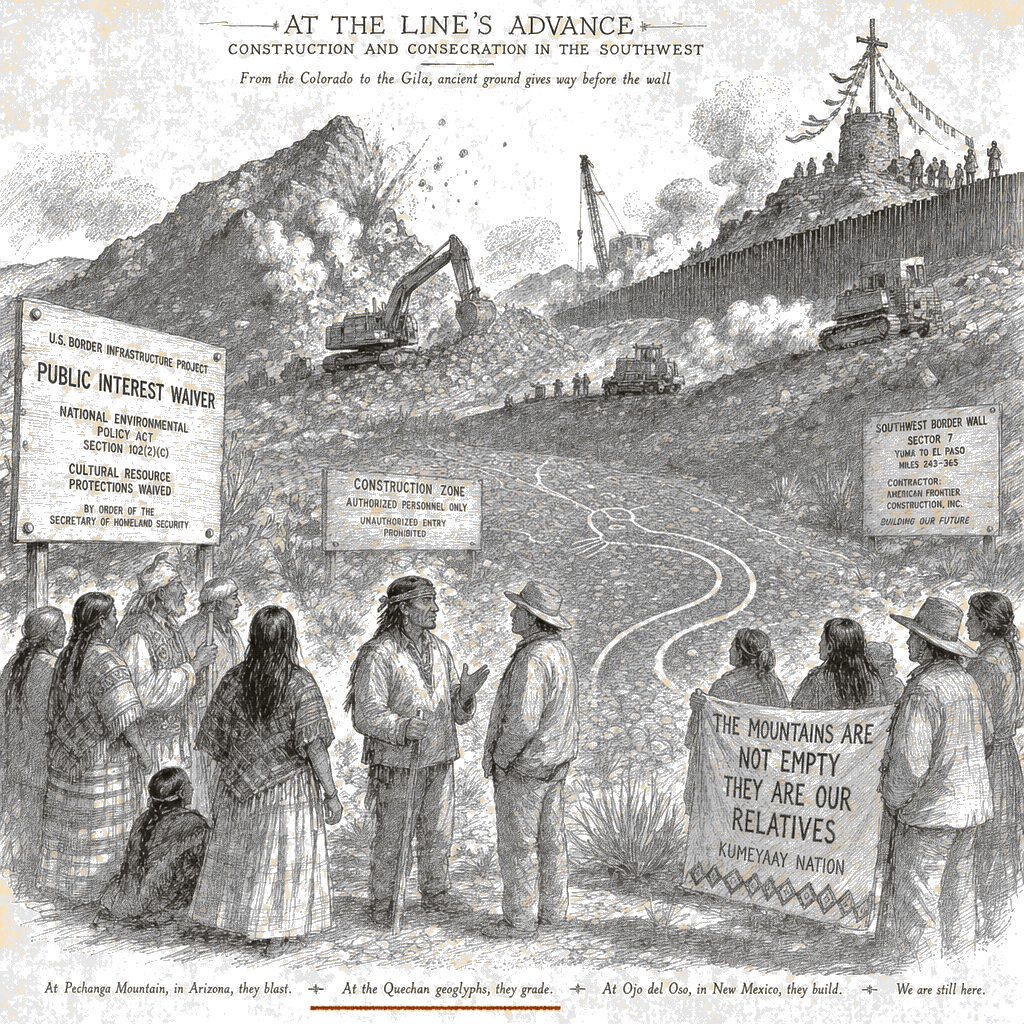
TECATE, Mexico — White sage smoldered as Norma Meza Calles, a Kumeyaay Nation tribal leader, led guests at a Mexican wellness resort into a semicircle facing Kuuchamaa Mountain. She asked them to close their eyes and feel its presence. “This is sacred to us like a church for you all,” Meza Calles said. “The mountain is our healer, our psychologist.”
Then she called for a moment of reflection. But the silence was broken by the crushing of rock. U.S. federal contractors have been blasting and bulldozing Kuuchamaa, which straddles the U.S.-Mexico border, to make way for new sections of border wall.
“We feel that in our DNA,” said Emily Burgueno, a California Kumeyaay member and chair of the Kumeyaay Diegueño Land Conservancy. In the Kumeyaay language, she noted, the same word means “body” and “land.”
The destruction on Kuuchamaa is one of several incidents in which barrier construction has damaged or threatened Native American sacred places and cultural sites at an unprecedented pace, according to Indigenous leaders and government records. The Trump administration has ramped up wall construction even as illegal crossings have fallen to historic lows, and the Department of Homeland Security has waived cultural and environmental laws to expedite the work.
In Arizona last month, DHS contractors carved through a massive 1,000-year-old fish-shaped geoglyph known as “Las Playas Intaglio.” The rare desert drawing, etched into a lava field on the Cabeza Prieta National Wildlife Refuge, was on ancestral land of the Tohono O’odham Nation, which said it had pointed out the site for contractors to avoid.
“This was a devastating and entirely avoidable loss,” Tohono O’odham Chairman Verlon Jose said in an April 30 statement. “There is nothing more important than our history, which is what makes us who we are as O’odham. The site was also an irreplaceable piece of the United States’ history, one none of us can ever get back.”
U.S. Customs and Border Protection said a contractor “inadvertently disturbed” the site near Ajo, Arizona, on April 23, but that it would protect the remaining portion. CBP Commissioner Rodney Scott is talking with tribal leaders to determine next steps.
Members of the Inter-Tribal Association of Arizona, representing 21 tribes, traveled to Washington last month to lobby against a 20-foot secondary wall being built along that section of the border, as well as a primary 30-foot bollard wall planned on Tohono O’odham tribal lands. They met with Homeland Security Secretary Markwayne Mullin, a member of the Cherokee Nation, who listened but made clear his intent is to build more border walls as fast as possible, the Tohono O’odham Nation said.
In Sunland Park, New Mexico, crews this year set off blasts on Mount Cristo Rey, a pilgrimage site topped with a limestone crucifix. CBP is seeking to seize part of the mountain, which is owned by the Roman Catholic Church, for wall construction. The Diocese of Las Cruces asked a judge this month to block the land transfer as an affront to religious liberty.
The Trump administration wants walls to cover at least 1,400 miles of the border and has devoted over $46 billion to the effort. CBP has awarded contracts or begun construction on more than 600 miles of new wall, with companion surveillance technology. A double wall is planned or under construction along another 370 miles, including in Arizona’s Patagonia Mountains, where a wildlife corridor for endangered ocelots and jaguars could be blocked. Jaguars have long been considered “spiritual guardians” by the Tohono O’odham, according to a 2025 tribal lawsuit that unsuccessfully challenged the DHS waivers.
CBP says it recognizes the importance of natural and cultural resources and is working to minimize construction’s impact, including leaving drainage gates open in wildlife corridors. The agency also notes that illegal crossings have polluted and trampled sensitive habitat and says 535 miles of remote border terrain will rely solely on detection technology — an approach many tribes would prefer to walls.
Desecrating a sacred Native American site on U.S. federal or tribal land is a felony. In 1992, the National Park Service listed Kuuchamaa Mountain, also called Tecate Peak, in the National Register of Historic Places, noting that “discarding or disturbing the mountain’s natural state would be sacrilegious.” Tribal members have met with DHS officials about protecting the mountain and are considering legal action.
“No one ever consented or supported the use of dynamite on the mountain,” Burgueno said.
Meza Calles, who leads walks at Rancho La Puerta to teach resort guests about Kuuchamaa, said the mountain traditionally hosted coming-of-age ceremonies and remains a source of strength for people suffering hardship. “It’s sad they are ruining the mountain,” she said. “We’ll see how far they go. Destiny is destiny. But the fight is not over.”