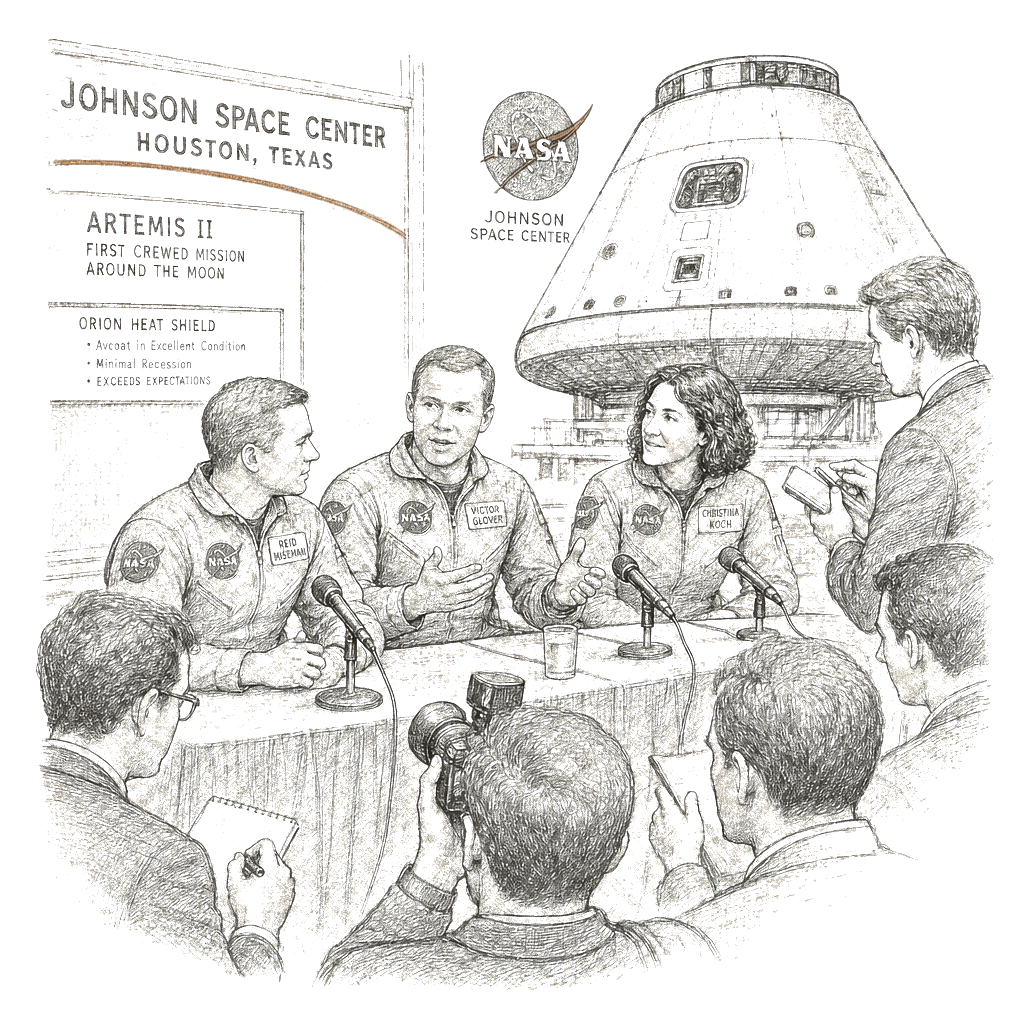
The Artemis II astronauts praised their spacecraft’s performance Thursday while discussing their historic lunar mission at NASA’s Johnson Space Center in Houston. Commander Reid Wiseman, Pilot Victor Glover, Christina Koch, and Canada’s Jeremy Hansen—the first humans to travel to the moon in more than half a century—made the remarks in their first news conference since returning to Earth.
The crew traveled 252,000 miles during their nearly 10-day expedition, breaking Apollo 13’s record as the most distant travelers ever. Their mission puts NASA in a stronger position for a crewed lunar landing within two years and an eventual permanent moon base.
The successful performance of Artemis II’s heat shield during reentry—where the capsule plunged through the atmosphere at 39 times the speed of sound—addresses a critical technical hurdle that delayed the previous uncrewed test flight. The mission demonstrates NASA’s readiness to advance its lunar exploration program.
The Artemis II astronauts returned to widespread acclaim for their moonship, especially its heat shield, which performed far better than engineers expected during their most dangerous moment—hurtling back to Earth at 39 times the speed of sound.
“For four humans just looking at the heat shield, it looked wonderful to us,” Commander Reid Wiseman said Thursday at the news conference held at NASA’s Johnson Space Center in Houston. “It looked great, and that ride in was really amazing.”
Wiseman and Pilot Victor Glover spotted only minimal charred material loss on the heat shield’s shoulder, where it meets the Orion capsule they named Integrity. The absence of major damage marks a sharp departure from Artemis I, the uncrewed test flight in 2022, which returned so scarred and pockmarked that it delayed the entire program. This time, NASA had changed the capsule’s reentry path to minimize heating rather than redesign the shield itself.
Wiseman cautioned that the initial observations are only the start. “We are going to fine-tooth comb every single, not even every molecule, probably every atom on this heat shield,” he said. Detailed engineering analysis will continue in the coming weeks.
A Historic Journey
The successful heat shield performance represents a technical milestone for NASA’s lunar ambitions. The four astronauts—Wiseman, Glover, Christina Koch, and Jeremy Hansen of Canada—spent nearly 10 days in space, traveling 252,000 miles to become the most distant humans ever to travel, surpassing Apollo 13’s record. They launched April 1 on humanity’s first return to lunar exploration in more than half a century.
The crew described the journey in vivid terms. Wiseman recalled seeing the lunar far side, illuminated features that no human eyes had witnessed before, and a total lunar eclipse from space.
“Being 252,000 miles away from home was the most majestic, gorgeous thing that human eyes will ever witness,” Wiseman said in an interview with the Associated Press. Yet the return proved harrowing. “That is scary and that is risky,” he said of reentry. During the parachute deployment just before splashdown into the Pacific on April 11, Glover described the sensation as “like diving backward off a skyscraper” for five seconds. “It was glorious” once the parachutes stabilized the capsule, he said.
Since returning, the astronauts have undergone extensive medical evaluations. NASA placed them in spacewalking suits and subjected them to exercises simulating the moon’s one-sixth gravity to measure what endurance and dexterity future moonwalkers might possess.
Path to Lunar Landing
The successful mission advances NASA’s timeline for landing humans on the moon. The crew said their flight puts the agency “in a much better position for a moon landing by a crew in two years.” NASA is developing Artemis III, which will remain in orbit around Earth as astronauts practice docking their Orion capsule with lunar landers being developed by SpaceX and Blue Origin.
Artemis IV, scheduled for 2028 under NASA’s latest timeline, will see two astronauts land near the moon’s south pole, marking a shift from Apollo-era practice. During the original moon missions, astronauts kept visits brief. Twelve explorers touched the lunar surface between 1969 and 1972. This time, NASA aims for sustained presence.
Jeremy Hansen struck a note of realism about the challenges ahead. “We’re not going to be able to pound everything flat before we go. We’re going to have to trust each other,” he said. The journey demonstrated the volatility of spaceflight. “It was also very clear to us that it can get pretty bumpy. Future crews will have to understand it can get real bumpy real fast.”
Human review: not triggered. License: CC0.