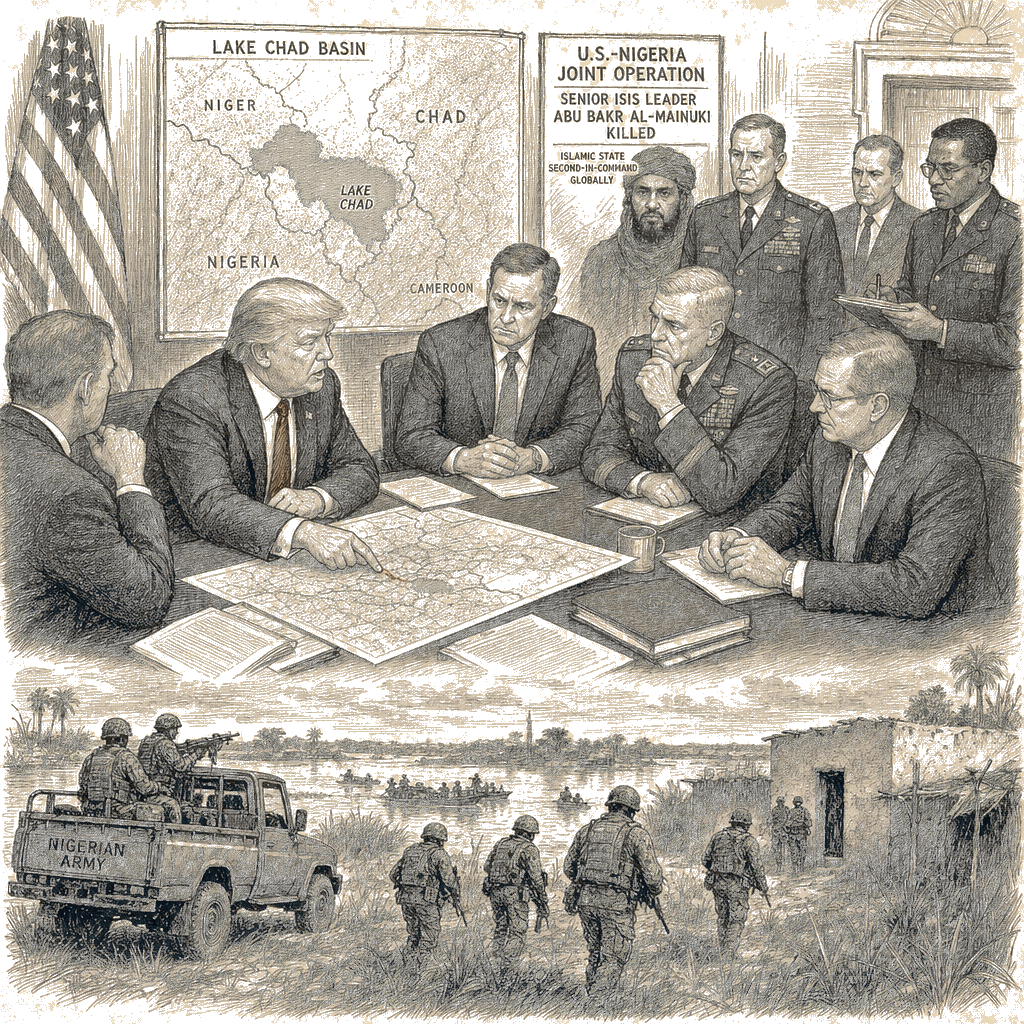
President Donald Trump announced in a late-night social media post that a joint U.S.-Nigerian military operation had killed Abu Bakr al-Mainuki, a leader of the Islamic State group in West Africa. Trump said the Friday mission eliminated the terrorist group’s second-in-command globally, a claim that some analysts later questioned as unverified and potentially overstated.
Nigerian President Bola Tinubu confirmed the killing, stating that al-Mainuki was killed alongside “several of his lieutenants” when forces struck his compound in the Lake Chad Basin. The U.S. military released footage Saturday that it said showed the airstrikes targeting the Islamic State group in Nigeria.
Sani Uba, spokesperson for the Nigerian military task force that conducted the operation, described it as a “highly complex precision air-land operation” carried out over three hours of darkness without casualties. “His elimination represents the single most consequential counterterrorism outcome” in the region since the task force’s inception in 2015, Uba said.
U.S. Secretary of Defense Pete Hegseth echoed the claim that al-Mainuki was the senior ISIS General Directorate of Provinces Emir, “the number two for ISIS globally — responsible for overseeing the planning of attacks, directing the hostage-taking and managing financial operations.” An anonymous U.S. official, speaking on condition they not be named, said al-Mainuki was a key figure in IS organizing and finance and had been plotting attacks against the United States and its interests.
Independent analysts urged caution about the leader’s exact position. Malik Samuel, a senior researcher at Good Governance Africa who studies insurgent groups in Nigeria, said that if confirmed, the killing would be “huge” because it would be the first time a security agency has killed someone that high in ISWAP’s hierarchy. “The potential to cause chaos within the group is also there because the operation must have been carried out in the heart of ISWAP’s fortified base, which is very difficult to access,” Samuel said.
Al-Mainuki, born in Nigeria’s Borno province in 1982, took over the IS branch in West Africa after his predecessor was killed in 2018, according to the Counter Extremism Project. He was based in the Sahel and was sanctioned by the U.S. in 2023. He was regarded as the deputy to Abu Musab al-Barnawi, the former ISWAP leader reported dead in 2021, and as a central figure in the group’s split from Boko Haram.
The operation follows a series of escalating U.S.-Nigerian military engagements since the two nations launched a new security partnership last year. That partnership was forged after Trump claimed Christians were being targeted in Nigeria’s multifaceted security crisis and threatened military intervention. The U.S. sent advisory troops in February and deployed drones in March. The Friday night operation is the latest in a string of covert missions abroad that Trump has announced this year, including the January raid that captured Venezuelan leader Nicolás Maduro and the subsequent launch of strikes against Iran.
United Nations experts, in their most recent report, said the Islamic State group had intensified efforts in West Africa, citing more than 500 attacks between January and October of last year. The region’s IS affiliates have emerged as some of the continent’s most active militant groups since the collapse of the group’s self-declared caliphate in Syria and Iraq.