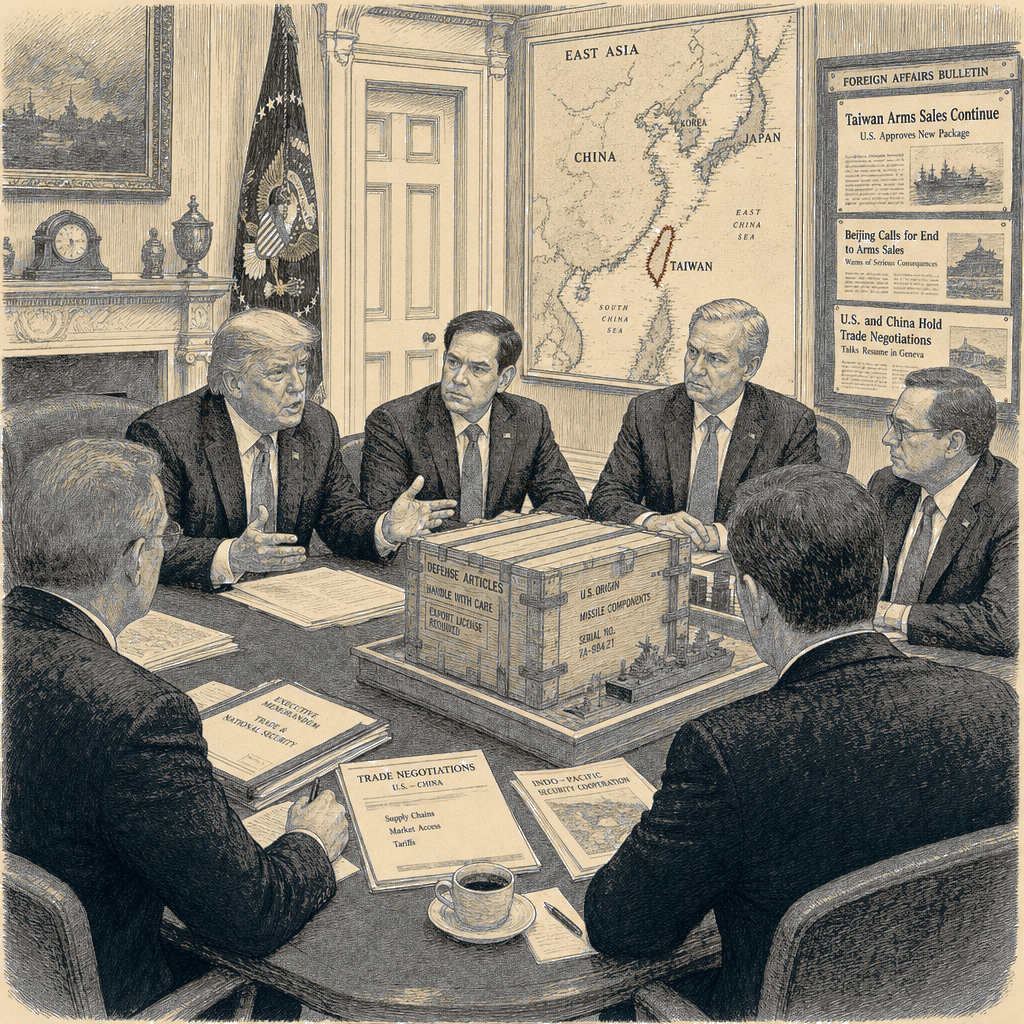
President Donald Trump said Friday that arms sales to Taiwan are a “very good negotiating chip” with China, leaving a $14 billion weapons package in limbo and raising alarms on the island, the Associated Press reported.
The comments came in a Fox News interview with Bret Baier that aired just after Trump concluded a high-stakes summit with Chinese President Xi Jinping. Asked whether he would approve the long-delayed $14 billion arms package to Taiwan, Trump said the decision is now tied to Washington’s dealings with Beijing. “I’m holding that in abeyance and it depends on China,” Trump said. “It’s a very good negotiating chip for us, frankly. It’s a lot of weapons.”
The statement marks a sharp break from the United States’ longstanding stance, which binds it by law to provide Taiwan with the means to defend itself and treats any threat to the island as a “matter of grave concern.” William Yang, a Northeast Asia senior analyst for International Crisis Group, said Trump’s posture feeds into one of the island’s worst fears: that Taiwan will be left out of the room. “Instead of being at the negotiating table, Taiwan is on the menu,” Yang said.
Trump did not specify what concessions he would seek from China in exchange for withholding the weapons, but he has pressed Beijing to buy more American goods and to help pressure Iran. An $11 billion arms package approved by Congress in December drew a furious response from Beijing, which then staged live-fire drills around Taiwan.
In the same interview, Trump called on Taiwan’s microchip producers — who make more than 90% of the world’s most advanced semiconductors — to move their operations to the United States. “I’d like to see everybody making chips over in Taiwan come into America,” he said. Taiwan’s flagship chipmaker, TSMC, has already committed $165 billion to an Arizona mega-campus, and the island’s government pledged $250 billion in U.S. microchip investment earlier this year under a broad trade agreement. Trump also revived a claim that Taiwan “stole” its chip industry from the U.S. decades ago.
Xi, during the summit, delivered one of his strongest warnings yet to Trump, telling him that failure to handle the Taiwan issue properly could lead to “clashes and even conflicts.” The exchange came days before Russian President Vladimir Putin is scheduled to visit Beijing.
Taiwan’s presidential office sought to steady nerves on Saturday, saying “the consistent U.S. policy and position toward Taiwan remain unchanged.” Spokesperson Karen Kuo called Taiwan a sovereign, independent, democratic country and stressed that U.S. arms sales remain mandated by American law.
Trump also appeared to echo Beijing’s narrative about Taiwan’s current president, Lai Ching-te. China brands Lai a “Taiwan independence diehard” and warns he is courting war. In the Fox interview, Trump said he did not want to see a change in the status quo but added, “They have somebody there now that wants to go independent,” suggesting Lai is pushing independence to draw the United States into conflict. “They’re going independent because they want to get into a war and they figure they have the United States behind them,” Trump said.
Wen-Ti Sung, a fellow with the Atlantic Council, characterized Trump’s remarks as “his transactional rhetoric being turned up to the max,” while adding, “What matters more is the substance, which Taiwan is holding its collective breath for.”