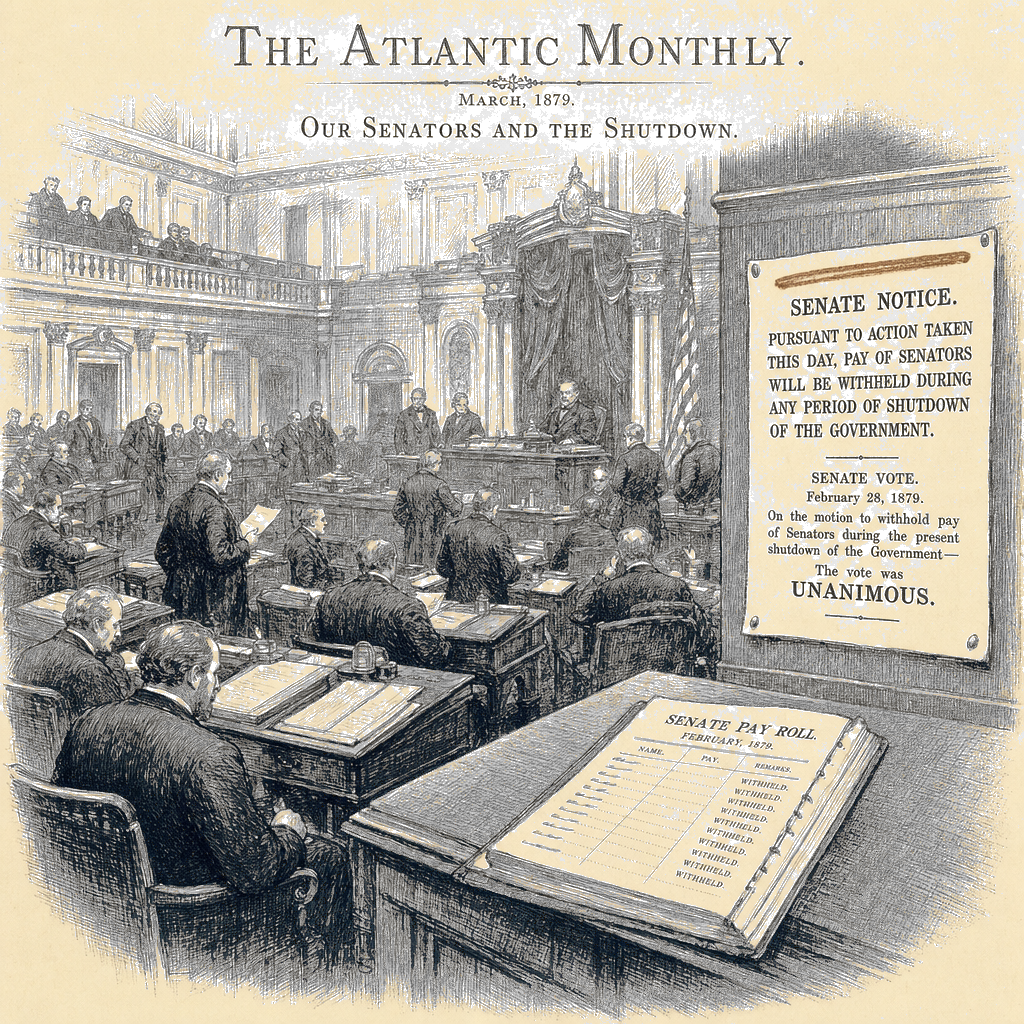
WASHINGTON — The Senate on Thursday voted unanimously to withhold senators’ pay during government shutdowns, an attempt to impose financial consequences on lawmakers after a year in which federal funding lapses broke duration records and left federal workers in financial distress.
The resolution, sponsored by Sen. John Kennedy, a Louisiana Republican, directs the secretary of the Senate to withhold members’ pay whenever a shutdown affects one or more federal agencies and to release the funds only once full government funding is restored. The measure will take effect the day after the Nov. 3 general election.
“Shutting down government should not be our default solution to our refusal to work out our issues and our differences,” Kennedy said in a floor speech Wednesday. “This is about putting our money where our mouth is.”
Two shutdowns since late 2025 have placed acute financial strain on the federal workforce. A 43-day lapse of the entire federal government began in October amid a dispute over health care subsidies. Months later, the Department of Homeland Security endured a 76-day partial shutdown — the longest agency funding lapse in U.S. history — before reopening last month. Throughout both closures, members of Congress continued to receive their salaries because the Constitution requires that lawmakers be compensated for their service.
The constitutional guarantee has frustrated lawmakers who argue that elected officials should not be insulated from the consequences of their own legislative failures. Sen. Lindsey Graham, a South Carolina Republican, proposed a constitutional amendment during the October shutdown to require members to forfeit their paychecks when the government closes. “If members of Congress had to forfeit their pay during government shutdowns, there would be fewer shutdowns and they would end quicker,” Graham said at the time.
Graham acknowledged that his proposal was the most “constitutionally sound” approach, but the amendment process — requiring ratification by 38 states — would have been far more laborious than the Senate resolution. Lawmakers in prior shutdowns have sometimes pledged to forgo their paychecks voluntarily, though such pledges carry no enforcement mechanism. Senators earn an annual salary of $174,000, but many are independently wealthy, blunting the practical force of any voluntary gesture.
Kennedy told reporters Wednesday that his resolution ensures “shared sacrifice” during shutdowns, adding that the measure does not go as far as he would like but represents a starting point.
The resolution’s scope is limited to the Senate, a constraint Kennedy attributed to chamber tensions when asked why it does not extend to the House. “The House’s business is the House’s business,” he said, while acknowledging friction between the two chambers. “There’s a very strong undercurrent of animosity among some of my friends in the House,” Kennedy said. “It’s quickly becoming like two kids fighting in the back of a minivan.”
The unanimous vote reflects bipartisan frustration with the recent pattern of shutdowns, which have grown longer and more frequent as congressional negotiators have repeatedly failed to reach funding agreements before deadlines. Federal workers and contractors bore the immediate costs of those failures, facing missed paychecks, furloughs, and uncertainty that rippled through local economies in regions with high concentrations of federal employment. The Senate resolution, by attaching a direct financial stake to lawmakers’ own pay, aims to alter the incentive structure that has made shutdowns a recurring feature of federal budget politics.