Back behind the bar at Pearl & Peril in downtown Raleigh, 30-year-old bartender Evan Duke considered the financial trade-offs defining the current economic landscape. He appreciates the ability to earn hundreds of dollars on a busy night without paying federal income tax on those tips, but he cannot afford private health insurance and worries about how mounting costs for rent, food, and fuel are affecting him and his patrons.
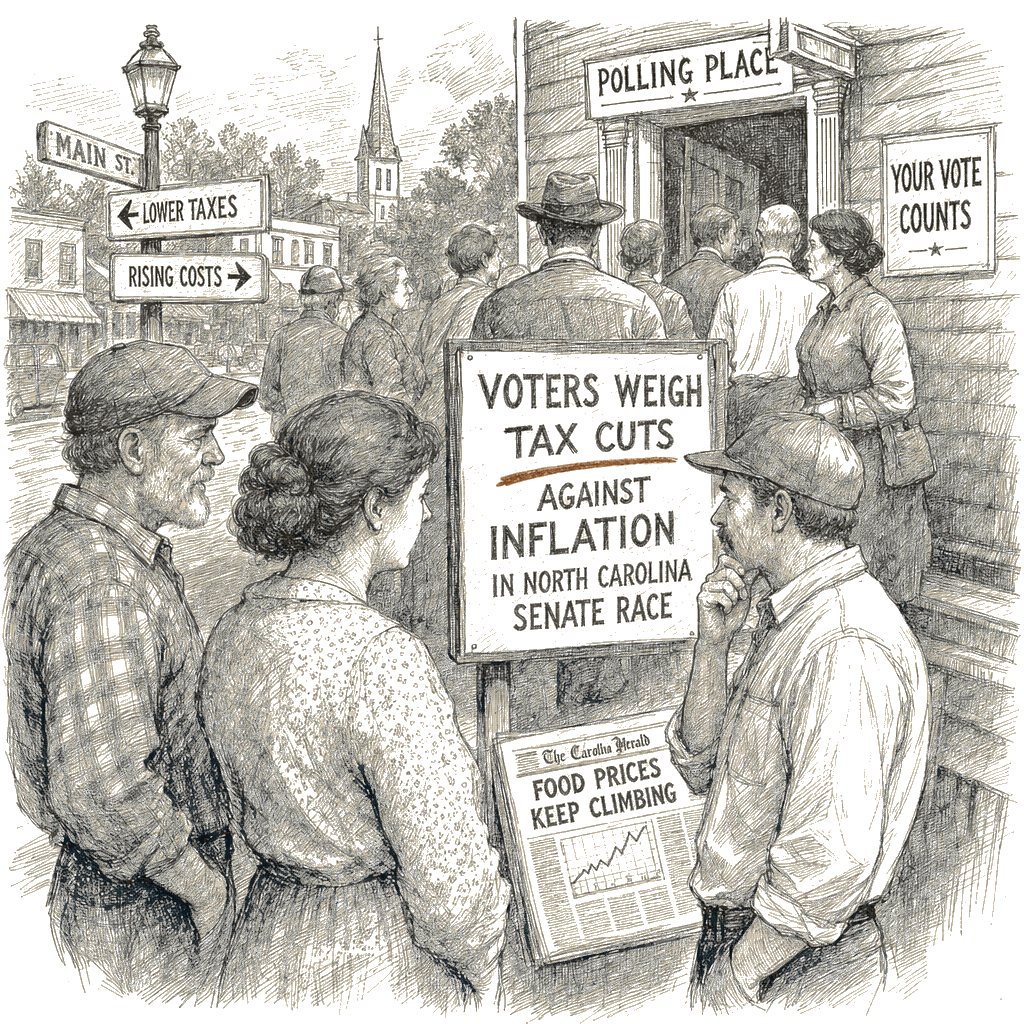
“It’s kind of messy right now,” Duke said. His mixed financial reality mirrors a broader tension shaping the North Carolina U.S. Senate race, where competing narratives about President Donald Trump’s economy have taken center stage.
The dividing line centers on what the administration calls “the one big beautiful bill,” the signature legislation that reduces federal tax rates but also scales back funding for public programs including Medicaid. Republican nominee Michael Whatley, the former national party chairman, has been championing the tax overhaul at campaign stops alongside Vice President JD Vance.
During a late-April appearance in Rocky Mount, Whatley told supporters the midterm elections were about “protecting no tax on tips, no tax on overtime, no tax on Social Security.” Some of the framing stretched the legislation’s actual scope; the bill does not entirely eliminate federal levies on overtime work. Still, the messaging reflects a Republican strategy to brand the overhaul as a working-families tax cut. “I don’t know about you, but I sure trust you to spend your money better than a federal government in D.C.,” Whatley said.
Tracy Brill, 62, a Trump supporter in the Rocky Mount audience, said she was willing to absorb rising costs tied to the war with Iran. “The course he’s taken is spot on,” Brill said, adding that she believes previous administrations failed to address underlying economic vulnerabilities.
Conversely, Democratic nominee Roy Cooper, a former two-term governor, has built his campaign around what he calls an “affordability crisis.” Cooper emphasizes the impact of elevated health care premiums, the Republican refusal to extend expanded Affordable Care Act subsidies, and price hikes on consumer goods linked to Trump’s tariffs. He has also pointed to ripple effects from the Iran war on domestic supply chains, noting how it has driven up costs for fuel, agricultural fertilizer, and groceries.
“It seems like everything that Washington is doing is driving up costs across the board,” Cooper said during a recent stop in Greensboro. Democrats argue that economic dissatisfaction gives them a viable path to flipping Senate seats in North Carolina, Maine, Ohio, and Alaska. North Carolina is a long-standing challenge for Democrats, but party strategists see an opportunity in this cycle: Republican incumbent Thom Tillis is retiring, and Cooper enters the race with a centrist reputation and a record of six statewide victories.
Whatley brings deep ties to Republican circles and extensive fundraising networks as a former lobbyist and party leader, but he remains less familiar to voters outside party circles than his Democratic opponent.
For some voters, the economic pressure has already altered their political calculus. Phyllis Aycock, a 79-year-old antiques store owner in Nash County, is leaning toward Cooper despite voting for Trump three times. She told AP she regrets her most recent presidential vote, citing a trickle-down economic reality that she says is failing working-class residents. Premium hikes on her supplemental Medicare insurance have canceled out Social Security cost-of-living adjustments, effectively neutralizing any tax breaks she has received under the current administration.
“I wonder whether Trump even thinks about the cause-and-effect of what he does or what he doesn’t do, how it directly affects us, and when I say ‘us,’ I definitely mean the middle-class, lower-class working people, the blue collar, the ones that pay the taxes,” Aycock said. She noted that foot traffic and purchases at her store have decreased, and expressed skepticism about Whatley’s background, worrying he is “just a yes man.”
Cooper is also leaning heavily on his record of expanding North Carolina’s Medicaid program during his second gubernatorial term, a policy enacted through a bipartisan compromise with the Republican-run Legislature. The issue resonates with voters like Emily Miller, 43, a Greensboro education consultant and volunteer for Democratic turnout operations.
“Medicaid and the Affordable Care Act absolutely have saved my life,” Miller said. During periods between full-time teaching and consulting work, she relied on the 2010 law’s benefits for inpatient physical and mental health care, coverage her part-time roles could not afford at market rates. She is skeptical that proposed overtime tax exemptions will help workers past their ability to secure hours. “I had an overtime-eligible job, and I had bosses who would send us home before we got those extra hours,” Miller said.
Still, Democrats face the dual task of winning over independents like Duke and energizing apathetic voters who feel disconnected from policy shifts. In rural Bertie County, 60-year-old James Outlaw told reporters he would likely vote but expects little change. “It won’t get no better,” he said at a local convenience store. “Never does.”
Duke said he appreciates the “few thousand dollars” he expects to save from the tax breaks and said he would “at least look at” Whatley’s platform. Yet he keeps the back-of-house restaurant workers in mind, noting they earn no tips and will see no direct benefit from the proposed overtime exemptions. While he does not have health insurance, being healthy and able to pay his current rent means his vote is not guaranteed to Cooper, whom he remembers as “a pretty good governor.”
As Democrats and Republicans mobilize for the November cycle, the administration is urging voters to trust the economic trajectory. Speaking to the crowd in Rocky Mount, Vance insisted the president would not allow the economy to stagnate. “He constantly is pressing on the gas,” Vance said. “He wants us to do more.”