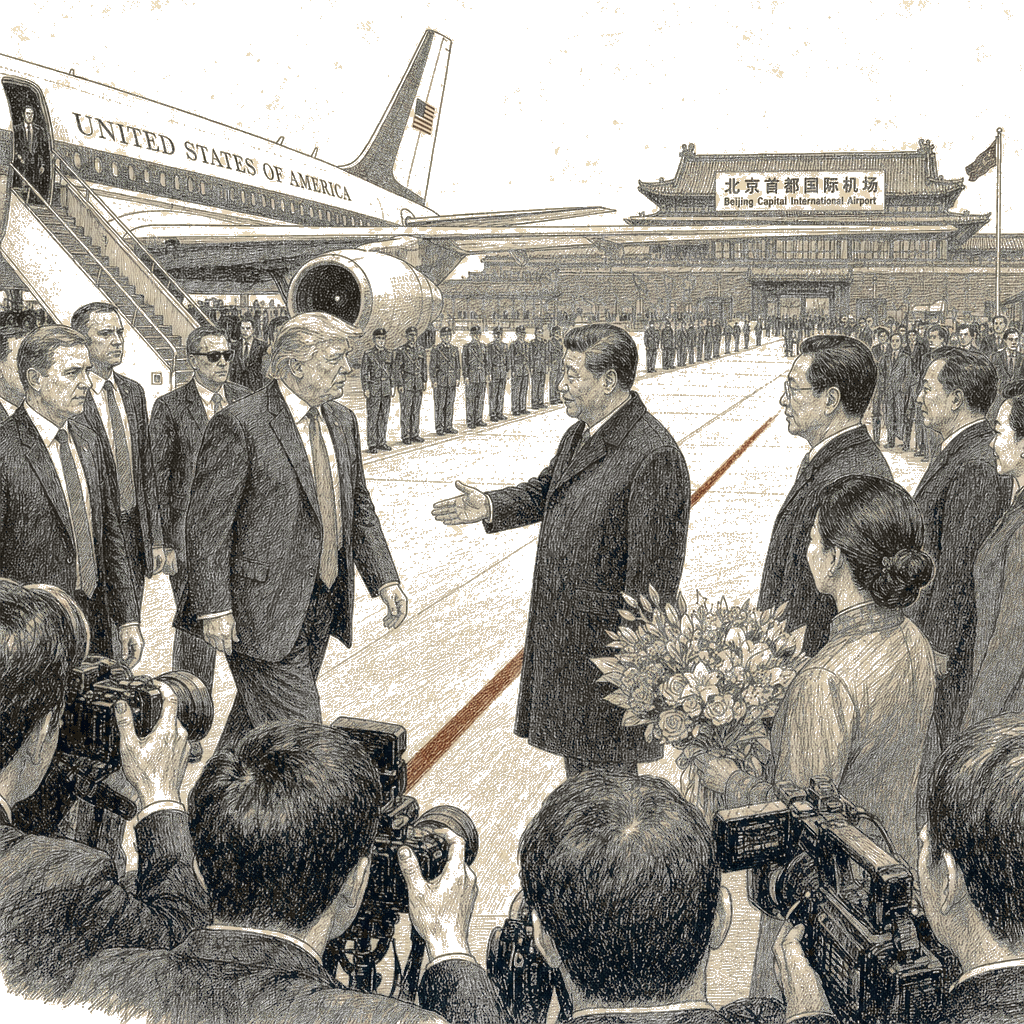
President Donald Trump is set to arrive in Beijing on Wednesday for a one-day summit with Chinese leader Xi Jinping, a highly anticipated meeting at a restless moment for a world grappling with the economic fallout of the Iran war, persistent trade frictions, and the race to govern artificial intelligence. Chinese officials are preparing a welcome ceremony laden with the military honor guards, red-carpet stairways, and 21-gun salutes that Beijing knows appeal to Trump’s well-documented taste for spectacle. But foreign policy experts say the visit will not approach the lavish, multi-day “state visit plus” that Xi mounted during Trump’s first presidential trip in 2017.
“That reflects greater Chinese confidence in their position, greater skepticism of Trump, and the awkwardness of the current relationship,” said Rush Doshi, C.V. Starr senior fellow for Asia studies at the Council on Foreign Relations and a former National Security Council official under President Joe Biden.
The context for the visit is wholly different from 2017. The China-U.S. relationship has shifted from a framework of engagement to one of strategic competition, reaching a low point during the COVID-19 pandemic and successive rounds of trade warfare. The Iran conflict, triggered by U.S. and Israeli strikes on February 28, has further scrambled the geopolitical landscape. The Strait of Hormuz, a critical artery for global energy shipments, remains blocked, roiling markets and amplifying China’s leverage as the world’s largest trading nation. The war also forced Trump to postpone the trip from its initial late-March slot. First lady Melania Trump will not accompany him, in contrast to the 2017 visit.
Danny Russel, a former senior U.S. diplomat, said the schedule has been “compressed to basically one day and stripped down to the basics.” Still, Russel expects China to “roll out the red carpet” because Beijing views protocol as a diplomatic tool, and Trump’s responsiveness to flattery is widely understood in foreign capitals.
“It’s no secret to any government that President Trump responds positively to flattery and spectacle,” Russel said. “The pomp and pageantry is designed both to flatter Trump and to pacify him, making him more amenable to Chinese asks and reducing the risk of an embarrassing public confrontation.”
The most carefully arranged moment of the trip will unfold at the Temple of Heaven, a former imperial site in central Beijing. Xi plans to accompany Trump on a tour of the World Heritage landmark, including the Hall of Prayer for Good Harvests, an iconic circular building with a triple-gabled roof of blue tiles that served as the stage for imperial prayer ceremonies. The White House confirmed the outing. Park management said the entire complex would be closed to the public on Wednesday and Thursday, while the main attractions were closed on Tuesday for what it described as “the maintenance of ancient architecture.”
Those closures are unusual. The park remained open during recent visits by the prime ministers of Britain and Spain, who toured other Beijing landmarks without Xi as their guide.
During Trump’s first trip, Xi and his wife Peng Liyuan hosted the president and then-first lady Melania Trump for tea, dinner, and a traditional opera performance at the Palace Museum inside the Forbidden City — the first foreign leader to dine there in modern memory. The welcome ceremony the next day featured a military band playing “The Stars and Stripes Forever,” an unusual selection intended to impress the American visitor. Trump still refers to the display nearly nine years later.
“You know, last time I went to China, President Xi, he treated me so well, he gave me a display,” Trump said in February. “I never saw so many soldiers, all the same height, exactly the same height within a quarter of an inch.”
How China treats Trump on this visit will offer clues about the present state of the relationship, Doshi said. In Beijing’s rigidly hierarchical diplomatic culture, the rank of officials who greet a visiting leader, the music played at ceremonies, and the sites chosen for private moments all carry signaling weight.
“China uses diplomatic protocol as a method of signaling favor or disfavor,” Doshi said. “That is why we should pay close attention to how President Trump is received.”