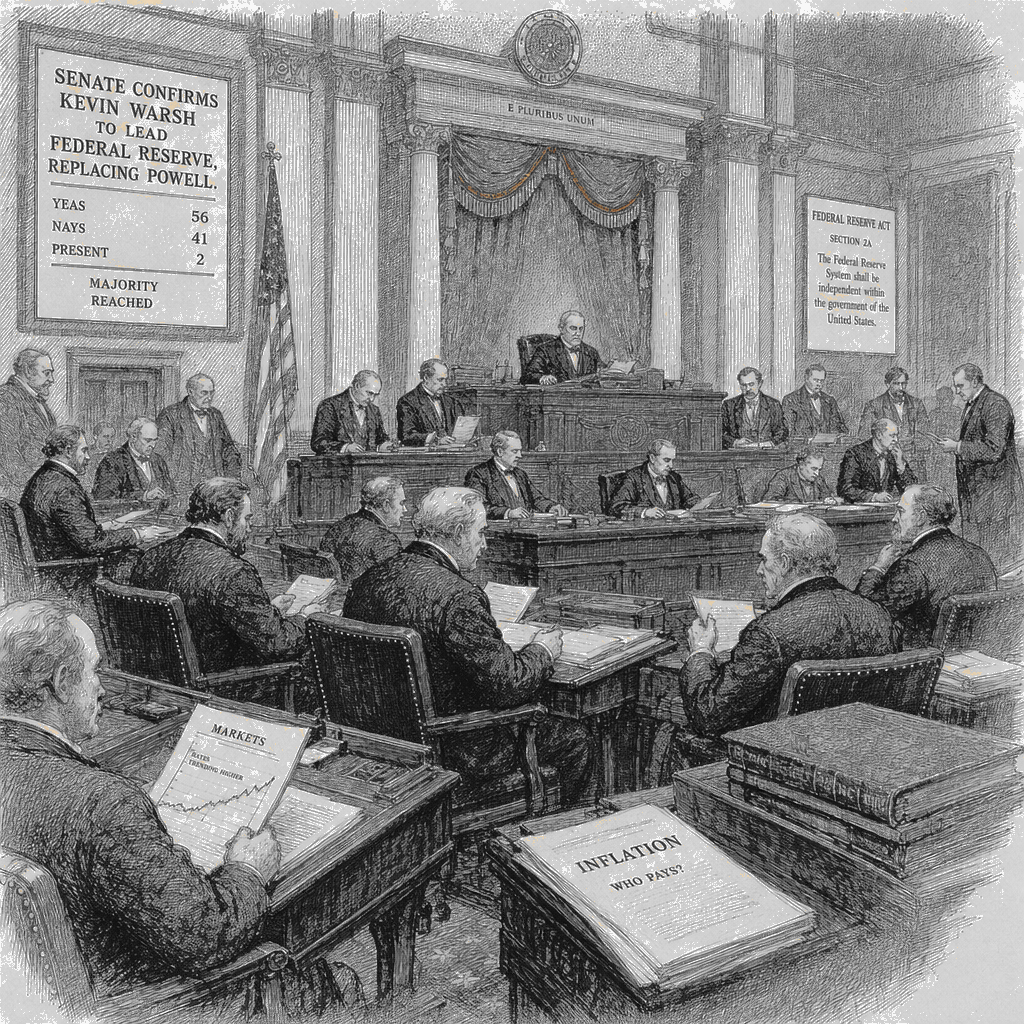
WASHINGTON — The Senate voted 54-45 on Wednesday to confirm Kevin Warsh as the next chair of the Federal Reserve, elevating President Donald Trump’s nominee to the world’s most powerful central bank post as the U.S. economy faces rising inflation, a fractured rate-setting panel, and open questions about the Fed’s independence.
Warsh, 56, a former Fed official who had been sharply critical of the institution’s recent monetary policy, replaces Jerome Powell just days after a meeting in which three committee members objected to language suggesting the central bank would next cut rates. The vote was largely along party lines, with all Republicans plus Democratic Sen. John Fetterman of Pennsylvania supporting the confirmation.
Senate Majority Leader John Thune, R-S.D., said in a floor speech that a Fed chair must “understand not only the macro” but also “appreciate the microeconomy: and that’s the hardworking Americans, their jobs and their livelihoods,” and added, “Kevin Warsh is just such a person.”
Warsh steps into the role with inflation running at 3.8% in April, well above the Fed’s 2% target for five years, fueled by a 50% rise in gasoline prices since the war in Iran disrupted oil shipments through the Strait of Hormuz. The rate-setting Federal Open Market Committee has held its key rate steady for three consecutive meetings as it assesses the price spike. At the latest meeting, three members dissented over the committee’s guidance, which they said implied a rate cut; they preferred more neutral language that would leave a hike on the table. Many Fed watchers saw the dissents as a warning to the incoming chair that lowering borrowing costs will face internal resistance. A fourth member, Trump appointee Stephen Miran, dissented in favor of a cut — as he has at every meeting — but will leave the board when Warsh replaces him.
During his confirmation hearing last month, Warsh denied that Trump had pressured him to reduce the Fed’s benchmark rate, which the president has demanded for months. “I will be an independent actor if confirmed as chair of the Federal Reserve,” Warsh said. Sen. Elizabeth Warren, D-Mass., had derided him as a “sock puppet” for Trump. Trump said on social media in December that he wanted a chair who would cut rates when stock prices rise — the opposite of what orthodox economics would counsel — and added, “Anyone that disagrees with me will never be the Fed chairman!” Kevin Hassett, director of the White House’s National Economic Council, said in a Fox News interview on Sunday that markets are relieved that Warsh “is going to help lower interest rates over time,” calling the approach “data driven” and insisting, “I’m not putting any pressure on Kevin Warsh.”
Warsh drew additional Democratic criticism for refusing to fully disclose his wealth, which is estimated at more than $100 million and includes stakes in Polymarket and SpaceX whose size he has not revealed. He has promised to sell all such holdings within 90 days of being sworn in. Warren said, “He will be the wealthiest Fed chair in history, but he refuses to provide transparency to the American people about who he is entangled with.”
Warsh has also called for restricting the Fed’s communications, a sharp break from decades of greater transparency, arguing that quarterly rate-path projections have made it harder for policymakers to shift course when conditions change. His background as a critic of the central bank’s response to the 2021–22 inflation spike — the worst in four decades — adds to the charged atmosphere.
Meanwhile, Powell said at a news conference on April 29 that he would remain on the Fed’s board as a governor until the Justice Department closes an investigation into a building renovation project. A chair who stays on the board after leaving the top post is a rarity not seen since 1948, and Powell’s extended presence could create a competing power center. U.S. Attorney Jeanine Pirro has dropped the probe but said it could be reopened if the Fed’s inspector general, which has been looking into the renovation since last July, uncovers evidence of criminal activity.