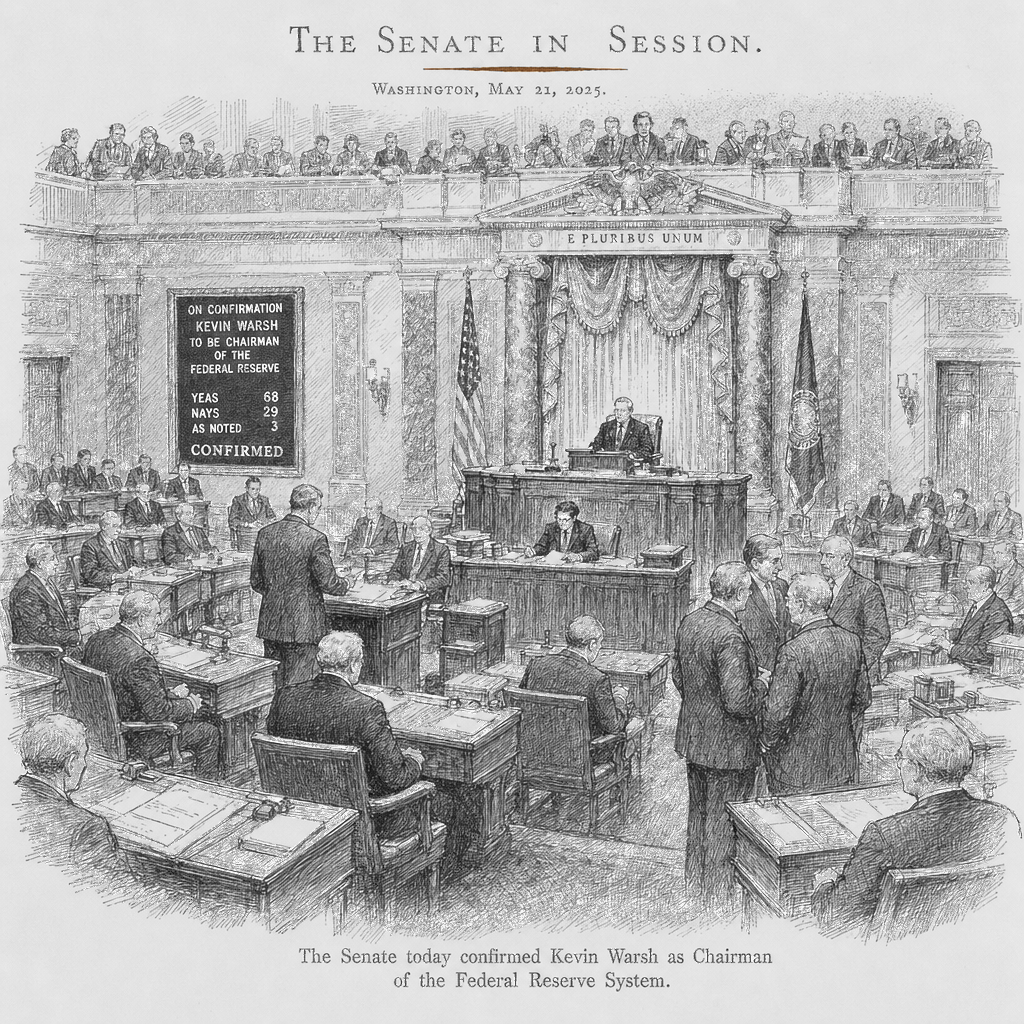
The Senate’s confirmation of Kevin Warsh as chair of the Federal Reserve marks a major leadership shift at a moment when the central bank is contending with persistent inflation and internal disagreements over the next steps for interest rates.
Warsh, 56, was confirmed Wednesday in a largely party-line 54-45 vote, and will replace Jerome Powell as chair of the Federal Reserve, an independent agency. Senate Majority Leader John Thune, R-S.D., said during the floor debate that it was critical that the Fed chair “understand not only the macro” but also “appreciate the microeconomy: and that’s the hardworking Americans, their jobs and their livelihoods,” adding, “Kevin Warsh is just such a person.”
The vote came after a period of heightened political friction around the Fed’s independence. Trump has repeatedly attacked Powell for not cutting interest rates and sought to reshape the Fed’s leadership and membership, including pursuing efforts tied to Gov. Lisa Cook. Trump also launched an investigation into Powell’s Senate testimony about a building renovation, a probe that threatened to delay Warsh’s nomination.
That investigation was dropped in April, clearing a path for the confirmation after Sen. Thom Tillis of North Carolina said he would withhold support until the inquiry ended. Every Republican voted for Warsh on Wednesday, and Democratic Sen. John Fetterman of Pennsylvania also supported the nomination.
Trump’s broader push for change at the Fed has fueled questions about whether Warsh would follow economic conditions in setting policy or instead seek to align with Trump’s stated preferences. Kevin Hassett, director of the White House’s National Economic Council, said in a Fox News interview on Sunday that he expected markets were relieved Warsh “is going to help lower interest rates over time,” saying, “Obviously, data driven,” and, “I’m not putting any pressure on Kevin Warsh.”
At the confirmation hearing last month, Warsh sought to confront those concerns directly. Sen. Elizabeth Warren, D-Mass., derided him as a “sock puppet” for Trump, and Warsh denied at the hearing that Trump had pressured him to reduce the Fed’s key rate, saying, “I will be an independent actor if confirmed as chair of the Federal Reserve.”
Warsh also faces scrutiny from Democrats over transparency and potential conflicts. Senate Democrats condemned him for not fully disclosing details of his wealth, which was described as amounting to at least $100 million. His investments include stakes in Polymarket and SpaceX, and he has promised to sell those assets within 90 days of being sworn in. Warren said, “He will be the wealthiest Fed chair in history, but he refuses to provide transparency to the American people about who he is entangled with.”
Beyond the political and personal questions, Warsh inherits a Fed confronting economic conditions that have challenged policymakers in recent months. Inflation has topped the Fed’s 2% target for five years and is rising faster because of higher gas prices, with inflation reported as reaching 3.8% in April. The Fed is tasked by Congress with keeping prices stable, and typically seeks to cool inflation and growth by raising its short-term rate to make borrowing and spending more expensive.
The Fed’s deliberations have also been marked by unusual internal division. In the most recent meeting described in the reporting, three members of the 12-member rate-setting committee objected to language that suggested its next move would be a rate cut, preferring more neutral wording that would leave room for a hike. Many Fed watchers viewed the dissent as a warning that Warsh may not be able to engineer rate reductions easily. Another committee member, Stephen Miran, dissented in favor of a rate cut at every meeting since Trump appointed him to the Fed’s board last September; Miran’s term ends as Warsh takes his spot.
The transition also reflects how long Powell has remained in place amid the legal and political turmoil. Powell said at a news conference on April 29 that he would remain as a Fed governor until the Justice Department closes its investigation into the Fed’s building project, and his term as a governor lasts until January 2028. ___
As Warsh assumes the chair, the Fed’s policy choices are expected to be shaped by the same pressure points that have defined Powell’s final stretch: inflation that has moved beyond the 2% target, a recent rise in gas prices associated with the war in Iran, and lingering questions about how much influence politics should or could exert over monetary policy.