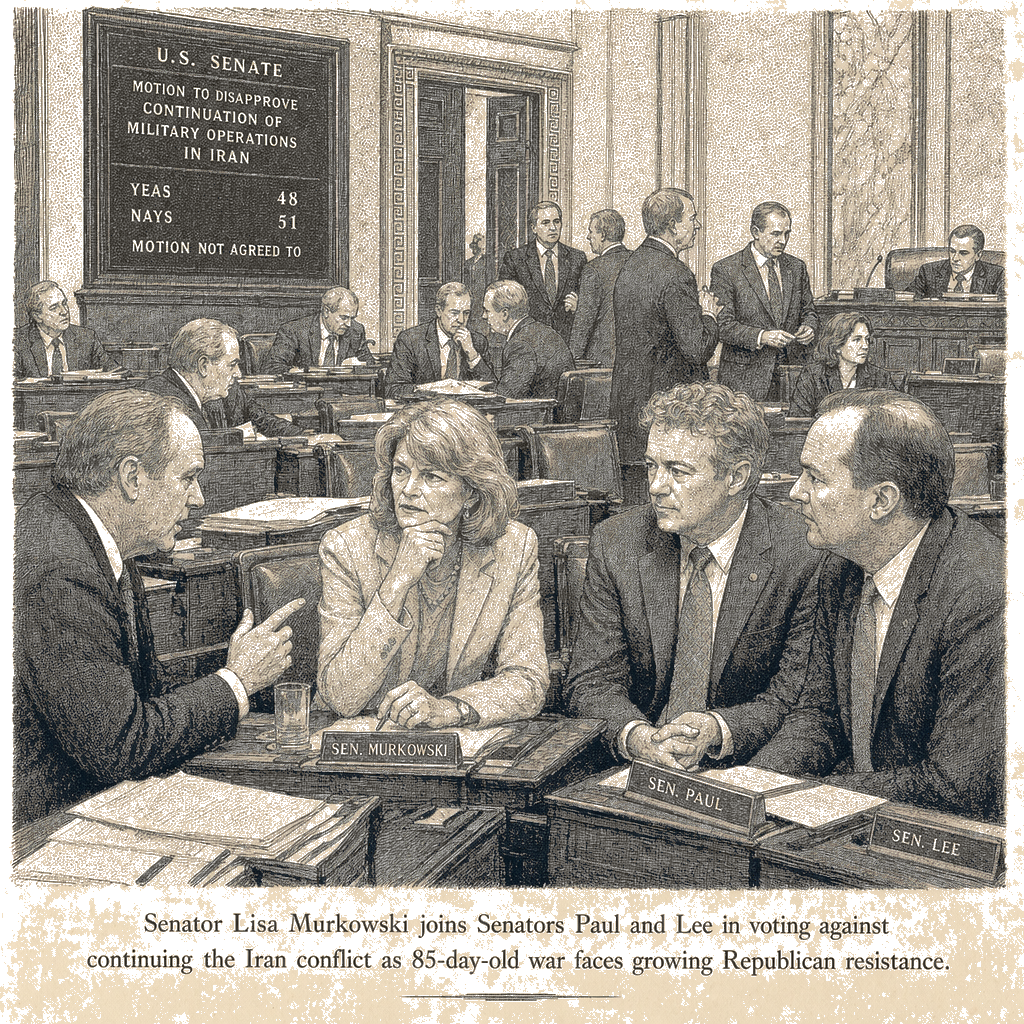
WASHINGTON — Senator Lisa Murkowski of Alaska joined Democrats on Wednesday in voting to halt President Donald Trump’s military campaign against Iran, a sign that Republican support for the three-month-old war is fraying as the administration insists it can continue the fight without congressional approval.
The vote on the war powers resolution, the latest in a weekly series forced by Democrats, failed 49–50. Only one Democrat, Senator John Fetterman of Pennsylvania, opposed the measure. But the partisan tally masked a notable shift: Murkowski voted against the war for the first time since it began in late February, joining Senators Susan Collins of Maine and Rand Paul of Kentucky, who had previously crossed the aisle.
“There will be a day — and it might be soon, I believe — where this Senate will say to the president, ‘Stop this war,’” Senator Tim Kaine of Virginia, the lead Democrat driving the repeated votes, said before the roll call. Kaine has made the war powers resolutions a weekly ritual, part of an effort to build political pressure on the White House even though any measure that passes the Senate would almost certainly die in the House or face a veto.
The White House argues it does not need Congress’s authorization because it considers the conflict with Iran technically over. Administration officials have told lawmakers that the United States is observing a ceasefire and that therefore the War Powers Resolution of 1973 — which generally requires presidents to seek authorization after 60 days of hostilities — no longer applies.
Defense Secretary Pete Hegseth delivered that message directly to Murkowski during a Senate hearing on Tuesday. He said the Trump administration believes it has “all the authorities necessary” to resume strikes without coming back to Congress. Murkowski, visibly skeptical, pointed to the thousands of troops and warships still stationed in the region. “It doesn’t appear that hostilities have ended,” she said.
Republicans leaders continue to back the war. Senator John Barrasso of Wyoming, the No. 2 GOP leader, argued on the Senate floor that the protracted stalemate in the Strait of Hormuz — which has bottled up most commercial oil tanker traffic — is hurting Iran more than the United States. “Iran’s economy is on life support. Its leadership is eliminated,” Barrasso said. He accused Democrats of trying to “pull out the rug from under” Trump just as he arrived in China for a trade summit.
Yet other Republicans are growing restless. With gasoline prices at elevated levels and the November elections approaching, the war’s economic fallout is becoming a political liability. Senator Mike Rounds of South Dakota said he preferred that the two branches negotiate their constitutional responsibilities rather than force a war powers vote or court battle. “We have shared constitutional responsibilities,” Rounds said, suggesting talks could avert a showdown.
Democrats, for their part, say the erosion of GOP support is only beginning. Senator Jeff Merkley of Oregon, who sponsored Wednesday’s resolution, told reporters he detects an “erosion of support, erosion of enthusiasm, an increase in skepticism” about the war from his Republican colleagues.
The administration’s legal rationale — that a self-declared ceasefire ends the 60-day clock while leaving the military able to strike again at any moment — has drawn sharp criticism from constitutional scholars and even some conservatives. Former Trump administration lawyers have warned that the position would effectively nullify the War Powers Resolution.
Still, the path to binding legislation remains steep. Even if a war powers resolution were to clear the Senate, Republican leaders in the House have shown no appetite to take it up, and Trump has promised a veto. The Democrats’ weekly votes are, for now, a messaging exercise — but one that is drawing more Republican support each time.
“There is a growing discomfort,” said Senator Richard Blumenthal, a Connecticut Democrat who is a member of the Armed Services Committee. “The administration is operating in a legal never-never land.”
The next vote is expected as early as next week.