Body
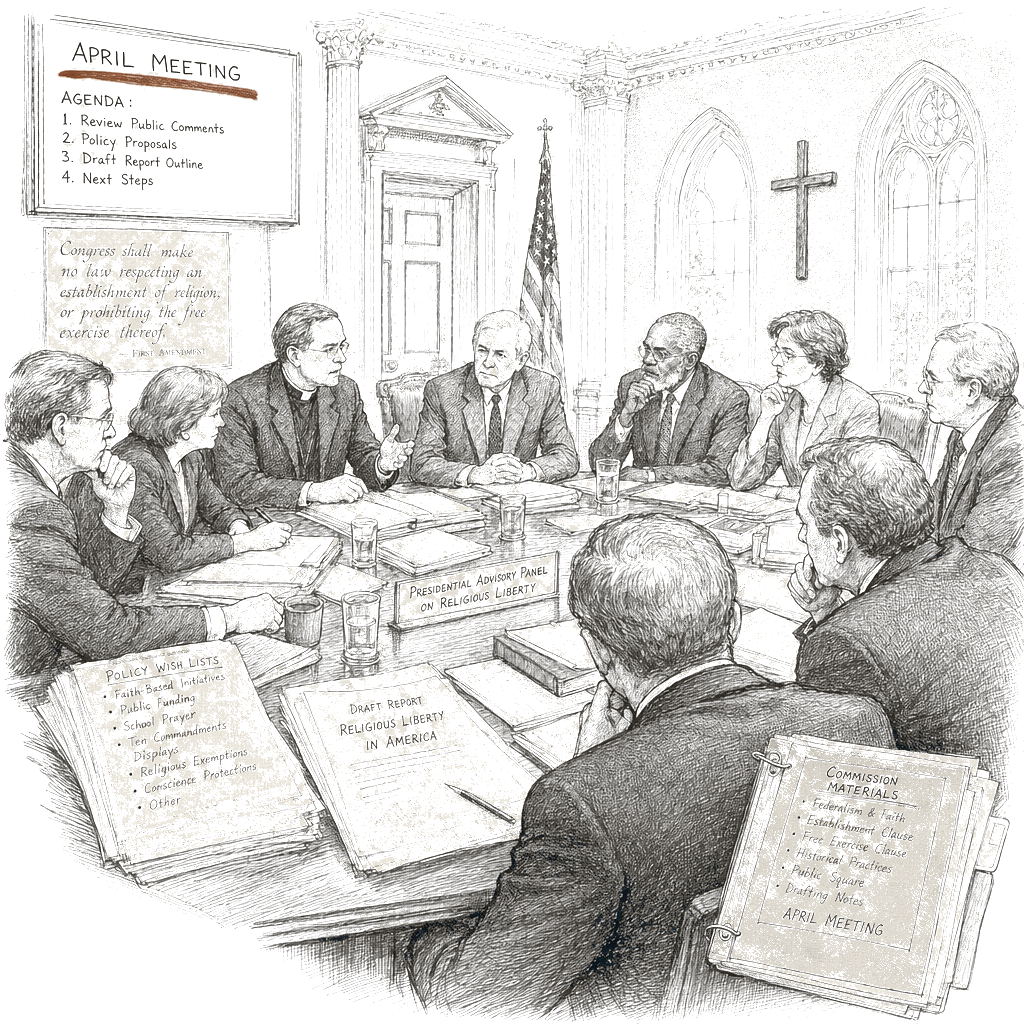
Commissioners on President Donald Trump’s Religious Liberty Commission met in April and described what they want in a final report that remains in the works, with the Associated Press reporting that much of the discussion reflected a consistent set of policy preferences. The panel includes members drawn largely from conservative Christian supporters, and their recommendations span religion-related rules in public schools, potential government support for faith-based groups, and legal changes that would broaden exemptions.
At the center of the agenda is a dispute over how far government should separate from religion. Dan Patrick, the commission chair and Texas lieutenant governor, used the commission’s proceedings to promote a direct rejection of the concept: the chair called for a federal hotline and wanted an automated recording that says, “There is no separation of church and state,” according to the AP report. No commissioner at the April meeting publicly disagreed with Patrick’s framing, the AP said.
Patrick’s approach also mirrors statements Trump made in 2025 at a White House prayer event, when Trump said, “They say separation between church and state,” and added, “I said, all right, let’s forget about that for one time.” The AP report noted that while the phrase “separation of church and state” does not appear in the Constitution, 20th-century Supreme Court decisions cited Thomas Jefferson’s description of the First Amendment as creating “a wall of separation between church and state,” and courts have since grappled with balancing freedom of religion with limits on government establishment of religion.
The AP report said the commission’s wish lists include expanding avenues for religious expression in public schools, expanding opportunities for faith-based organizations to receive public money, and allowing religion-based exemptions across areas ranging from labor rules to classroom lessons and health-care mandates. The recommendations also align with themes the AP said have appeared in Supreme Court decisions in recent years issued by the court’s conservative majority.
Several commissioners pointed to court fights and workplace or public-accommodations disputes tied to religious views, and the AP report described a focus on claims for relief through exemptions and government interventions. One member called for a Presidential Medal of Freedom for a baker who refused to create a wedding cake for a same-sex couple, while others sought federal court actions by the Department of Justice in support of Amish parents challenging New York vaccine requirements and Catholic nuns challenging that state’s requirement that they accommodate hospice patients’ gender identities.
Commissioners also discussed measures aimed at strengthening what they describe as religious freedom, including public postings of rights and exemptions. The AP reported that Patrick has advocated for prayer and Ten Commandments postings in public schools, and that commissioners called for requiring schools and workplaces to post notices of rights for religious expression and related exemptions. Other proposals described by the AP included restoring full pay and pension benefits for military service members discharged for refusing COVID-19 vaccines.
Critics said the commission’s emphasis reflects a narrow perspective that threatens the constitutional separation of church and state. The AP report said a lawsuit filed by a progressive interreligious coalition argues the panel fails to meet federal law requiring advisory panels to include diverse members and viewpoints, and that the complaint echoes criticism that most commissioners are conservative Christian clerics and commentators, with only one Orthodox Jewish rabbi among them. The coalition also raised concerns about the commission’s use of the Museum of the Bible in Washington, an institution with Christian leadership.
The Republican administration, the AP said, is asking a federal court to dismiss the lawsuit, arguing legal technicalities and contending the law does not define how an advisory panel should be balanced or whose viewpoints must be represented. The AP also connected the broader ecosystem of Trump-related initiatives to a separate Task Force to Eradicate Anti-Christian Bias, which issued a report alleging Christians faced discrimination under the Biden administration in areas that included education, tax law and prosecution of anti-abortion protesters; progressive groups criticized that report for not documenting systemic discrimination and for focusing on causes favored by conservative Christians.
The AP report described both harmony and turbulence inside the commission. It said members mostly agreed, but one notable exception came in February, when Carrie Prejean Boller was ousted after a contentious hearing on antisemitism. The AP reported that Dan Patrick said Prejean Boller sought to “hijack” the hearing, where she had sharp exchanges with witnesses about the definition of antisemitism and defended commentator Candace Owens, denying Owens’ record of antisemitic statements. Prejean Boller, a Catholic, told commissioners she was wrongly ousted for expressing her beliefs.
At other hearings, the AP said witnesses described workplace rules they said conflicted with their conservative religious values, including on gender, abortion, and COVID-19 vaccines. The commission also heard testimony at a hearing devoted to antisemitism, where Jewish witnesses described being harassed and threatened at campus pro-Palestinian protests against Israel, and it heard from people of other faiths including Hindu, Muslim and Sikh witnesses, according to the AP.
The AP report also quoted the Rev. Paul Brandeis Raushenbush, president of the progressive Interfaith Alliance, one of the groups suing over the commission’s composition. Raushenbush said the commission’s omissions are as significant as what it focuses on, warning that the panel failed adequately to address issues such as anti-Muslim efforts in Texas and elsewhere and the rise of antisemitism on the right, not just the left.