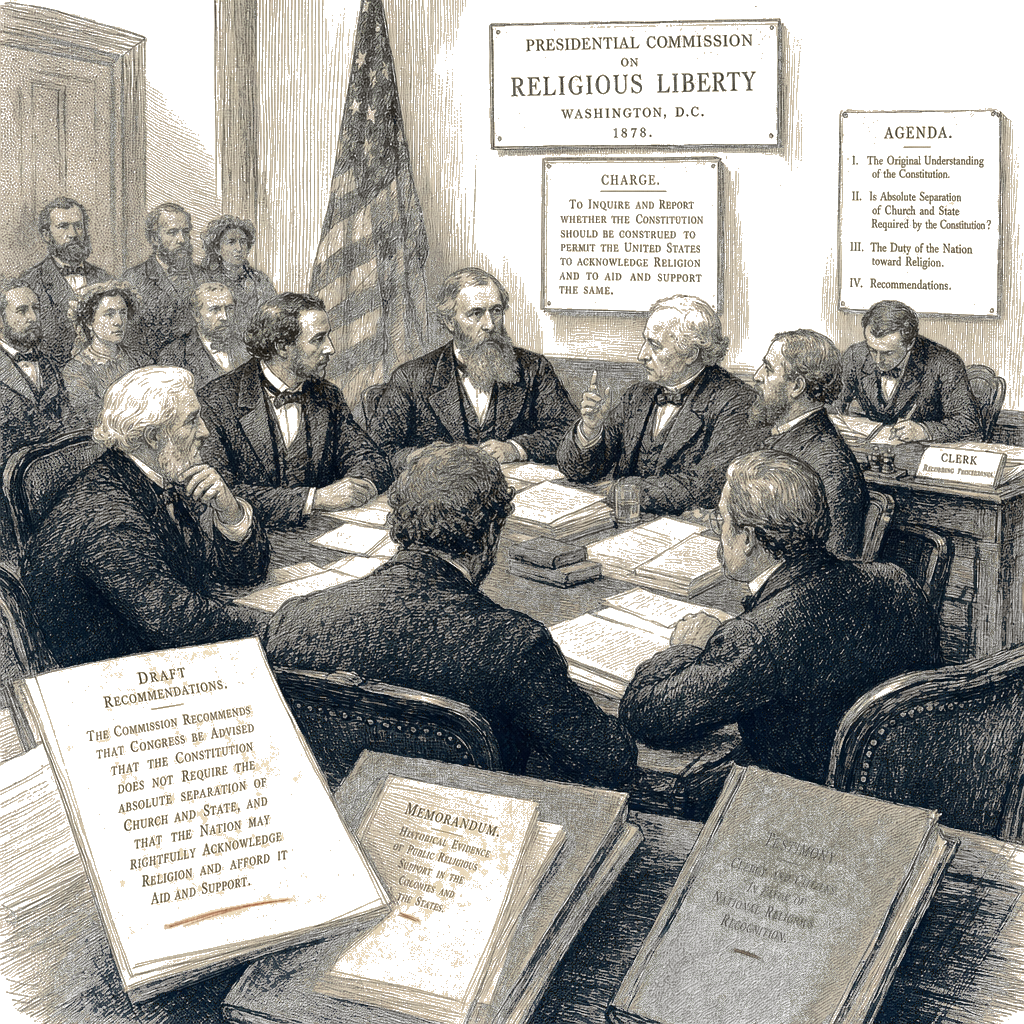
Members of the Religious Liberty Commission, the advisory body President Donald Trump established last year, used their April meeting to outline a set of policy recommendations that would substantially reshape the relationship between religious institutions and the federal government, according to commission proceedings obtained by The Associated Press.
The commission’s chair, Texas Lieutenant Governor Dan Patrick, a Republican, told members the panel should actively reject the principle that the Constitution separates church and state. “We need to say there is no separation of church and state,” Patrick said at the April meeting. “That’s a lie.” He proposed printing “a million bumper stickers” to promote the message and suggested creating a federal hotline whose automated recording would tell callers: “There is no separation of church and state.”
No commissioner present at the April meeting pushed back against Patrick’s remarks, the Associated Press reported.
The phrase “separation of church and state” does not appear in the text of the Constitution. However, the Supreme Court cited Thomas Jefferson’s description of the First Amendment as erecting “a wall of separation between church and state” in a series of 20th-century rulings. The court applied the amendment’s prohibition on any law “respecting an establishment of religion” to state governments through the 14th Amendment, and subsequent decisions have grappled with how to balance the free exercise of religion with the guarantee that government will not sponsor or favor a particular faith.
Trump himself made similar remarks at a White House prayer event in 2025: “They say separation between church and state. I said, all right, let’s forget about that for one time.”
Commission Recommendations Span Schools, Courts, and Workplaces
The commission, whose members are drawn mostly from Trump’s base of conservative Christian supporters, is still drafting its final report. But the April meeting provided a detailed preview of what commissioners want to see in that document.
Kelly Shackelford, president and chief executive officer of the legal organization First Liberty Institute, called for new rules requiring governments to pay the legal bills of citizens who successfully sue them in religious liberty cases. “That would be a huge shifting of power in favor of citizens,” Shackelford said.
Bishop Robert Barron of the Catholic Diocese of Winona-Rochester, Minnesota, urged that federal money flow to religious charities such as Catholic Charities without requiring those organizations to compromise on traditional church teachings about the family. He also called for humane treatment and access to sacraments for Catholic immigrants in detention, and said immigration enforcement agents should not disrupt worship services — a policy the administration eliminated last year.
Other commissioners advocated requiring schools and workplaces to post notices explaining the rights of religious expression and the availability of religious-based exemptions. Several called for restoring full pay and pension benefits to military service members discharged for refusing COVID-19 vaccines.
The recommendations reflect a well-established agenda among conservative Catholic and evangelical legal activists: increasing avenues for religious expression in public schools, including prayer and the posting of the Ten Commandments; expanding the eligibility of faith-based organizations for public funding; and widening religious-based exemptions from mandates in labor law, classroom curricula, and healthcare coverage.
The Supreme Court’s conservative majority has issued a series of decisions in recent years consistent with that agenda, and the commission’s proposals signal that the administration and its allied legal organizations intend to push further.
Critics Challenge the Commission’s Composition and Focus
Progressive religious and civil-liberties groups have challenged the commission on multiple fronts. The Interfaith Alliance, a progressive interfaith coalition, is suing the commission in federal court, arguing that its membership violates the Federal Advisory Committee Act, which requires advisory panels to be “fairly balanced in terms of the points of view represented.”
Most members of the commission are conservative Christian clerics and commentators; one is an Orthodox Jewish rabbi. The lawsuit notes that the majority of commission meetings have been held at the Museum of the Bible in Washington, an institution with evangelical Christian leadership, and that commissioners have asserted that the United States is a Judeo-Christian or Christian nation.
The Trump administration has asked the court to dismiss the lawsuit, citing procedural grounds and arguing that the law does not specify how a commission should achieve balance or define which viewpoints must be included.
The Rev. Paul Brandeis Raushenbush, president of the Interfaith Alliance, said the commission’s omissions are as notable as the recommendations it is developing. He said the panel has not adequately addressed anti-Muslim efforts in Texas and other states, nor has it fully examined the rise of antisemitism on the political right. “The commission has mostly focused on conservative Christian and right-leaning political grievances,” Raushenbush said.
Another Trump-created entity, the Task Force to Eradicate Anti-Christian Bias, issued a report alleging that Christians faced systemic discrimination under the administration of Democratic President Joe Biden in areas including education, tax law, and the prosecution of anti-abortion protesters. Progressive groups said that report failed to demonstrate systemic discrimination and amounted to advocacy rather than investigation.
Internal Tensions and Broader Reach
The commission has operated with broad agreement among its members — with one prominent exception. Commissioner Carrie Prejean Boller was removed from the panel in February after a contentious hearing on antisemitism. Patrick, the commission’s chair, said Prejean Boller sought to “hijack” the hearing. She had engaged in sharp exchanges with witnesses over the definition of antisemitism and defended conservative commentator Candace Owens against accusations of antisemitic statements. Prejean Boller, a Catholic, has contended she was wrongly ousted for expressing her religious beliefs.
In other hearings, the commission heard from witnesses who described defying workplace regulations they said conflicted with their conservative religious convictions on gender, abortion, and COVID-19 vaccines. Some witnesses testified they were prevented, at least temporarily, from displaying religious symbols at work or from performing Christian songs at school talent shows.
At the antisemitism hearing, Jewish witnesses described being harassed and threatened at campus protests against Israel. The commission has also heard testimony from Hindu, Muslim, Sikh, and other witnesses.
Several commission members are scheduled to participate in a May 17 prayer event marking the country’s upcoming 250th anniversary. Several also took part in a recent Bible-reading marathon staged largely at the Museum of the Bible.
The commission’s final report has not yet been released. The April meeting, with its list of member wish-list items and Patrick’s declaration against church-state separation, offers the clearest picture to date of what the report is likely to contain.