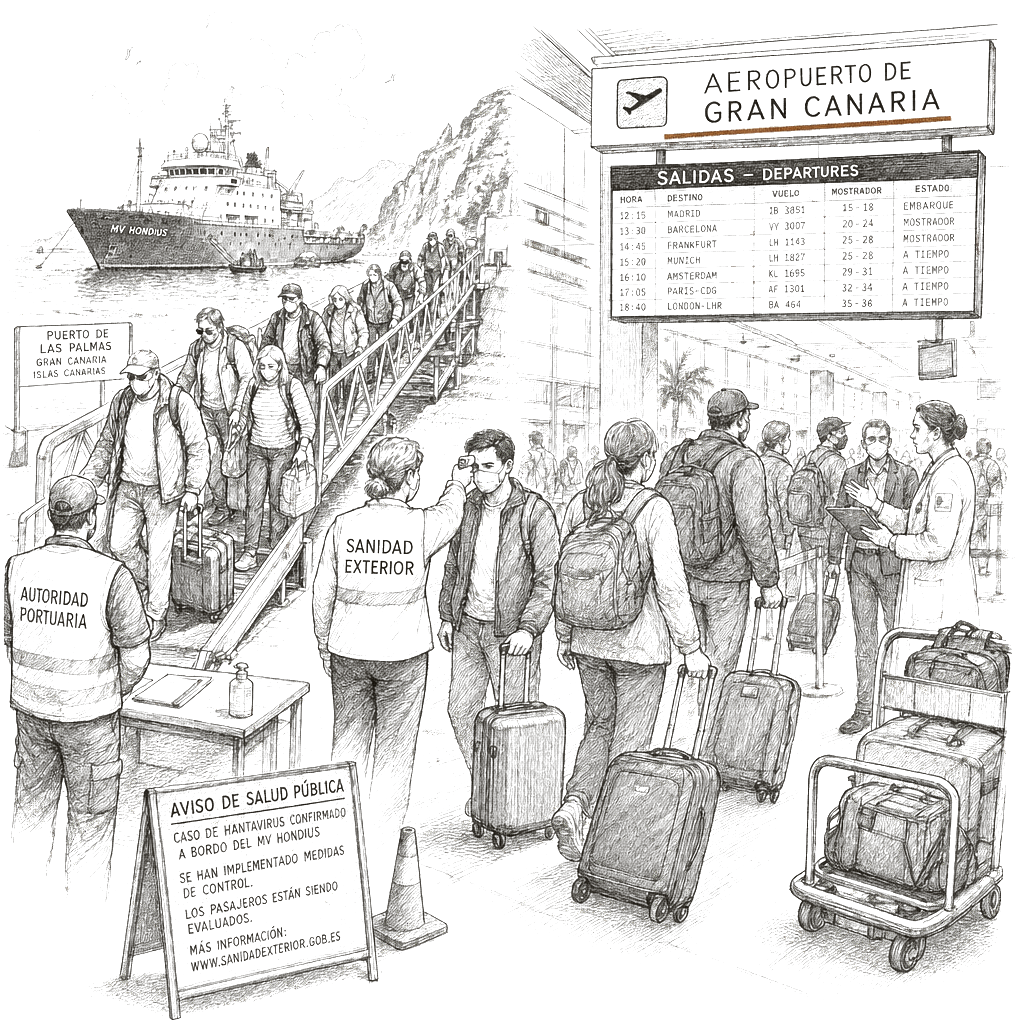
Passengers evacuated from the hantavirus-hit cruise ship MV Hondius began flying home Sunday after the vessel anchored in the Canary Islands, with authorities moving to isolate people arriving on separate flights and monitor those most at risk. Spanish officials said the evacuees were escorted from the ship to shore in full-body protective gear, face masks and respirators, and then flown out from Tenerife by governments and militaries.
The first U.S. outbound flight carried 17 American passengers, after one passenger tested positive for hantavirus aboard separate aircraft but was not showing any symptoms, U.S. health officials said late Sunday. Kayla Thomas, a spokesperson for Nebraska Medicine, said one passenger would be transported to the Nebraska Biocontainment Unit upon arrival, while other passengers would go to a National Quarantine Unit for assessment and monitoring. “The passenger who is going to the Biocontainment Unit tested positive for the virus but does not have symptoms,” Thomas said.
Even as the American evacuation began, officials also reported illness linked to the French group. French Prime Minister Sébastien Lecornu said in a statement that one of the five French passengers developed symptoms on their flight home, and that all evacuees were put into strict isolation with plans to be tested.
Authorities said passengers were disembarked only when evacuation flights were ready, and that the groups would be checked for symptoms while being forbidden from having any contact with the local population. Tedros Adhanom Ghebreyesus, director-general of the World Health Organization, reiterated that the general public should not be worried about the outbreak, saying, “We have been repeating the same answer many times,” and that “This is not another COVID. And the risk to the public is low. So they shouldn’t be scared, and they shouldn’t panic.”
The WHO and other health officials said hantavirus typically spreads when people inhale contaminated residue from rodent droppings, and that the disease is not easily transmitted between people. But the agencies said the Andes virus detected in the cruise ship outbreak may be able to spread between people in rare cases, and symptoms usually appear between one and eight weeks after exposure.
As the repatriation effort expanded beyond Europe, governments described case-by-case monitoring plans. The WHO recommended that passengers’ home countries conduct “active monitoring and follow-up, which means daily health checks, either at home or in a specialized facility,” according to the organization’s top epidemiologist Maria van Kerkhove. Van Kerkhove said the WHO left it to countries to develop their own policies, but that “our recommendations are very clear.”
In the United States, the aircraft carrying Americans was due to arrive in Omaha, Nebraska, early Monday, where officials said the University of Nebraska Medical Center would assess whether passengers had been in close contact with any symptomatic people and evaluate their risk levels for spreading the virus. Thomas said the Nebraska medical school’s biocontainment treatment unit, which has been used for highly infectious diseases, would receive the passenger who tested positive but had no symptoms.
Other evacuations were underway across multiple countries. Spain and the WHO said crews and passengers left behind their luggage and were allowed only a small bag with essentials, a cellphone, a charger and documentation, and authorities said some crew and the body of a passenger who died on board would remain on the ship. Spanish authorities said the MV Hondius would sail on to Rotterdam, Netherlands, for disinfection, and the cruise company said the trip to Rotterdam would take about five days. The journey and follow-up monitoring plans were part of an evacuation described as expected to last until Monday.
Elsewhere in the evacuation network, Japan’s foreign ministry said a Japanese national arrived in Britain on a chartered flight arranged by the British government and would be under health monitoring by British authorities for up to 45 days. The Netherlands reported that a Dutch evacuation plane touched down Sunday evening in Eindhoven with masked passengers who carried belongings in white plastic bags, and that the group of 26 included people from multiple countries; officials said the Dutch citizens would self-quarantine for six weeks while local health services arranged quarantine locations for others.
In the United Kingdom, the defense ministry said British Army medics parachuted onto Tristan da Cunha—Britain’s most remote inhabited overseas territory—after one of the territory’s 221 residents had a suspected case of hantavirus. The British government said a team of six paratroopers and two medical clinicians jumped Saturday from a Royal Air Force transport plane that also dropped oxygen and medical equipment, and Tristan da Cunha is usually accessible only by a six-day boat voyage from Cape Town, South Africa.
In parallel with the evacuations, countries described additional quarantine and hospital observation measures for those repatriated. The Netherlands, the U.K. and France all described keeping evacuees isolated or under medical oversight, and officials said authorities were supervising the operations in Tenerife, including Spain’s health and interior ministers and Tedros and other WHO officials.