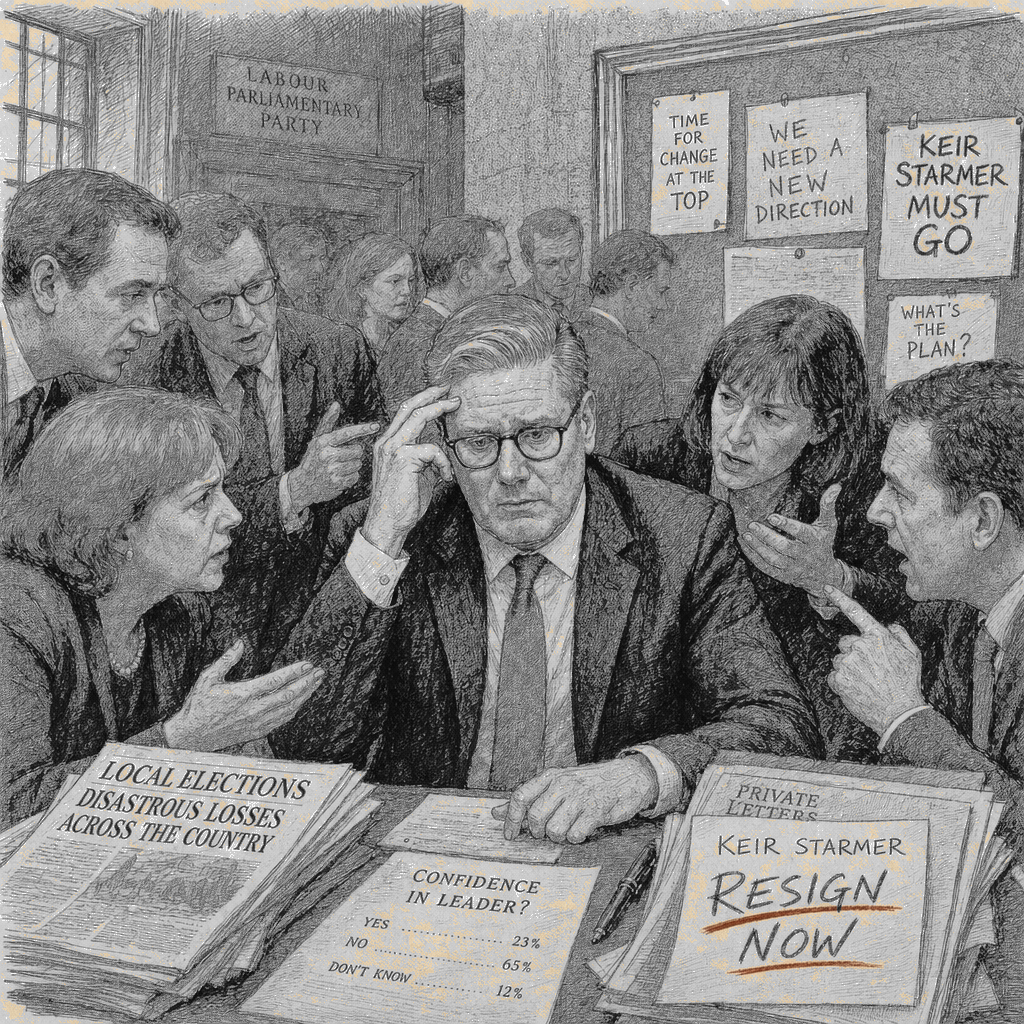
Starmer’s hold on power has weakened dramatically after last week’s local elections in England and legislative votes in Scotland and Wales were widely viewed as an unofficial referendum on his premiership. The center-left Labour Party, which swept to a landslide victory less than two years ago, has seen its popularity plunge amid repeated policy missteps, U-turns on welfare reform, and a failure to deliver on core economic promises.
A growing number of Labour lawmakers are now openly urging the prime minister to set a timetable for his departure. Josh Simons, a formerly loyal member of Parliament, wrote in the Times of London that Starmer “has lost the country” and “should take control of the situation by overseeing an orderly transition to a new prime minister.” British political rules allow a party to change leaders midterm without triggering a general election, making the internal pressure immediately consequential.
Starmer is attempting to regain momentum with a speech on Monday that his aides are casting as a course correction. The prime minister told The Observer newspaper on Sunday that he wants to remain in office for a decade. But Catherine West, a former junior minister, said she will move to trigger a leadership contest unless the speech meets her expectations. “Working people sent us a message,” West said. “We have to listen to that, and we have to change and we have to do it quickly.” She acknowledged she does not yet have the support of 81 colleagues required to force a contest, and her move appeared designed to pressure more prominent potential challengers to declare themselves.
None of the high-profile Labour figures seen as possible successors — including Angela Rayner, Health Secretary Wes Streeting, and Greater Manchester Mayor Andy Burnham — has explicitly called for Starmer’s resignation. Rayner, the former deputy prime minister, said the party “needs to change” but added that “the prime minister must now meet the moment and set out the change our country needs,” leaving the door open to either outcome.
Starmer is also looking to a legislative agenda, to be set out Wednesday by King Charles III at the State Opening of Parliament, to reassert control. Central to his pitch is a push for closer ties with the European Union, which the United Kingdom left in 2020. His government has already eased some post-Brexit trade restrictions, and Starmer told The Observer he will pursue a youth mobility deal to allow young people to work across the continent. “Brexit has held back our young people,” he said, adding that “we have to be closer to Europe.” However, he has ruled out seeking to rejoin the EU, its customs union, or its single market, limiting the economic relief the measures can offer British businesses.
The local elections underscored how deeply Labour is being squeezed by opponents on both flanks. The party lost votes to Nigel Farage’s anti-immigration Reform UK on the right and to the “eco-populist” Green Party on the left, a pattern that reflects the increasing fragmentation of British politics. The results have intensified doubts about whether Starmer, who has struggled to articulate a clear governing vision since taking office, can reverse his government’s fortunes before the internal revolt becomes unstoppable.