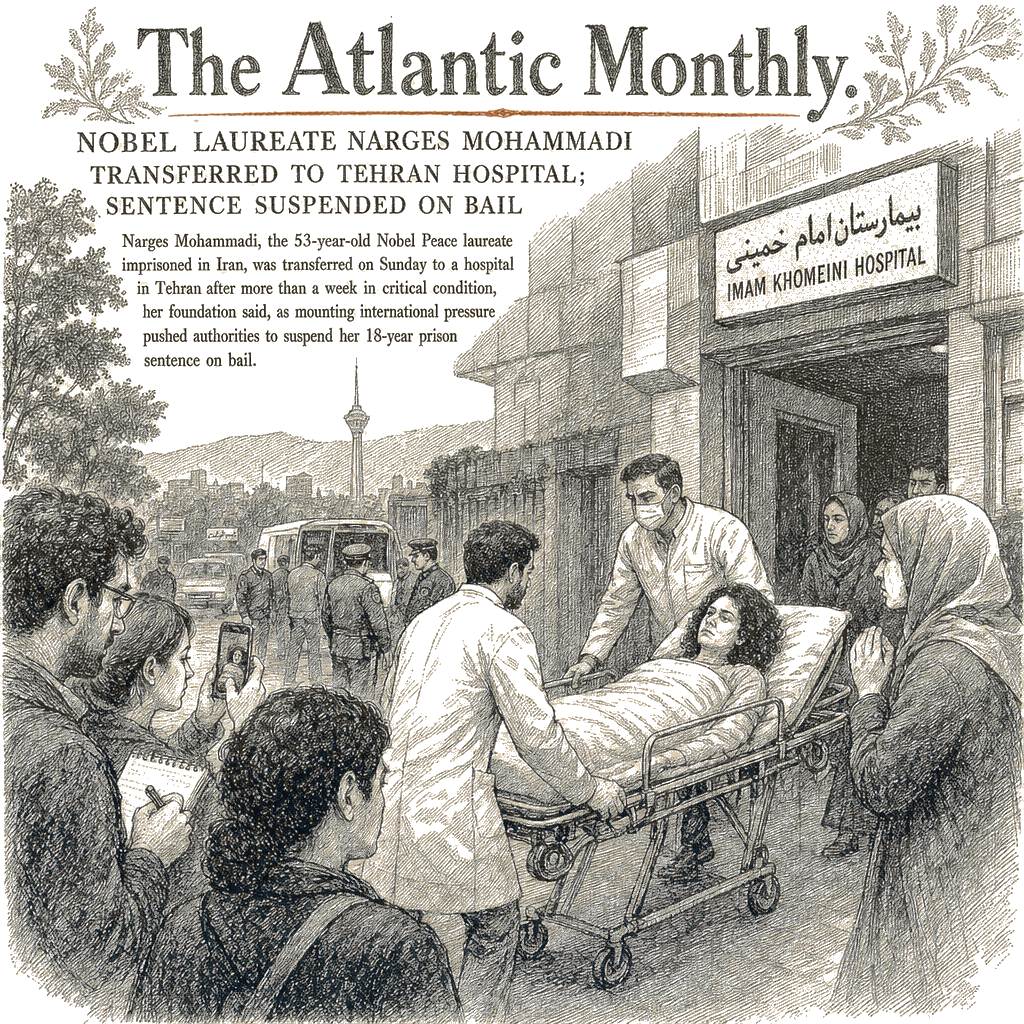
Narges Mohammadi, the 53-year-old Nobel Peace laureate imprisoned in Iran, was transferred on Sunday to a hospital in Tehran after more than a week in critical condition, her foundation said, as mounting international pressure pushed authorities to suspend her 18-year prison sentence on bail.
The transfer came after days of pleading by her family, human rights groups, and the Nobel committee, who described her condition as life-threatening. Mohammadi had been imprisoned since December in Zanjan prison, where she lost consciousness twice and was initially taken to a local hospital on May 1. Her transfer to the capital was delayed; her brother Hamidreza Mohammadi blamed Iran’s intelligence agency for blocking an earlier medical recommendation.
In a statement shared with The Associated Press, the Narges Mohammadi Foundation said the suspended sentence “is not enough” and that Mohammadi needs “permanent, specialized care.” The statement added that “we must ensure she never returns to prison to face the 18 years remaining on her sentence. Now is the time to demand her unconditional freedom and the dismissal of all charges.”
Her lawyer, Mostafa Nili, said on social media that the transfer order followed a decision by the Legal Medicine Organization — government-appointed medical examiners — which stated that, due to her multiple illnesses, she needs to continue treatment outside prison and under the supervision of her own medical team.
Her brother, reached by AP in Oslo, said: “I’m relieved now. I can breathe lightly.”
The Nobel committee had previously called on Iranian authorities to immediately transfer Mohammadi to her dedicated medical team in Tehran, warning that “without such treatment, her life remains at risk.”
Mohammadi, awarded the Nobel Peace Prize in 2023 while behind bars, has been jailed repeatedly throughout her career. Her current imprisonment began with her arrest in the northeastern city of Mashhad. Her health has steadily worsened, due in part to severe beatings during her arrest. She suffered a heart attack in March and has a blood clot in her lung that requires blood thinners and monitoring. Since being hospitalized, her blood pressure has fluctuated dangerously and she has required oxygen; she cannot speak.