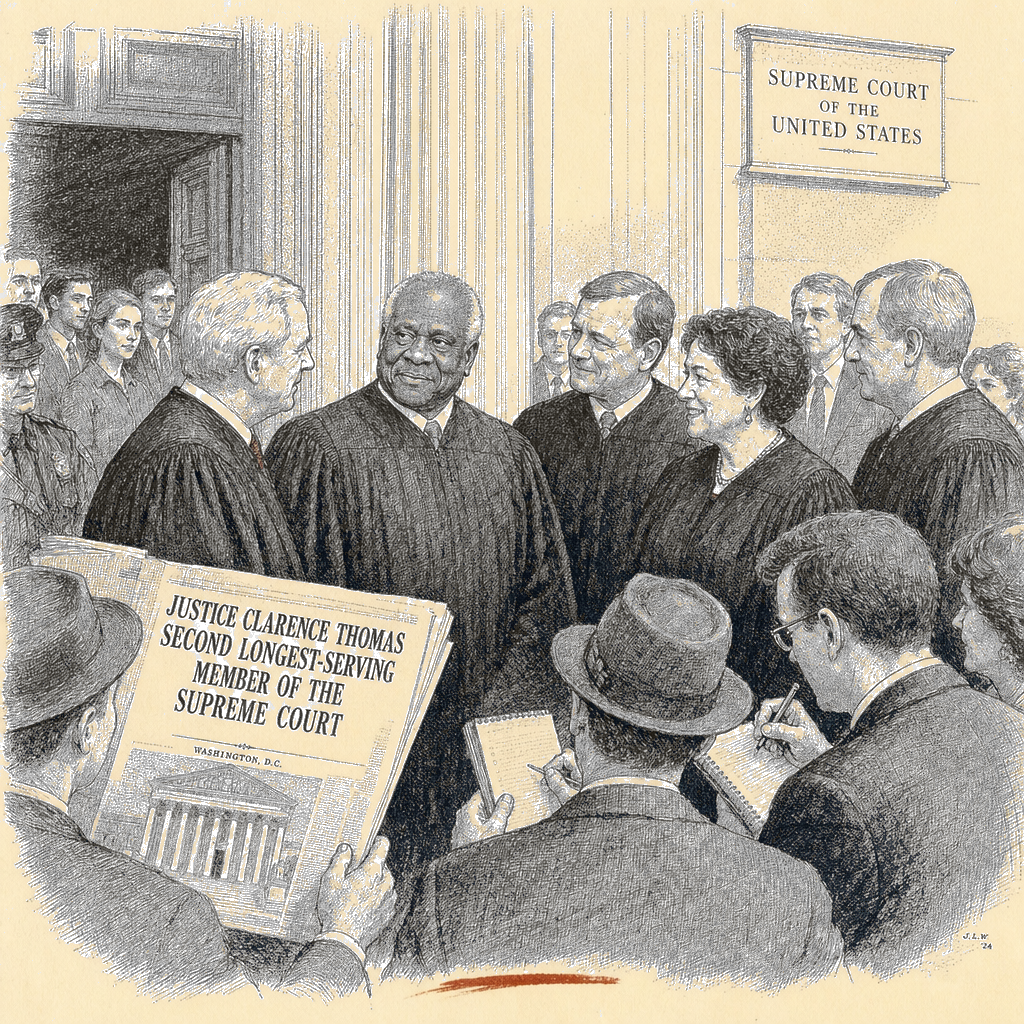
Justice Clarence Thomas hit a historic milestone on Thursday, becoming the second longest-serving member of the U.S. Supreme Court as he enters his 35th year on the bench. At 77, the first baby boomer to serve on the high court has outlasted nearly all of his contemporaries, cementing a tenure that has grown increasingly central to the direction of American law.
Only Justice William O. Douglas has served longer than Thomas. Thomas would overtake Douglas in 2028 if he remains on the court, and observers noted there is currently no public sign he plans to retire anytime soon.
“I think he’s more energized and excited now than when I first met him,” said John Yoo, a law professor at the University of California, Berkeley, who clerked for Thomas three decades ago before serving in Republican President George W. Bush’s administration.
Thomas’s path to the bench was marked by controversy. Nominated in 1991 by Republican President George H.W. Bush, he faced contentious confirmation hearings during which Anita Hill alleged he had sexually harassed her. Thomas forcefully denied the allegations. More recently, he has drawn public scrutiny for accepting lavish, undisclosed trips from a GOP megadonor, as well as for the conservative political activism of his wife, who backed false claims that the 2020 presidential election was stolen from Donald Trump. Thomas has stated he was not required to disclose the trips and has ignored calls to recuse himself from election-related cases.
Despite these controversies, Thomas’s influence on the court has expanded dramatically over the last decade. Following the confirmation of three conservative justices nominated by Republican President Donald Trump, Thomas now sits as the most senior member of a six-justice conservative supermajority. The bloc has overturned abortion as a constitutional right, ended affirmative action in college admissions and sharply limited the scope of the Voting Rights Act.
“The court has radically moved in his direction over the course of his time on the court,” said Stanford University law professor Pamela Karlan. Karlan noted that Thomas’s seniority allows him to assign opinion drafts if he finds himself in a majority that excludes Chief Justice John Roberts — a structural lever that can quietly influence how other justices vote behind closed doors.
Off the bench, Thomas has cultivated a powerful network of former clerks who now hold influential positions across the federal judiciary and the executive branch, including several appointments in the Trump administration. Sarah Konsky, director of the Supreme Court and Appellate Clinic at the University of Chicago Law School, said the clerkships represent a lasting institutional footprint.
“That is an important legacy that he will leave,” said Sarah Konsky, director of the Supreme Court and Appellate Clinic at the University of Chicago Law School. “Even as justices’ own time on the court winds down, significant influence lives on through their clerks.”
Thomas has also redefined his presence at oral arguments. Once known for his near-silence on the bench, he now routinely poses the first questions to advocates, a shift in behavior that mirrors his rising authority within the conservative legal movement. In 2022, he authored the court’s landmark opinion expanding Second Amendment rights, establishing that people generally have the right to carry firearms in public.
On the jurisprudential front, scholars say Thomas’s legal philosophy has remained remarkably steady even as the court’s center of gravity has moved toward him. Scott Gerber, author of “First Principles: The Jurisprudence of Clarence Thomas,” described the justice’s record as unwavering.
“He’s incredibly consistent,” Gerber said. Once known for solo dissents, “now he writes majority opinions.”
Thomas topped 34 years of service with this week’s milestone, placing him ahead of Justice Stephen J. Field, who was nominated by President Abraham Lincoln before the end of the Civil War and served for decades as the court’s only tenth justice until 1897.
At a recent speech at the University of Texas, Thomas tied the nation’s highest ideals to a conservative vision of limited government, launching a broadside against progressivism that critics called inappropriate. The remarks earned a standing ovation in the room, underscoring the justice’s enduring appeal among conservative legal scholars and activists as he continues his record-setting tenure.
The justice did not respond to a request for comment on his historic milestone.