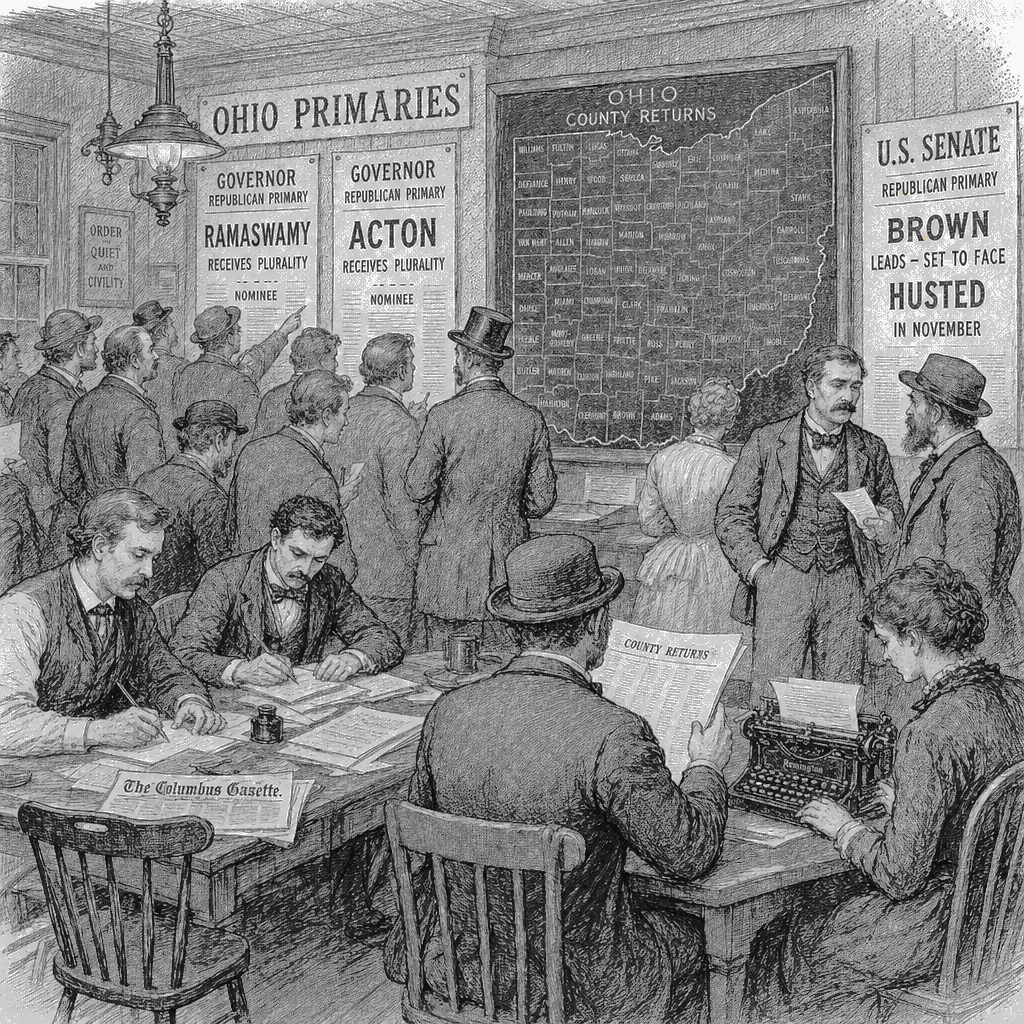
Biotech billionaire Vivek Ramaswamy and former Ohio health director Dr. Amy Acton emerged from Tuesday’s primary as the Republican and Democratic nominees for governor of Ohio in a race that will test the limits of the state’s rightward drift during the Trump era. Former U.S. Sen. Sherrod Brown, meanwhile, cruised through his primary and will face Republican Sen. Jon Husted in a Senate contest that national Republicans have already pledged $79 million to defend. The twin matchups place Ohio at the center of the 2026 midterm map.
Ramaswamy, who ran for the 2024 GOP presidential nomination before dropping out and endorsing Trump, cleared a Republican field that once included the state attorney general, treasurer, and lieutenant governor. He benefited from the political shuffle touched off when then-Sen. JD Vance ascended to the vice presidency and Husted — then the front-runner for governor — was appointed to fill Vance’s seat. That sequence left an opening at the top of the Republican ticket, and Ramaswamy, armed with a national profile, tech-industry connections, and Trump’s endorsement, consolidated support quickly.
Trump praised Ramaswamy on social media Tuesday as “Young, Strong, and Smart!” His endorsement continues to carry weight in Ohio, which he won in 2016, 2020, and 2024. But Ramaswamy could face headwinds from the president’s declining popularity, driven by the war in Iran and rising consumer costs. Ramaswamy told supporters in Columbus that Ohio has “an historic opportunity to lead Ohio to be the top state in the country — to raise a young family, to give our kids a world-class education and to be the state where we will revive this quaint idea that we call the American Dream.”
Acton was unopposed in the Democratic primary. She became a household name in Ohio during the early months of the COVID-19 pandemic, appearing daily alongside Republican Gov. Mike DeWine during coronavirus briefings. Her comforting presence made her a beloved figure for many Ohioans. “I just think she’s real,” said Aaron Weiner, a Cincinnati real estate agent who voted for Acton. “She has had struggles, so I think she can empathize with people who are struggling to get ahead.” Acton’s campaign has highlighted her childhood in Youngstown, where she overcame poverty, homelessness, and sexual abuse.
But Acton’s role in the DeWine administration’s aggressive pandemic response — which included business closures, school shutdowns, and the cancellation of an election — also earned her enemies, and she became the occasional target of armed protesters outside her home. Ramaswamy’s campaign has sought to capitalize on lingering anger over the restrictions, though he, too, has connections to the government’s pandemic response: he was advising Husted, then the lieutenant governor, on virus-related economic issues and founded a company that profited from vaccine development.
“I refuse to look the other way,” Acton said at her victory party, saying she is running because Ohioans are working harder than ever and still not getting ahead. Democrats last won the governor’s office in 2006; Acton’s high public profile and early fundraising strength have made the party optimistic about breaking that streak.
In the Senate race, Brown dispatched a primary challenger and immediately trained his fire on corporate power. “No one in the Senate is standing up to these corporations who raise your prices and who game the system,” Brown said, continuing, “Ohioans don’t have anyone fighting for you, until November.” Brown served three terms in the Senate before losing a bitter 2024 reelection bid that flipped the seat to the GOP.
Husted, who was unopposed in his special-election primary to fill the remainder of the term Vance won in 2022, responded in a statement earlier Tuesday. “Over the next six months, Ohioans will hear a lot from Sherrod Brown about his so-called solutions,” Husted said. “The truth is, after 32 years in Washington, he created the very problems he now blames others for. His record is indefensible.” The Senate Leadership Fund, a top Republican super PAC, has pledged $79 million to defend the seat — an early signal of how expensive the race will become. Ohio’s Senate contest will be the state’s third in four years, and both parties view it as central to determining control of the chamber.
Down-ballot, Tuesday’s primaries set up competitive congressional races across the state. Former state Rep. Derek Merrin won the GOP primary in the Toledo-area 9th District for a rematch with Democratic U.S. Rep. Marcy Kaptur, the longest-serving woman in Congress. In the Cincinnati-area 1st District, Republican Eric Conroy, a CIA and Air Force veteran endorsed by Trump, Vance, and Moreno, won a three-way primary and will challenge Democratic U.S. Rep. Greg Landsman, who fended off a primary challenger from his left. Democrats, who hold 5 of Ohio’s 15 U.S. House seats, are contesting Republican-held districts redrawn under a new map that slightly favors the GOP. Brian Poindexter, a union ironworker endorsed by Sen. Bernie Sanders, won a five-way Democratic primary in the Cleveland-area 7th District and will face Republican U.S. Rep. Max Miller in November.