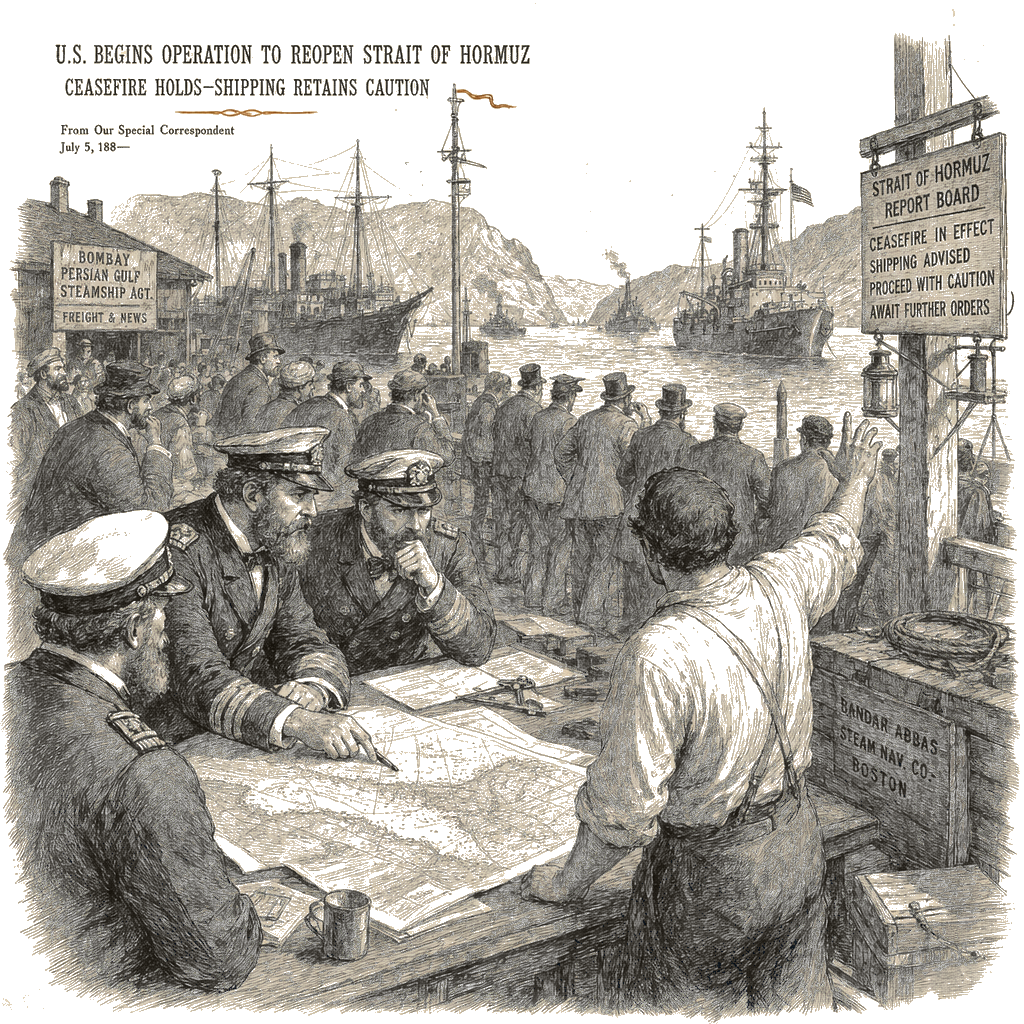
The three-week-old ceasefire in the Iran war lurched toward collapse Monday after President Donald Trump’s administration launched a military effort to escort commercial ships through the Strait of Hormuz, a move Iran immediately denounced as a violation of the truce. The operation, named “Project Freedom,” drew immediate Iranian threats and left the shipping industry struggling to assess whether the waterway was safe for transit.
Iran has used its grip on the narrow strait to keep hundreds of commercial vessels and tens of thousands of sailors stranded since the war broke out more than two months ago, the Associated Press reported. The U.S. military says 87 countries are represented among the stuck ships, which are carrying weeks’ worth of oil, gas, fertilizer and other globally needed supplies.
Trump announced the initiative Sunday, describing it as a humanitarian effort to help countries that have been “neutral and innocent” in the war. The U.S. military said the operation involves guided-missile destroyers, more than 100 aircraft and 15,000 service members, though it did not detail how those forces are deployed. The president warned that interference “will, unfortunately, have to be dealt with forcefully.”
Iran’s military command responded Monday by saying ships still must coordinate with Tehran to transit the strait and that “any foreign military force — especially the aggressive U.S. military — that intends to approach or enter the Strait of Hormuz will be targeted,” state media reported. Iranian news agencies claimed Iran struck a U.S. vessel southeast of the strait for violating “maritime security and navigation norms”; the U.S. military denied the claim.
As the warnings escalated into violence, the U.S. military said it sank six Iranian small boats that were targeting civilian vessels, and reported that Iran fired missiles and drones at ships the U.S. was protecting. Adm. Brad Cooper, head of U.S. Central Command, said Iran initiated the “aggressive behavior” but declined to say whether the ceasefire was over. Meanwhile, the United Arab Emirates came under attack for the first time since the early April ceasefire, and a British military monitor said two cargo vessels were ablaze off the UAE.
The threat level around the strait remains critical, according to the U.S.-led Joint Maritime Information Center, even as it issued an advisory on the new U.S. effort. The center advised ships to cross in Oman’s waters, saying the U.S. has set up an “enhanced security area,” but warned that passing close to usual routes “should be considered extremely hazardous due to the presence of mines that have not been fully surveyed and mitigated.”
Shipping industry groups expressed deep caution. Jakob Larsen, chief safety and security officer for the Baltic and International Maritime Council, said no formal guidance or details about the effort had been issued to the industry. Without Iran’s consent for safe transit, “it is currently not clear whether the Iranian threat to ships can be degraded or suppressed,” Larsen said. He questioned whether the U.S. operation is sustainable in the long run and warned of a “risk of hostilities breaking out again” if it goes ahead.
United Nations spokesperson Stephane Dujarric told journalists, “There’s not much clarity at this point.”
Oil prices rose Monday amid the uncertainty over the strait and the U.S. operation. Cooper said the U.S. military had cleared a pathway and established a “defensive umbrella” of helicopters and fighter planes to protect freighters leaving the area, but few ships appeared to take advantage of the operation. Only two U.S.-flagged merchant vessels were reported to have safely transited with U.S. assistance.