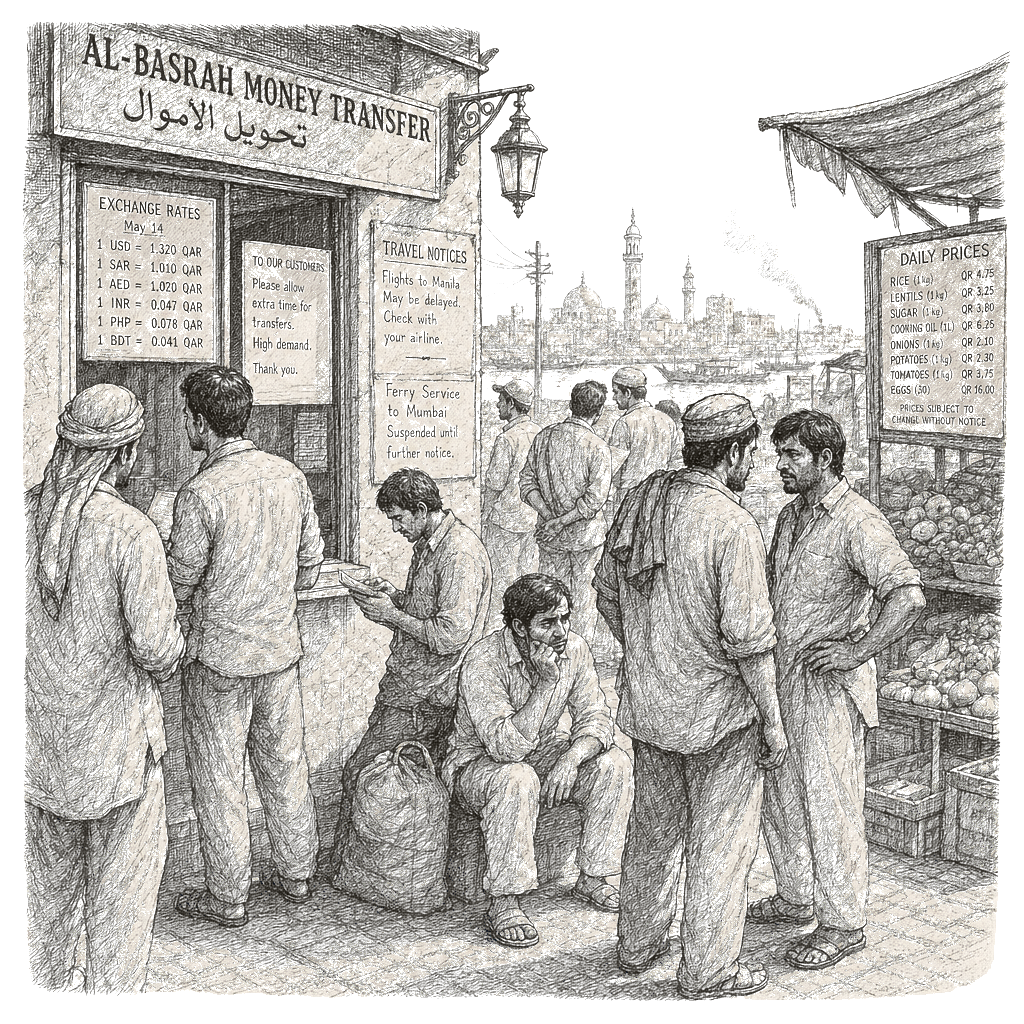
Iran’s war is reshaping daily decisions for millions of foreign workers across the Persian Gulf, pushing many into a painful tradeoff between staying in jobs that pay more and risking deeper harm in a conflict zone, or returning to countries where the war’s economic shock has made even basic life harder. The Associated Press described the case of Mohammad Abdullah Al Mamun, a 35-year-old Bangladeshi man who worked in Saudi Arabia for 15 years and planned to return this year so he could spend time with his 6-year-old son and improve his family’s home.
After a missile struck his workers’ camp on March 8, Al Mamun suffered severe burns and later died. His family said he arrived home in a coffin earlier this month, and his widow, Sadia Islam Sarmin, said, “We don’t know what we will do next.”
For many migrant workers, the stakes are both physical and financial, and advocacy groups say protections lag behind the risks. Migrant workers make up a majority in many Gulf Arab states, while much of the business and finance is staffed by Westerners, Arabs and Indians and labor-intensive work is often carried out by people from poorer countries in Asia and Africa. The Coalition for Labor Justice for Migrants in the Gulf said few workers had access to bomb shelters and that many became stranded as fighting disrupted travel and operations.
The group said attacks killed at least 24 foreign workers in the Gulf and four in Israel as Iran and allied armed groups launched waves of missile and drone strikes, and it said its count includes eight mariners killed at sea. In a separate incident described in the report, three Indian workers were moderately injured in the United Arab Emirates when an Iranian drone sparked a fire at an oil facility, which the report described as the first time the UAE came under attack since a fragile ceasefire took hold in early April.
Udaya Wagle, who studies labor and migration at Northern Arizona University, said, “It’s a very precarious situation for migrant workers.” While the ceasefire has mostly held, negotiations to end the war have repeatedly stalled, and Iran has effectively blocked the Strait of Hormuz, a key waterway for global oil and gas. The report said Iran would only reopen it if the war ends and the U.S. lifts its blockade, a position that has fed into higher prices for gas, fertilizer and other goods that hit Asian economies particularly hard.
In several countries, the report said remittances from the Gulf make up a meaningful share of household and national income, increasing pressure on families facing strained budgets. It cited remittances at about 1% of gross domestic product in India, 3% to 5% of GDP in Bangladesh, Pakistan and Sri Lanka, and nearly 10% in Nepal, framing the war’s disruption as a threat to both wages abroad and purchasing power at home.
Within the Gulf, the report said low-wage laborers remain especially vulnerable because they perform the most dangerous and difficult jobs and often lack job security and protections. Shariful Islam Hasan of BRAC said workers like Al Mamun are most at risk because they do the “most dirty, dangerous and difficult” jobs. The report also included testimony from a Bangladeshi worker in Qatar, who said he labored through 12-hour shifts as missiles flew overhead and that shrapnel from a strike fell near his living quarters; he described workers going to a designated room when alarms sounded and said he earns less than $400 monthly and sends two-thirds home, speaking on condition of anonymity for fear of angering authorities.
The report said Qatar enacted reforms in the run-up to hosting the 2022 World Cup, including partial dismantling of an employer-linked system for workers, but activists say abuses remain widespread and workers have few avenues to pursue justice. It also described the experience of Ahmed al-Aliyli, a taxi driver in Qatar, who said he has not sent money home to his family in Egypt for two months and that his income dropped to about a third of what he earned before the war disrupted travel. “We are the collateral damage of this war,” he said.
BRAC and the labor coalition described other ways conflict pressures translate into work instability, including informal employment and the potential for withheld wages or reduced access to leave. The coalition said workers from Bangladesh and Pakistan are especially vulnerable because they are often employed informally and without fixed contracts, and it said work permits can be tied to a single employer, in some cases leaving people stranded. It warned that some employers may use the conflict to withhold wages, deny leave or carry out arbitrary dismissals.
For many, returning home can mean giving up the steady income and higher wages available in the Gulf, even as conflict makes life riskier there. The report described Al Mamun’s mother, Shahida Khatun, urging him to come home when the war began, and it said that he had been saving money since November with plans to pay for his siblings’ studies, build a larger house and return this spring. Now, the report said, his family is struggling to recover his wages and piece together life without him, and Khatun said, “The pain of losing a child. There are no words to describe the agony.”
Other workers described weighing personal safety against the possibility that their families might not survive if they leave. Marlene Flores, a Filipina worker in Qatar, said she felt the “shudder” each time a missile was intercepted but said tax-free pay and health insurance made it feel safer than the Philippines, which has declared a “national energy emergency.” “It’s not easy for me to say,” she admitted. “But I would really stay here.”
The report also described an Israeli workforce that includes foreign caregivers, saying Jeremiah Supan, a Filipino caregiver in Israel, continued caring for two elderly charges despite near-daily missile alerts. It said he sometimes dashes out for food or medicine despite the danger and questioned whether his own family could survive if he returns to the Philippines. “I know that in the blink of an eye, one can die,” he said. “But what life shall we return to?”