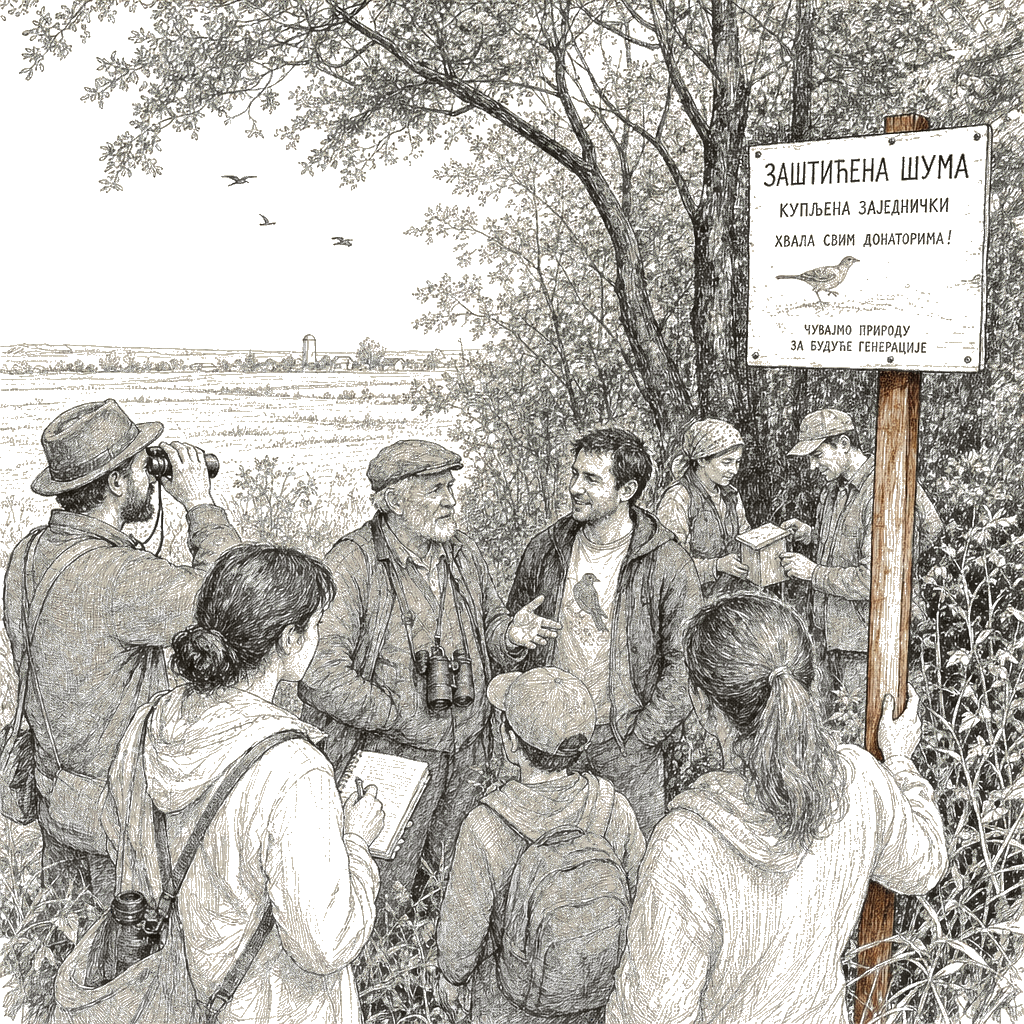
PLANDISTE, Serbia — The Bird Protection and Study Society has secured a rare patch of thick greenery in northeastern Serbia’s flat agricultural expanse, purchasing the 5-acre woodland known as the Nightingale’s Forest to protect its ecosystem. The acquisition, finalized through a grassroots fundraising drive last year, stands as a localized example of environmental defense in a region where natural habitats face steady pressure from commercial development.
The 8,000-euro ($9,500) initiative underscores a swelling public appetite for nature conservation across the Balkan nation. Serbia is navigating severe ecological headwinds, including deteriorating air and water quality and rapid urbanization that threatens remaining green spaces, even as government officials pledge to strengthen environmental standards in pursuit of European Union membership.
Merry chirping echoed through the canopy on the property, and animal tracks were visible in the damp ground cover beneath the towering trees. Society representative Uros Stojiljkovic told The Associated Press the woodland was privately held and listed for sale. He said that if another party had bought the parcel, the trees would likely have been felled for immediate profit rather than preserved.
“The value of timber was higher than its (land) price,” Stojiljkovic said. “We protected it this way.”
The new owners intend to catalog the diverse plant and animal species thriving in the moist terrain while leaving the habitat in its natural state. Natasa Jancic, who helped manage the fundraising drive, said the initial 8,000 euros ($9,500) was collected in under a month. Since the purchase, hundreds of contributors have continued donating to finance field research and future conservation acquisitions.
“Individually, we can’t do much, but as an active and stable community, we can achieve a lot,” Jancic said.
Founded roughly three decades ago as a small network of ecological experts, the society has expanded into a broad coalition of families and nature enthusiasts. Jancic said that many members contribute financially without participating directly in field operations, a trend she cited as further evidence of mounting environmental awareness among citizens.
Stojiljkovic acknowledged that preserving 5 acres alone will not solve the country’s macro-level ecological crises, but he said the effort establishes a vital precedent for grassroots action.
“Every village or town should have a Nightingale’s Forest of its own for a cumulative effect,” Stojiljkovic said. “It is important to start somewhere.”