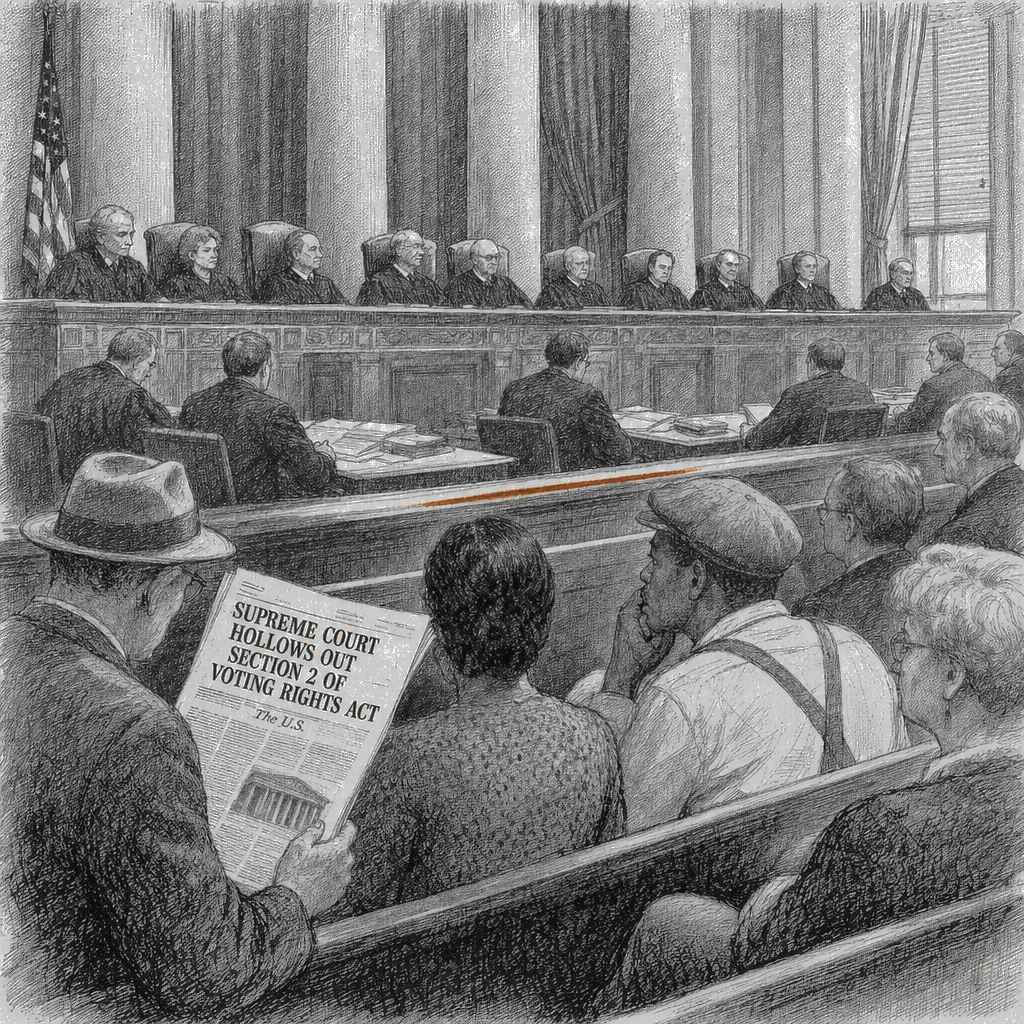
The Supreme Court on Wednesday delivered a ruling that voting-rights advocates say has gutted the last effective enforcement mechanism of the 1965 Voting Rights Act, holding that Section 2 of the law requires plaintiffs to show that a challenged map was drawn with intentional racial discrimination — a standard Justice Elena Kagan’s dissent described as “an almost insurmountable barrier.”
The decision, written by Justice Samuel Alito for the court’s conservative majority, arose from a congressional redistricting case in Louisiana. The state had drawn a second majority-Black district following earlier litigation, giving Louisiana two Black representatives in Congress for the first time. Wednesday’s ruling found that map unconstitutional because race was a predominant factor in drawing the lines.
“States can now point to partisan objectives to justify maps that strip voters of color of representation, and federal courts will have little basis to intervene,” said Sophia Lin Lakin, deputy director of the American Civil Liberties Union’s Voting Rights Project.
The ruling reshapes a law that had stood for six decades as the federal government’s primary tool against racial discrimination in voting. President Lyndon B. Johnson signed the Voting Rights Act on Aug. 6, 1965, five months after the “Bloody Sunday” attack on civil-rights marchers in Selma, Alabama, gave momentum to the bill. In the decades since, the number of Black elected officials nationwide grew from roughly 1,500 in 1970 to more than 10,000 today, according to Sherrilyn Ifill, a law professor at Howard University and former president of the NAACP Legal Defense Fund.
“And it isn’t because of the goodness of people’s hearts,” Ifill said. She attributed the growth to Black communities, civil-rights activists, and lawyers using the Voting Rights Act to challenge efforts to diminish minority voting strength — most often in local government redistricting.
The act had already sustained a major blow in 2013, when the Supreme Court’s decision in Shelby County v. Holder effectively ended the preclearance provisions, which had required certain states and local jurisdictions with histories of discrimination to obtain advance approval from the U.S. Justice Department before changing voting rules. That ruling paved the way for a wave of restrictive election laws in mostly Republican-controlled states, efforts that accelerated after former President Donald Trump falsely claimed widespread fraud cost him reelection in 2020.
Wednesday’s decision reversed a 2023 surprise ruling in which the Supreme Court had upheld Section 2 in a redistricting case out of Alabama. That 2023 ruling had led to the creation of a new Black-majority district now represented by Rep. Shomari Figures.
Figures said Wednesday’s decision does not immediately alter Alabama’s current congressional map but has made future challenges significantly harder. “It will lead to states, primarily in the South, launching immediate efforts to redraw districts in ways that will dilute the impact of Black voters and drastically reduce the number of realistic opportunities to elect Black members to Congress,” he said.
Shalela Dowdy, an Alabama resident who was a plaintiff in the 2023 case, said she worries the district created by that ruling is now at risk. “Putting it in the hands of the states on this level is dangerous,” Dowdy said. “There’s just been a history of the states not doing the right thing based off their state population.”
In Louisiana, the ruling has already placed Democratic Rep. Cleo Fields’s political future in doubt. The state’s top elected leaders, all Republicans, are planning to postpone the state’s May 16 primary in order to redraw the congressional districts. Fields, who served two terms in the 1990s before a redistricting cycle eliminated his district, has been down this road before.
“I’ve been down this road before, you know, 33 years ago,” Fields said.
Several civil-rights advocates described the decision as the culmination of a protracted judicial assault on minority voting protections. Kareem Crayton, vice president of the Brennan Center for Justice’s Washington office, said the court’s steady erosion of the Voting Rights Act amounted to “burying it without the funeral.”
Cliff Albright, a co-founder of the group Black Voters Matter, was more blunt. “It means that you have entire communities that can go without having representation,” he said. “It is literally throwing us back to the Jim Crow era unapologetically, and that’s not exaggeration.”
Maria Teresa Kumar, president of Voto Latino, said the ruling will permit more aggressive “cracking and packing” of populations to dilute minority votes not just in Congress but in state legislatures, county commissions, school boards, and city councils.
Marc Morial, president and CEO of the National Urban League, cautioned against framing the ruling narrowly as a battle between Democrats and Republicans. “This decision is a continuation of a frontal assault on the gains of the Civil Rights Movement that began in 1954 with the Brown versus Board of Education decision,” Morial said.
On Thursday, the day after the ruling, a coalition of civil-rights groups held a joint news conference condemning the decision and pledging to fight its effects at the state and local levels. The practical consequences of the ruling — how many existing majority-minority districts will face legal challenge, how many states will move to redraw maps before the next election cycle, and what avenues remain for voting-rights litigation — are now unfolding in real time across the country.