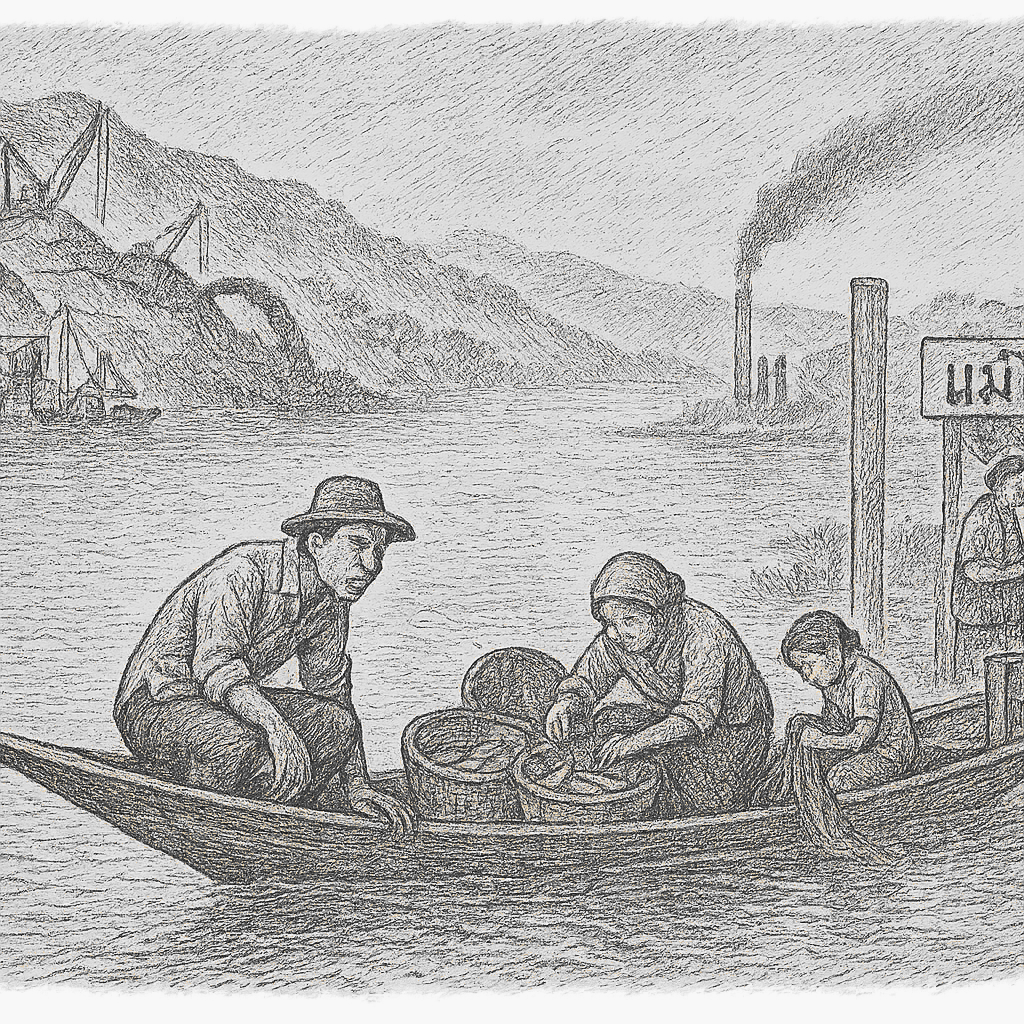
Toxic runoff from rare earth mining is raising alarm across the Mekong
On the banks of Thailand’s northern Mekong, fishermen and farmers are weighing each day’s work against worries that toxic runoff tied to rare earth mining upstream is reaching the river systems they depend on. In Chiang Saen, a fishing hub in the province of Chiang Rai, a 75-year-old fisherman said he sometimes untangles small fish from his net only to hesitate over whether he can sell them as demand falls due to fears about contamination in the Mekong and its tributaries.
The concern, described by Thai researchers and regional organizations, is aimed at rare earth mining operations concentrated in war-torn Myanmar that are spreading to neighboring countries, including Laos. The Mekong runs nearly 5,000 kilometers (3,100 miles), feeding farms and fisheries for about 70 million people across mainland Southeast Asia, and experts say the river is already under pressure from other sources of pollution and disruption, including plastic waste, hydropower dams and sand mining.
Thai scientists and environmental groups warned that the risks extend beyond livelihoods. Heavy metals such as arsenic, mercury, lead and cadmium are associated with health problems including cancer, organ failure and developmental harm, with children and pregnant women facing heightened vulnerability. Agriculture—described as a backbone of Southeast Asia’s economies—links the concerns in the river to global food markets, from rice and fruits to garlic and other crops grown with water drawn from the basin.
In rural areas, farmers described the practical effects of those fears in what they grow and what they can afford to export. A 63-year-old farmer in Tha Ton, tapping his fingers to count the toxin-exposed crops he harvests—rice, garlic, corn, onion, mangoes and bananas—said he irrigates fields using water from the Kok River, a Mekong tributary that flows from Myanmar into Thailand. “Everyone is afraid of the toxins,” he said, adding that if they cannot export, “a farmer is the first to die.”
Thai agriculture officials face limits in responding to what happens across borders. Thailand’s Pollution Control Department said the government has little leverage over mining operations across Myanmar and Laos, and researchers cited constraints including limited expertise, information and funds. Instead, local governments, universities and regional organizations such as the Mekong River Commission have emphasized monitoring and educating communities about health risks.
Research described in the report points to evidence of contamination in multiple tributaries. Scientists said recent water, fish and sediment samples from Mekong tributaries showed elevated heavy metal pollution tied to rare earth mining, including in rivers such as the Sai and Ruak. In a lab setting at Naresuan University, a researcher demonstrated how contamination can be visible in fish, pointing to signs such as tumor-like growths, discolored scales and unusual eye coloration before dissecting a catfish caught from the Kok River.
To reach fishing communities, researchers and local partners also developed tools aimed at changing behavior around suspected tainted catch. Tanapon Phenrat of Naresuan University helped create a smartphone fish safety app that trains fishers in Chiang Saen to identify suspicious fish and upload images into a citizen-science database, a step he said could help quantify the scale and spread of contamination.
The mounting worries come as demand for rare earth elements continues to rise. The report describes how rare earths are used in modern technology, from smartphones and electric vehicles to defense systems, and says mining and refining—often concentrated in China—has expanded the extraction footprint. The U.S.-based Stimson Center used satellite photo analysis to identify nearly 800 suspected unregulated rare earth and other mining sites along Mekong tributaries in Laos, Myanmar and Cambodia.
In Myanmar, where many mining sites are located in areas affected by fighting, the report says conflict has driven a “diversification of mines” geographically, including expansion to 26 sites along rivers in Laos tracked by the Stimson Center. Myanmar is described as a leading supplier of heavy rare earths to China, with exports of more than $4.2 billion worth between 2017 and 2024.
The political and military demand behind critical mineral stockpiling is also part of the pressure, the report said. It described U.S. President Donald Trump making rare earths and critical minerals a key foreign policy objective and cited U.S. government uses including fighter jets, submarines, radar systems and smart bombs. With this demand increasing, the report frames the risk to the Mekong basin as an additional, potentially existential threat layered on top of other historical shocks to the region.
In the report’s depiction, the challenge is not only technical—detecting heavy metals in water and organisms—but also enforcement and coordination across countries with different capacities. For communities who say life and identity are tied to river water, the disruption is not abstract: a Lahu elder in northern Thailand said the contaminated river has cut off their lifeline. “The Lahu’s way of life is always with a river,” Sela Lipo said. “The contaminated river has cut off our lifeline.”