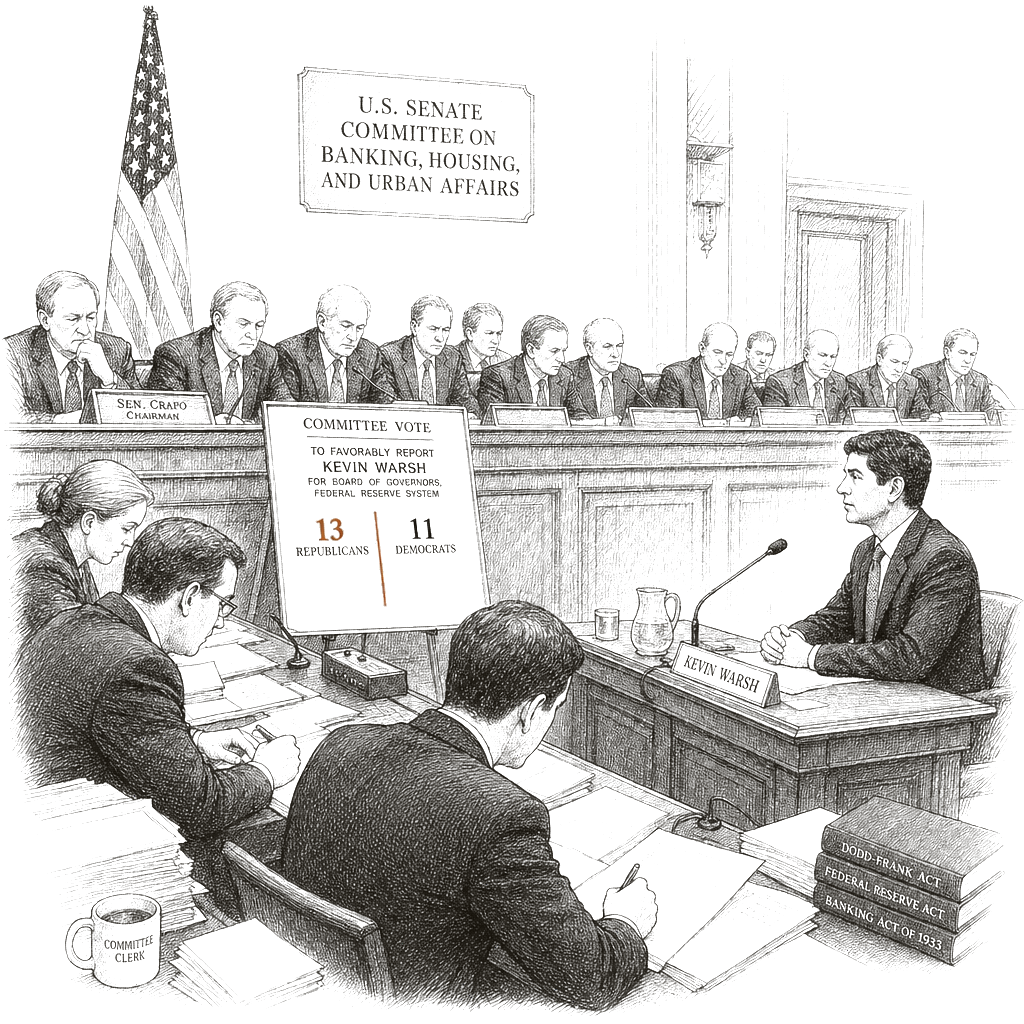
The Senate Banking Committee advanced President Donald Trump’s pick for Federal Reserve chair on Wednesday, voting 13-11 along party lines to approve Kevin Warsh as the next chair, according to the Associated Press. Republicans on the committee backed Warsh, while Democrats opposed the nomination as it moved to the next stage.
The committee vote came as Jerome Powell, a Trump target over criticism that he had not cut borrowing costs as far as Trump wanted, presided over what was expected to be his final meeting of the Fed’s interest-rate setting committee. At a news conference Wednesday afternoon, Powell was expected to signal whether he would remain as a governor on the central bank’s board after his chair term ends on May 15.
Powell’s staying would likely be unusual, the AP reported, but it could deny the Trump administration an opportunity to appoint a new board member. The AP reported that Powell may choose to remain if he sees it as necessary to protect the Fed’s independence, which has become part of his legacy as leader.
The panel’s vote also drew direct praise from the Republican chair of the committee, Sen. Tim Scott of South Carolina. Scott called Warsh “battle tested” and added that “It is incredibly important that we break the bind of Bidenomics on households across this nation,” the AP said.
Warsh’s nomination has drawn scrutiny because he is not only a former top Fed official but has also been critical of the institution and Powell’s leadership. The AP reported that Warsh previously called the inflation spike to 9.1% in 2022 the central bank’s biggest policy mistake in four decades and has advocated changes that could include “regime change” at the Fed, including the models it focuses on, how it communicates with the public, and how large its bondholdings could be in the long run.
Democrats on the committee argued that the move is designed to increase political control over the Fed. Sen. Elizabeth Warren of Massachusetts criticized the committee for voting on Warsh’s nomination and said it “will bring the president one step closer to completing his illegal attempt to seize control of the Fed and artificially juice the economy,” the AP reported, citing Trump’s efforts to fire Fed governor Lisa Cook and investigate Powell.
The AP reported that the Fed was widely expected to leave its key interest rate unchanged at about 3.6% for its third straight meeting, even as Warsh’s interest-rate views could push for faster reductions if he takes the chair. It said most of the other members on the rate-setting committee indicated they would prefer to wait and evaluate where inflation and the economy are headed before changing rates, which could slow Warsh’s influence early on.
Warsh was also expected to replace Stephen Miran on the interest-rate setting committee. Miran, appointed by Trump last September, was described by the AP as the most consistent advocate for rate reductions at the central bank.
In addition to questions about how quickly Warsh could move to cut rates, the AP reported that his independence from the White House has been a concern during his Senate Banking hearing. On Wednesday, Warren called Warsh a “Trump sock puppet” and said he was “so cowed by the president that he could not even say that Trump lost the 2020 election,” while the AP reported that Warsh denied at his hearing that Trump had ever pressured him directly to cut rates.
Sources also pointed to past statements by Trump pressing for lower rates, including a social media post last December arguing for much lower interest rates and a recent comment to Fox Business that he expects rates to head lower “when Kevin gets in.” The AP also said Warsh’s rate-cut push would face barriers in the near term, with the AP reporting that the Iran war has contributed to a spike in gas prices that pushed inflation to a two-year high of 3.3%.
FRED’s vintage value for the effective federal funds rate for this article’s publish date was 3.64, providing a context point for the policy expectations described by the AP for Wednesday’s meeting.