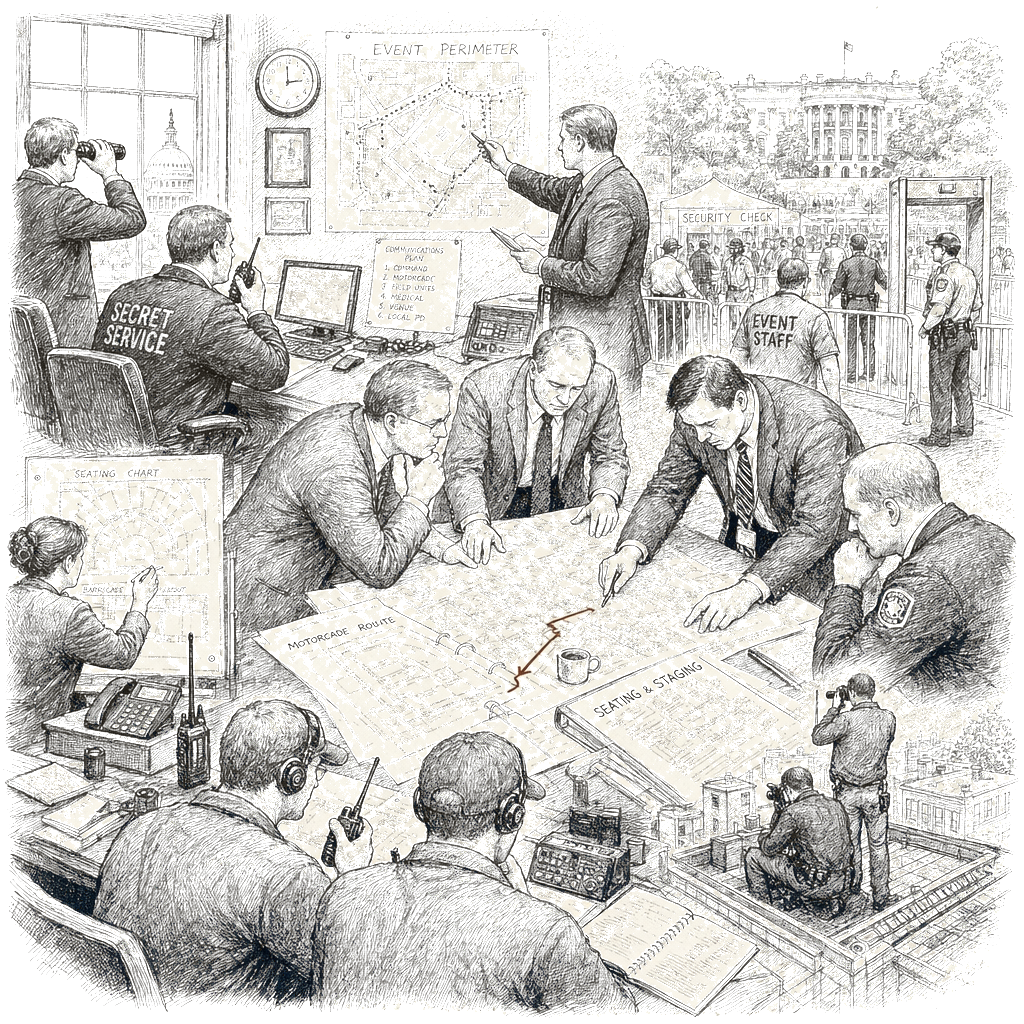
A day after a man tried to storm the Washington hotel ballroom where President Donald Trump was set to address the White House Correspondents’ Association Dinner, federal law enforcement officials were already looking ahead to how to secure Trump’s next major appearances. The assessment is centered on what changes might be needed for an expected run of large, high-profile events over the coming months, including indoor and outdoor gatherings.
White House chief of staff Susie Wiles is scheduled to hold a meeting this week with officials from the White House operations team, the Secret Service and the Department of Homeland Security to discuss security protocol at events with the president. A senior White House official said the meeting will examine security steps that were successful on Saturday while “exploring additional options” for future events, speaking on condition of anonymity to confirm private discussions.
Separate from the White House meeting, a person familiar with the matter said the U.S. Secret Service was already reevaluating its security footing for upcoming events. The agency’s posture was described as elevated because of the extraordinary number of threats facing Trump, including two back-to-back assassination attempts in 2024, along with the realities of recent events such as the U.S.-Iran war.
Saturday’s incident comes amid a wider public debate about how to balance the public-facing nature of a U.S. presidency with the limits of protective security. The Associated Press reported that it was the third time in less than two years that a gunman came uncomfortably close to Trump, renewing an ongoing tension over how to accommodate public demands while minimizing the risk of an attack. The scene at the Washington hotel, where the attacker was reported to have been armed with guns and knives and attempted to storm the ballroom, is already shaping how officials plan for events that may draw large crowds.
Lawmakers and some event attendees and allies of Trump questioned Saturday’s security planning, saying someone like the attacker appeared to be able to reserve a room at the hotel and bring weapons past an outermost layer of security. Republican Texas Rep. Michael McCaul, chairman emeritus of the House Homeland Security Committee, said the Secret Service may need to alter protocols for Trump and Vice President JD Vance when they appear together at events like the correspondents’ dinner. McCaul told CNN’s “State of the Union” that he thinks the Secret Service “needs to reconsider having both the president and vice president together at something like that.”
Kari Lake, who was named to lead the U.S. Agency for Global Media, also criticized the entry screening she said was required for the correspondents’ dinner. Lake, in a post on X, complained about not having to show a photo ID to match her ticket when entering the hotel, saying: “I can’t believe how lax the security was.”
The Secret Service responded by emphasizing its protective role and saying its systems worked. Director Sean Curran said Saturday that “Our multilayered protection works.” Trump echoed that assessment in an interview with CBS News’ “60 Minutes” on Sunday, saying, “Those guys did a good job last night. They did a really good job.”
Several commentators pointed to how those layers function in practice, including after past attacks. Garrett Graff, author of “Raven Rock,” wrote in analysis of the security layers around Trump during the dinner that “Seems like the system basically working as designed, amid the always necessary trade-offs of security in a free society.” Retired Secret Service agent Thomas D. Quinn, who helped pioneer Secret Service counterassault teams, posted on X that the “Secret Service security plan for the WHCD worked and the assailant was stopped,” and added that “As long as we are a free people in a freedom loving Nation, the Secret Service responsibilities will continue to be immense.”
Further changes may be coming, but they could also complicate logistics for large events. Ronald Kessler, author of “In the President’s Secret Service,” said authorities are likely to consider placing bulletproof glass around where Trump speaks outside and inside, drawing a comparison to security steps taken after the Butler, Pennsylvania, assassination attempt during the 2024 presidential campaign. Kessler also said attendees could face more thorough screening going forward, which he said could exacerbate already long lines at entrances.
Kessler described the trade-offs in terms of presidential preferences and public expectations, saying some presidents “don’t like to have too much protection” because they want to be outgoing and meet people. He added, “I think, by their nature, they’re very outgoing. They want to meet people. They don’t want to be accused of being prisoners of the White House. And so, they’ll try to get around some of these improvements.”
While planning continues for Trump’s future appearances, officials were also handling other security-heavy schedules. The White House and Buckingham Palace said King Charles and Queen Camilla’s state visit Monday is going ahead as planned, even as organizing around large-scale events later in the future—including the UFC bout on the White House lawn marking Trump’s 80th birthday in June, World Cup matches and an IndyCar race passing the White House—could become more complicated.
Trump himself said he believes his security detail has handled the situation well, and he has discussed how quickly agents moved him and Vance during Saturday’s chaos. In comments to CBS News’ “60 Minutes,” Trump said he was “wasn’t making it easy” for the Secret Service by being “a little bit me.” He also said, “I wanted to see what was happening,” describing how he and his team came to realize the threat posed “a bad problem — different kind of a problem — bad one.” Trump later repeatedly praised the Secret Service and said the correspondents’ association dinner should be rescheduled, adding that the next event would have “even more security,” including “bigger perimeter security.”
In a country where citizens expect presidents to move through public spaces, hold rallies and appear before crowds, security planning remains an evolving balance. Officials and outside observers said Saturday’s attack is likely to prompt more detailed planning—especially for venues where the practical constraints of layered security collide with the public-facing demands that make presidential events possible in the first place.
Associated Press writer Will Weissert reported from Washington.