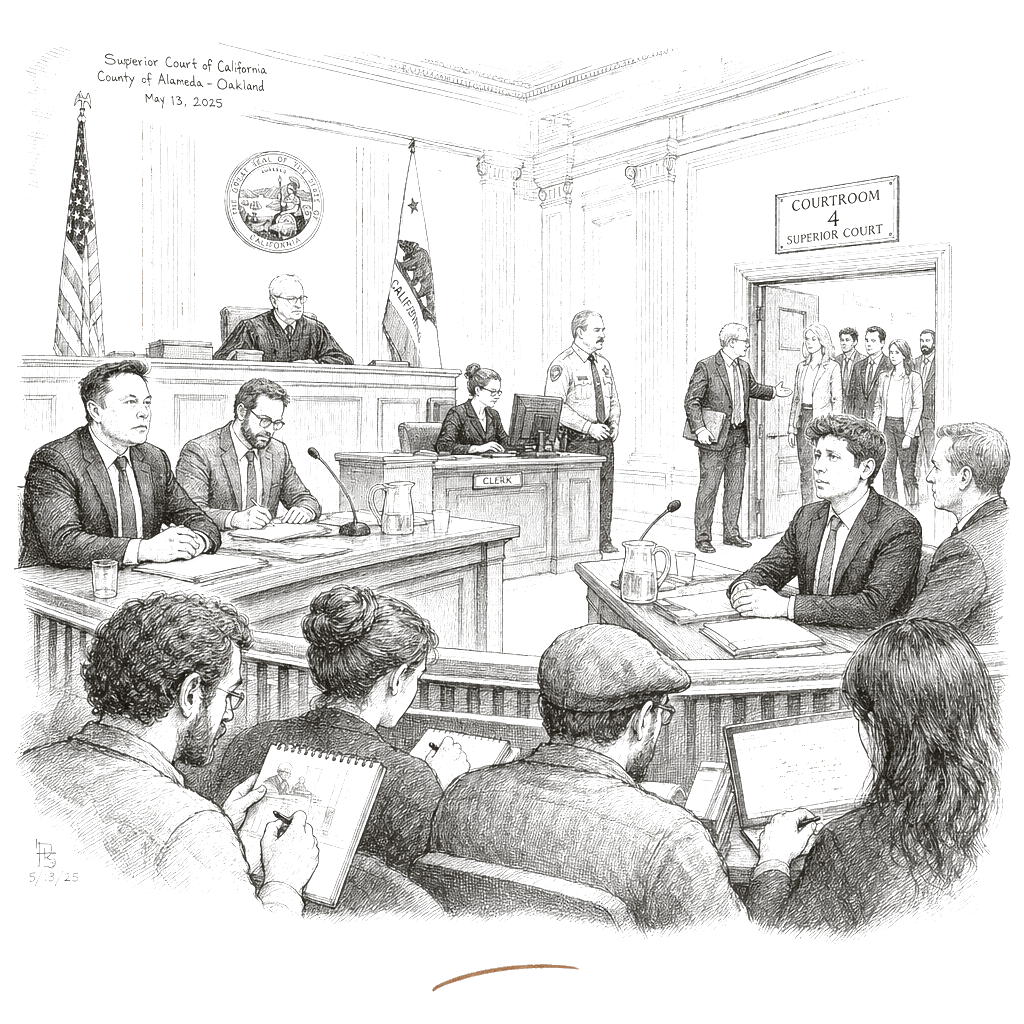
Elon Musk and Sam Altman headed into a courtroom showdown in Oakland, California, where a jury’s view of the evidence and the credibility of witnesses will be central to a civil case over OpenAI’s beginnings. The dispute, before U.S. District Judge Yvonne Gonzalez Rogers, centers on Musk’s contention that he and others built the company’s early artificial-intelligence work around altruistic goals that were later abandoned. Jury selection began Monday.
Musk is asking the court to order remedies that would not only address his claims against Altman and OpenAI, but also focus the result on the charitable mission of OpenAI’s operations. OpenAI has denied Musk’s account, saying the lawsuit is without merit and is aimed at slowing its momentum while supporting Musk’s competing xAI venture, which he launched in 2023.
The trial’s framing reflects a broader conflict about who can steer the future of artificial intelligence as the technology advances rapidly and faces fears that it could disrupt jobs or pose risks to society. Musk, who filed the suit in August 2024, tied his legal action to those concerns. The case is set to play out with jury selection underway and Rogers overseeing the proceedings.
Court filings at issue date to the creation of OpenAI’s ChatGPT-making company in 2015 as a nonprofit, a period when Musk provided early funding. Musk invested about $38 million in OpenAI from December 2015 through May 2017, according to the reporting. The company later evolved into a for-profit business valued at $852 billion, a development that Musk argues signals the departure from the founding purpose.
Musk’s lawsuit accuses Altman, OpenAI’s CEO, and his top lieutenant, Greg Brockman, of double-crossing him by shifting OpenAI into a moneymaking mode behind his back. The complaint also seeks Altman’s ouster from OpenAI’s board. Musk said he stopped funding the company after what he described as deceptive conduct the board picked up on when it fired Altman as CEO in 2023, before he got his job back days later.
While Musk had initially sought more than $100 billion in damages, pre-trial rulings reduced what he could pursue. He has since abandoned a bid for damages for himself and instead is seeking an unspecified amount of money to fund altruistic efforts through OpenAI’s charitable arm, with the money expected to be paid primarily by OpenAI’s for-profit operations and Microsoft, which became the biggest investor after Musk cut off his funding.
Rogers questioned potential jurors Monday about their views of Musk, Altman and artificial intelligence. Some prospective jurors said they had negative views of Musk, but many said they would still be able to treat him fairly and focus on the facts of the case. Rogers has also said the jury would serve in an advisory role, and she previously told the courtroom, “Part of this is about whether a jury believes the people who will testify and whether they are credible.”
The evidence in the trial is expected to draw from key moments in OpenAI’s early development and from communications that documented how the relationship between Musk and Altman changed. The reporting described evidence as including what it called glimpses of the AI race’s early days, as well as a February 2023 email exchange that surfaced as part of the evidence leading up to the trial.
The record described in advance includes an exchange in which Altman told Musk, “you’re my hero,” and said: “I am tremendously thankful for everything you’ve done to help —I don’t think OpenAI would have happened without you — and it really (expletive) hurts when you publicly attack OpenAI.” Musk responded: “I hear you and it is certainly not my intention to be hurtful, for which I apologize, but the fate of civilization is at stake.”
The trial also has a personal and reputational dimension for both sides. Musk, estimated at about $780 billion, has been both praised for building companies such as PayPal, Tesla and SpaceX and criticized for a range of controversies, including social media commentary and unfulfilled promises about Tesla’s technology. The judge ruled that Musk could not be questioned during the trial about suspected use of ketamine, but she allowed questioning about his attendance at the 2017 Burning Man festival in Nevada and his relationship with Shivon Zilis, a former OpenAI board member described in the reporting as the mother of several of his children.
Altman, who rose to broad public visibility after ChatGPT’s late-2022 release, has faced heightened scrutiny amid growing public debate over AI’s dangers. The reporting said that earlier this month the New Yorker published a profile painting Altman as an unscrupulous executive, and that days later a 20-year-old man who worried about AI’s effects on humanity was arrested on attempted murder charges after throwing a Molotov cocktail at Altman’s San Francisco home. The trial’s competing testimony is expected to address not only the legal claims, but also what the court record shows about the thinking that helped drive the AI race and how the two men’s friendship unraveled.