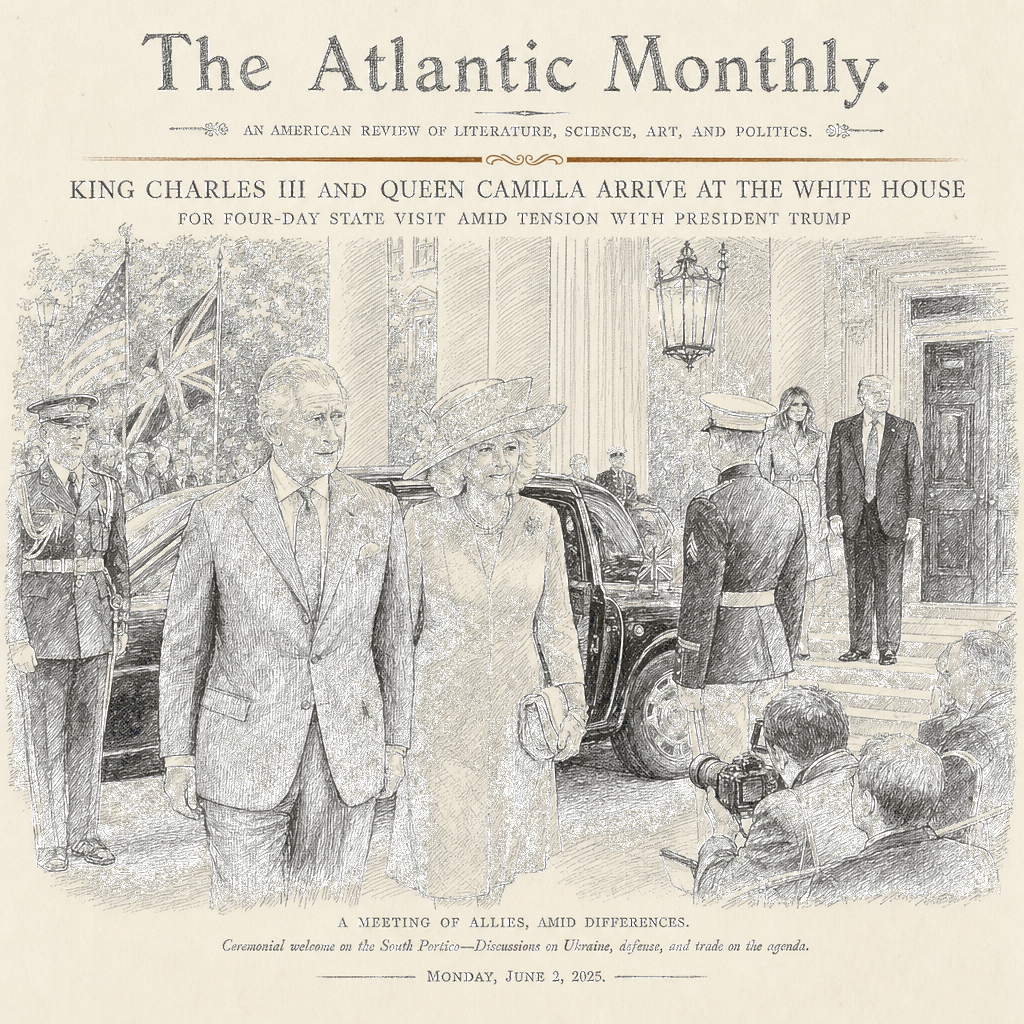
King Charles III and Queen Camilla arrived at the White House on Monday for a four-day U.S. state visit, positioning the visit as a test of goodwill across a strained political backdrop. Trump and first lady Melania Trump greeted Charles and Queen Camilla as they arrived, posing for photos and exchanging small talk before the royals went inside for tea in the Green Room, according to the Associated Press.
After that White House stop, the couples went to the south grounds to see a new beehive in the shape of the White House that Melania Trump said she installed last week. The AP reported that Charles and Camilla both support beekeeping, and that Charles keeps at least three beehives at his private residence in England. Later, after the White House visit, Charles and Camilla attended a garden party at the British Embassy.
The political stakes for the monarch’s visit have been raised by a rift between the U.K. government and Trump over issues including the Iran war. In recent weeks, Trump has lambasted Prime Minister Keir Starmer over his unwillingness to join U.S. military attacks on Iran, at one point dismissing Starmer as “not Winston Churchill,” referring to the World War II prime minister who coined the phrase “special relationship” for the U.K.-U.S. bond.
The AP said the dispute also fits into a wider strain between Trump and U.S. NATO allies, whom he has criticized as “cowards” and “useless” for not joining action against Iran. A leaked Pentagon email, according to the AP, suggested the U.S. could reassess support for the U.K.’s sovereignty over the Falkland Islands in the south Atlantic, where Britain and Argentina fought a 1982 war. Trump has said the political chill would not affect the royal visit, telling AP in March that Charles “has nothing to do with that.”
Even as the U.K.-U.S. political relationship has faced public friction, Trump has praised Charles in glowing terms, repeatedly calling the monarch his “friend” and a “great guy.” The AP also said Trump has continued to reference what he called his “amazing” trip to the U.K. in September with Melania Trump, describing it as the first time for a second state visit.
White House spokesperson Anna Kelly told the AP the president expects the visit to reinforce relations, saying: “President Trump has always had great respect for King Charles, and their relationship was further strengthened by the president’s historic visit to the United Kingdom last year.” Kelly added that Trump “looks forward to a special visit by Their Majesties,” including a “beautiful state dinner and multiple events throughout the week.”
Trump also told the BBC that the visit could help mend the trans-Atlantic relationship, saying, “He’s fantastic. He’s a fantastic man. Absolutely the answer is yes.” The BBC context in the AP story framed Trump’s remarks as an endorsement of the monarch’s ability to smooth relations even while politics remains tense.
Within the U.K., some politicians have argued that the trip should be canceled because it could create opportunities for embarrassment. Kristofer Allerfeldt, a University of Exeter professor specializing in American history, said the two governments have different objectives: for Charles, Allerfeldt said the visit is about “reinforcing long-term ties, showcasing the monarchy’s soft power and reminding the world that Britain still carries diplomatic weight,” while for Trump it is more focused on “a media event,” with attention to the optics of what he described as a meeting of “two gilded monarchs.”
Ed Davey, leader of the U.K. centrist opposition Liberal Democrats, called Trump “a dangerous and corrupt gangster” earlier this month and urged the government to cancel the trip. Davey told the House of Commons, “I really fear for what Trump might say or do while our king is forced to stand by his side. We cannot put His Majesty in that position.” Starmer, meanwhile, defended the visit, saying, “the monarchy, through the bonds that it builds, is often able to reach through the decades” and help bolster relationships.
Another factor raising the stakes is the shadow of Charles’s younger brother, Andrew Mountbatten-Windsor, who was stripped of his royal title, exiled from public life, and put under police investigation over his friendship with Jeffrey Epstein. Epstein victims have urged the king to meet with them and other sexual abuse survivors, and the AP said it is unlikely the king will do so. Andrew has denied committing any crimes.
The AP reported that Charles, 77, will spend four days in the U.S. accompanied by Queen Camilla. It said this is his first U.S. state visit since becoming king in 2022, and that his mother, Queen Elizabeth II, made four U.S. state visits. The AP also said Charles was diagnosed in early 2024 with an undisclosed form of cancer.
Planned events include a formal White House state dinner in Washington on Tuesday, a visit by the royals to the Sept. 11 memorial in New York, and an event in Virginia marking the 250th birthday of someone described in the AP story as part of the block-party program. The AP also reported that Charles will meet Indigenous leaders in Virginia involved in nature conservation, a cause the story described as a favorite of the environmentalist king.
A key moment on the agenda is the king’s speech to the U.S. Congress on Tuesday. The AP reported that it is only the second time, after Queen Elizabeth II in 1991, that a U.K. monarch has addressed a joint meeting of both houses. In the AP’s account, Charles’s focus on causes such as the environment and harmony among religious faiths contrasts with Trump’s, and the story described Allerfeldt as saying Charles could still use the speech in a subtle way to send a message about the issues he prioritizes.
“He does have an unorthodox way of looking at the world, and I think maybe he can actually have something valid to say when he addresses Congress,” Allerfeldt said. The AP said Charles will spend the remainder of the week continuing a sequence of engagements that mixes ceremony with diplomacy, with security remaining in the background as Trump’s public clashes with U.K. officials keep the political context sharp.