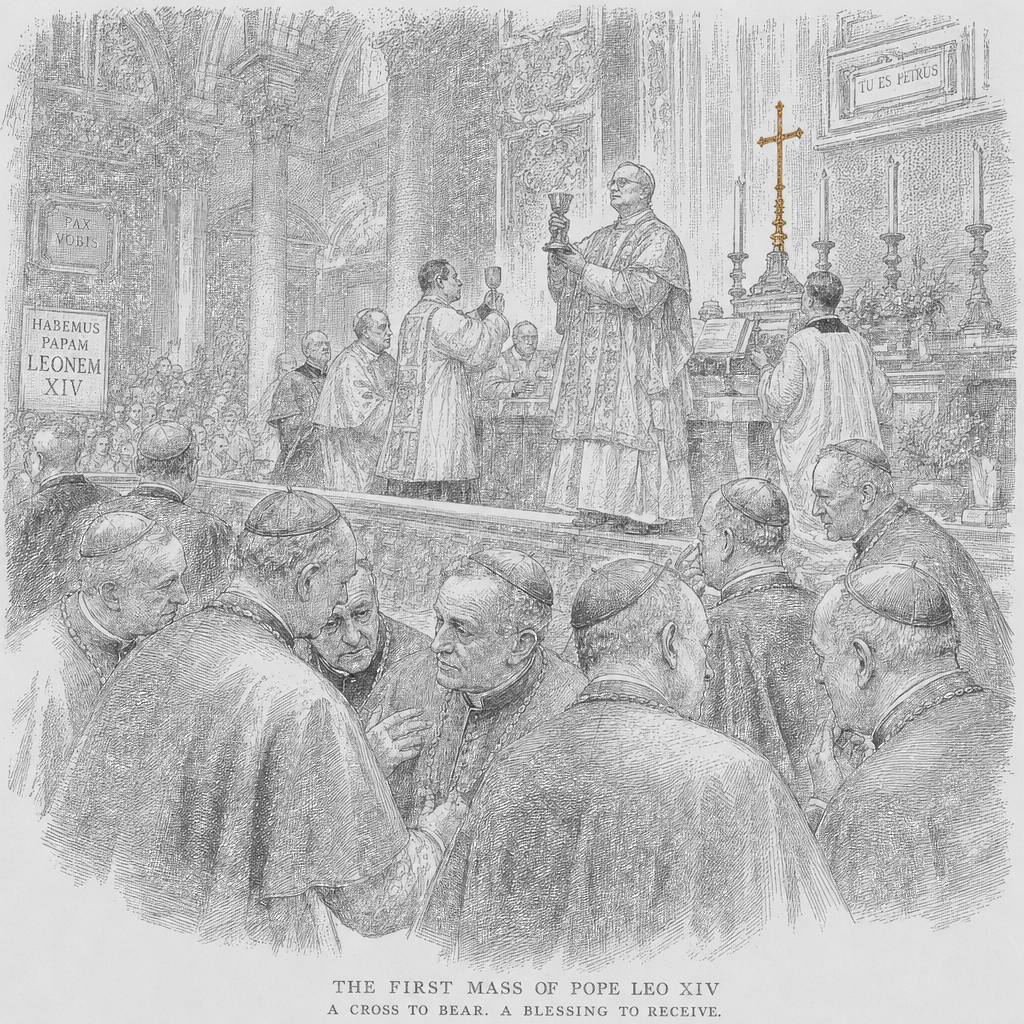
Pope Leo XIV said his election was both a “cross to bear and a blessing” as he celebrated his first Mass Friday, speaking off-the-cuff in English in the Sistine Chapel shortly after the conclave ended. In the homily that followed, he urged the joyful spreading of Christianity in a world he said often mocks the faith.
Cardinals, freed from their conclave, began describing the hours leading up to Thursday’s final ballot that brought Leo past the two-thirds majority needed. Many of them marveled that Robert Prevost, described as a Chicago-born Augustinian missionary, reached the threshold so quickly despite the long-running tradition that has made Americans a difficult prospect for some voters and outside observers.
“It is a miracle of the Holy Spirit,” said Cardinal Fernando Natalio Chomalí Garib, archbishop of Santiago, Chile, describing how 133 electors from 70 countries came to agreement in just over 24 hours. He added that it was “an example for all our countries where nobody comes to an agreement.”
Before Pope Leo XIV’s Mass, the Vatican hosted his election’s first public moments, and the transition unfolded alongside early signs of how the new pontiff might steer the church. At a briefing with American cardinals, the auditorium at the U.S. seminary above the Vatican blasted “Born in the U.S.A.” and “American Pie,” according to the Associated Press report, underscoring a contrast between celebration and the subsequent attempt to frame what the election would mean for the wider church.
Some conservative cardinals, however, seemed to distance Leo from his U.S. citizenship and from political polemics associated with the Trump administration back home. New York Cardinal Timothy Dolan, who had been President Donald Trump’s pick for pope, said, “Where he comes from is sort of now a thing of the past,” adding that “Robert Francis Prevost is no longer around. It’s now Pope Leo.”
Cardinal Joseph Tobin, a longtime friend of Prevost who repeatedly referred to him as “Bob,” said he expected the pope would remain true to himself, and he pointed to guidance electors received from Cardinal Raniero Cantalamessa, a retired preacher of the papal household. Tobin described warnings and expectations shared in the days before the voting began, and he also recounted his reaction during the moment he realized Prevost’s chances had taken hold—when he saw Prevost with his head in his hands, and later described what Tobin said was the shift as Prevost accepted the role.
At the Mass itself, Vatican coverage said the cardinals urged the public to give Leo time to adjust before judging what kind of pope he will be. But some details already appeared to reflect continuity from Pope Francis, including the use of two women to deliver Scripture readings at the start of Leo’s Mass, and the choice, as a cardinal, to put three women on a Vatican board that vets bishop nominations.
Pope Leo XIV used near-perfect Italian to lament what he said was the way Christianity can be reduced to something mocked, ignored, or misunderstood, and he said that in many places Jesus is “considered absurd,” mocked or opposed in the face of temptations such as money, success and power. He also complained that Jesus is often “reduced to a kind of charismatic leader or superman,” and he said the faith is challenged even among baptized Christians, who he said can end up living in a state of practical atheism.
As Mass concluded, the cardinals applauded and Pope Leo XIV was seen wearing simple black shoes rather than the red loafers associated with some traditionalist popes, a detail Vatican watchers said echoed Pope Francis’ approach. In another sign of possible departure from custom, he spent his first night as pontiff in the Sant’Uffizio Palace instead of the Apostolic Palace where popes traditionally reside; Vatican News said Francis had chosen to live in an apartment in the Santa Maria guesthouse.
Cardinals also offered a window into how Prevost’s candidacy gained traction. The Associated Press said they got to know him during preconclave discussions not through a show-stopping speech like one Pope Francis made during the 2013 conclave, when Francis was elected shortly after speaking about taking the church to the “existential peripheries” to find wounded souls.
Cardinal Wilton Gregory, the retired archbishop of Washington, said, “It wasn’t that he got up and made some overwhelmingly convincing speech that just wowed the body.” Instead, participants said Prevost made an impression in small groups, and although Italian had long been the primary language of past conclaves, they said English appeared to prevail during this one—an element that helped Prevost, according to some electors’ accounts, connect quickly with fellow cardinals from different regions.
German Cardinal Reinhard Marx, described as a close adviser of Francis, said he took note of the man who would become pope—an American with experience in Latin America, linguistic and cultural fluency, and a history of leadership as superior of the Augustinians—and that it led him to conclude the election was plausible. “That convinced me to say this could be a possibility,” Marx told reporters Friday, adding, “I can tell you, I’m very happy,” and he also recalled meeting Prevost last year and being struck by what Marx described as Prevost’s temperament.
Looking ahead, Pope Leo XIV said the cardinals elected him would help him in his duties as pope, and Vatican plans set out a sequence for the coming days. Leo meets with cardinals formally on Saturday, while Sunday brings a first noon blessing from the loggia of St. Peter’s Basilica; the formal installation Mass is set for May 18, according to the Associated Press report. The transition also unfolded with additional reporting contributions from Vanessa Gera and Pietro de Cristofaro.